
Two niches instead of every business in London.
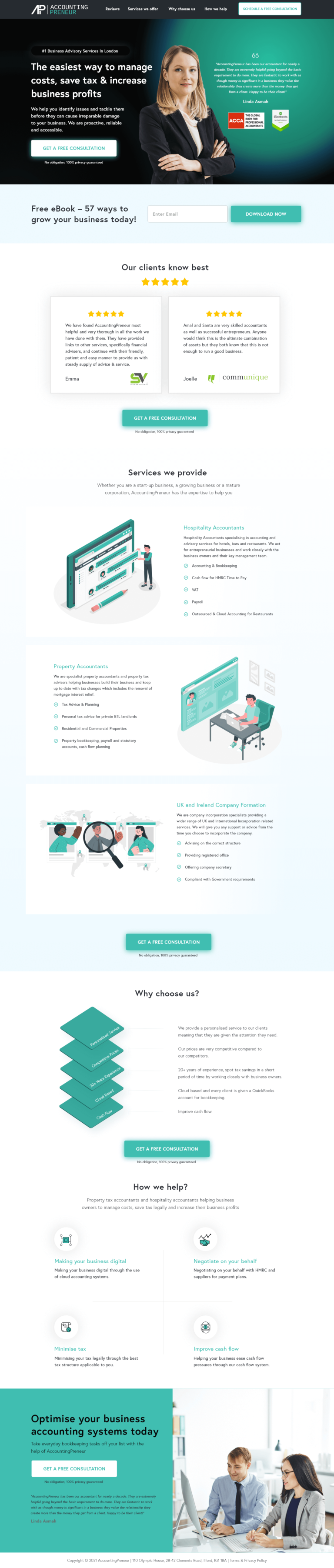
AccountingPreneur's Unbounce page for a London accounting firm serving hospitality and property clients. How the hero portrait, ACCA badge and eBook offer build trust, and the savings figure we would add.
- Primary CTAGet A Free Consultationthe button the page is built around
- GoalLead Generationwhat counts as a conversion
- PlatformUnbouncelead generation page
- Built forB2BAccounting / Professional Services
- The page as built, not a mockup.Analysed by Apexure, not by AccountingPreneur.
- Client
- AccountingPreneurAccounting / Professional Services
- Industry
- Accounting / Professional Services1 example
- Audience
- B2BLead Generation
- Platform
- Unbounce132 examples
- Page type
- Lead generationLead Generation
- Analysed by
- Waseem BashirMarch 2026
What the page does, and why
Why accounting landing pages have to fight the “all accountants are the same” problem
A business owner searching for an accountant in London has dozens of options that look identical. Same services listed. Same “we save you money” promise. Same stock photo of a calculator. Most accounting websites fail because they describe what accountants do (everyone knows) instead of who they do it for (the differentiator).
AccountingPreneur’s page breaks that pattern by specialising. Not “we do accounting for everyone.” Specifically: hospitality accounting for hotels, bars, and restaurants, and property accounting for landlords and investors. A restaurant owner reading this page does not have to wonder whether AccountingPreneur understands restaurant cash flow, VAT on food service, or staff payroll complications. The page tells them directly.
The conversion challenge for accounting firms is trust in a high-stakes relationship. A business owner handing over their financial records needs to believe the accountant is competent, trustworthy, and available. That trust has to be established before the first call, on this page, in the first 30 seconds.
Design decisions
The hero puts a face to the firm and a client endorsement next to the headline
The hero uses a dark teal-to-black gradient background with a professional woman in business attire, arms crossed, direct eye contact. The headline sits to the left: “The easiest way to manage costs, save tax & increase business profits.” To the right, a full client testimonial from Linda Asmah appears with a pull-quote format.
This hero layout does three things simultaneously. The professional portrait humanises the firm. This is a person, not a corporation. The headline names three specific outcomes (costs, tax, profits) instead of describing services. And the testimonial provides proof before the visitor scrolls.
The ACCA badge (Association of Chartered Certified Accountants) appears below the testimonial. For a UK business owner evaluating accountants, ACCA membership signals professional qualification and regulatory compliance. It is the accounting equivalent of the ABTA badge, a baseline credibility marker that many visitors check for.
The “#1 Business Advisory Services In London” badge in the hero is a bold positioning claim. Whether verifiable or not, it anchors the visitor’s perception: this firm considers itself the best in London, which creates a premium impression.
The lead magnet eBook creates a secondary conversion path
“Free eBook, 57 ways to grow your business today!” with an email field and “DOWNLOAD NOW” button. This appears immediately below the hero, before the testimonials section.
The eBook serves business owners who are not ready to book a consultation. Maybe they are comparing three accountants. Maybe they are not sure they need to switch. The eBook gives them something useful (57 actionable tips) in exchange for an email address. AccountingPreneur can then nurture that lead over time.
The placement is smart, directly after the hero, before the visitor invests in scrolling through services. A visitor who bounces after the hero can still convert on the eBook. Without it, that visitor leaves with nothing and the firm gets nothing.
Service sections use niche specialisation to pre-qualify visitors
Three service sections, each with custom illustrations:
- Hospitality Accountants, accounting and advisory for hotels, bars, restaurants. Checkmarks for: Accounting & Bookkeeping, Cash flow to HMRC, VAT, Payroll, Outsourced & Cloud Accounting for Restaurants.
- Property Accountants, specialist property and BTL tax advisors. Checkmarks for: Tax Advice & Planning, Personal tax returns for private BTL landlords, Residential and Commercial Properties, Property bookkeeping and statutory accounts.
- UK and Ireland Company Formation, incorporation services, registered office, company secretary.
Each section speaks the language of its target audience. A restaurant owner sees “Cash flow to HMRC” and “Outsourced & Cloud Accounting for Restaurants”, specific services they need. A property investor sees “BTL landlords” and “mortgage interest relief.” The visitor self-identifies with one specialisation and ignores the others.
The three specialisations are not just service descriptions. They are SEO targets. "Hospitality Accountants London" and "Property Accountants London" are specific long-tail keywords that a generalist accounting page would never rank for. The niche sections serve double duty: converting visitors who arrived through those searches, and ranking for the searches in the first place.
The stacked benefits visual communicates five differentiators without bullet points
A stacked teal card visual (like layered credit cards) shows: Personalised Service, Competitive Prices, 20+ Years Experience, Cloud Based, Cash Flow. Next to it, copy explains each: competitive pricing vs competitors, 20+ years of tax-saving experience, QuickBooks for every client, improved cash flow.
This visual treatment is more memorable than a bullet list. The stacking creates a sense of accumulation, each benefit builds on the one before it. “20+ Years Experience” sitting above “Cloud Based” signals that the firm combines traditional expertise with modern tools.
The “How we help?” section uses four icons to summarise the firm’s value
Making your business digital (cloud accounting systems), Negotiate on your behalf (HMRC and suppliers), Minimise tax (legal structure optimisation), Improve cash flow (systems to ease cash flow pressure).
These four categories map to the four biggest concerns business owners have about their accountant: “Are you modern?”, “Will you deal with HMRC for me?”, “Will you save me money?”, “Will you help me stay solvent?” Each icon answers one question. Together, they cover the full scope of what a business owner wants from an accountant.

"The 'Negotiate on your behalf' section is the one that closes small business owners. Most business owners dread dealing with HMRC. When an accountant explicitly says 'we negotiate with HMRC and suppliers for payment plans on your behalf,' the business owner feels relief. They are not buying accounting services. They are buying the removal of a problem they hate dealing with."
Trust architecture
Accounting trust is built on professional credentials, client proof, and perceived accessibility.
Layer one: ACCA badge and testimonial in the hero
The ACCA membership badge signals professional qualification. Linda Asmah’s testimonial, “AccountingPreneur has been our accountants for nearly a decade. They are extremely helpful, going beyond the basic requirement to do more”, provides a decade-long relationship as proof of retention. A firm that keeps clients for a decade is trusted.
Layer two: client testimonials with company identifiers
Emma (with SV company logo) and Joelle (with Communique logo) provide 5-star reviews with enough detail to feel genuine. The company logos next to each name signal that these are business clients, not individuals, matching the B2B target audience.
Layer three: risk reversal at every CTA
“No obligation, 100% privacy guaranteed” appears below every “GET A FREE CONSULTATION” button. For a business owner about to share financial information, the privacy guarantee addresses a specific anxiety: “Will my business data be safe?”
The footer shows a real London address: 113 Olympic House, 28-42 Clements Road, Ilford. For a local accounting firm, a physical address is a trust signal. A business owner searching for "London accountant" wants to know the firm exists in their city, not in a virtual office abroad. The address confirms locality and establishes that AccountingPreneur is a real firm with a real office.
Conversion strategy
The page uses two conversion paths: the primary “GET A FREE CONSULTATION” CTA (appears four times) and the secondary “DOWNLOAD NOW” eBook lead magnet (appears once, below the hero).
The dual path model captures visitors at different commitment levels. A business owner ready to talk books a consultation. A business owner still researching downloads the eBook and enters the email nurture sequence. Without the eBook, the researching visitors leave with nothing.
The consultation CTA includes “No obligation, 100% privacy guaranteed”, two risk-reversal statements that address the two main objections: “What if they try to sell me?” (no obligation) and “What if they see my messy books?” (privacy guaranteed).
"The 'privacy guaranteed' line under the CTA was added after the client told us their biggest objection was business owners being embarrassed about their bookkeeping. They do not want to show an accountant their messy spreadsheets. Promising privacy and no obligation removes that shame barrier. It says: we will not judge your books. We will fix them."
Platform: Unbounce
Unbounce was the right choice for a firm that runs seasonal campaigns, tax deadline pushes in January and April, corporation tax reminders, self-assessment season. The page can be updated with seasonal messaging without rebuilding.
Mobile experience
Small business owners browse on their phones between tasks, checking emails, responding to suppliers, and occasionally searching for better professional services. The page’s dark hero, teal CTAs, and white content sections create strong contrast on mobile screens. The eBook capture form is a single email field with a full-width button, minimising mobile input friction.
A slow-loading accounting page signals disorganisation, the opposite of what a business owner wants from their accountant. The custom illustrations are lightweight SVGs. The hero portrait is a single optimised image. The page has no video and no complex animations, which keeps it fast and reliable across devices.
What we would evolve today
-
Hypothesis 1: Add specific savings metrics near the headline. The page promises to “save tax & increase business profits” but does not quantify the claim. Adding a specific stat (“Our hospitality clients saved an average of £18,000 in tax last year”) would anchor the value proposition with a number the visitor can react to. Expected impact: high, specific numbers outperform vague claims consistently.
-
Hypothesis 2: Add a “Meet the Team” section with individual specialisations. The hero shows one person, but a business owner choosing an accountant wants to know who will handle their account. A section showing 2-3 team members with their specialisations (hospitality, property, company formation) would personalise the service further and help the visitor self-select. Expected impact: medium.
-
Hypothesis 3: Replace the illustration style with real photography in the service sections. The teal isometric illustrations are clean but generic. Real photos of the team working with clients in hospitality settings (a pub, a restaurant kitchen, a property viewing) would create a stronger connection between the service description and the real-world context. Expected impact: medium.
"The biggest missed opportunity on this page is the lack of a specific number in the hero. 'Save tax' is a promise every accountant makes. '£18,000 average tax saving for restaurant clients' is a promise only one accountant can make. The more specific the number, the more believable the claim, and the harder it is for competitors to copy. We would add that metric above the fold if the data supports it."
For a local London accounting firm targeting small business owners in specific niches, 76 shows strong positioning and trust architecture with room to add specificity and personalisation.
Browse our full collection of landing page examples to see how we apply these principles across industries. For more on professional services conversion, read our B2B landing page examples guide.
Waseem founded Apexure in 2015 and has led its work on 3,000+ pages for 300+ clients since. He writes about what the team sees after the click, which is pages, forms, tracking and the systems behind them.
What the page leans on
The principles at work on this page, each named in the analysis above.
Authority bias
People trust credible experts. Certifications, awards, media mentions, and expert endorsements boost credibility.
Social proof
People follow the actions of others. Testimonials, reviews, and client logos build trust and reduce hesitation.
Reciprocity
Giving something valuable first (free guide, tool, audit) creates an obligation to reciprocate.
Local trust
This principle influences visitor behaviour and supports the page's conversion goal.
Risk reversal
This principle influences visitor behaviour and supports the page's conversion goal.
What people ask about pages like this
A generic 'we do accounting for all businesses' page competes with every accountant in London. A page that says 'we specialise in hotels, bars, and restaurants' competes with a handful. Hospitality business owners face specific tax challenges, VAT on food vs alcohol, staff tips legislation, seasonal cash flow. When a restaurant owner reads 'Hospitality Accountants specialising in accounting and advisory services for hotels, bars and restaurants,' they think: these people understand my business. That niche positioning converts better than generalist messaging because the visitor sees themselves in the copy.
The eBook '57 ways to grow your business today' works as a secondary conversion path for visitors who are not ready to book a consultation. A business owner might be curious about tax savings but not yet convinced they need a new accountant. The eBook gives them value immediately (tips they can use today) while capturing their email for follow-up. We have seen lead magnet conversion rates of 15-25% on professional services pages, compared to 3-5% for direct consultation bookings. The lead magnet builds the top of the funnel.
Most landing pages place testimonials in the middle or bottom. AccountingPreneur's hero includes Linda Asmah's full testimonial next to the headline. This works because accounting is a trust-dependent service, a business owner will not hand over their financial records to a firm they do not trust. Seeing a detailed client endorsement before scrolling answers the first question every visitor asks: 'Has someone like me used this firm and been satisfied?' Answering that question in the first viewport reduces bounce.
A professional services landing page takes 2-3 weeks. The design challenge is balancing professionalism with approachability, too corporate and small business owners feel the firm is not for them, too casual and they question the competence. We wireframe the page to address both: the ACCA badge and dark hero signal competence, while the testimonials and consultation promise signal accessibility. The build follows our 7-step process.
Three more, taken apart the same way



Want one like this?
Tell us what the page has to do and where the traffic comes from. Within 48 hours you get a written quote from the people who wrote this breakdown. Already have a page that is not converting? Send it for a free audit instead.
UK hours, which is the East Coast morning.
"Professional services pages have a different conversion problem from product pages. You are not selling a thing. You are selling a relationship. A restaurant owner choosing an accountant is choosing someone who will know their revenue, their margins, their tax situation. The page has to feel like a trustworthy person is behind it, not a faceless firm. That is why the hero shows a real person, not a logo, not a stock photo, not an illustration."