
A long headline, a short form, nothing else.
The Autism Voyage's WordPress lead magnet page offers parents of children with special needs a free guide to writing a Letter of Intent. Why the page stays sparse, and the parent quote we would add beside the form.
- Primary CTAClaim Your Guidethe button the page is built around
- GoalLead Magnetwhat counts as a conversion
- PlatformWordPresslead magnet page
- Built forB2CConsulting
- The page as built, not a mockup.Analysed by Apexure, not by The Autism Voyage.
- Client
- The Autism VoyageConsulting
- Industry
- Consulting11 examples
- Audience
- B2CLead Magnet
- Platform
- WordPress96 examples
- Page type
- Lead magnetLead Magnet
- Analysed by
- Waseem BashirMarch 2026
What the page does, and why
Why we built this Letter of Intent lead magnet
Parents of children with special needs face one of the most complex planning challenges that exists: preparing for a future in which they are no longer able to advocate for their child. A Letter of Intent (a legal and personal document that communicates a child’s needs, routines, and wishes to future caregivers) is a critical piece of that planning. But most parents don’t know where to start or what to include.
The Autism Voyage’s lead magnet addresses that knowledge gap with a free guide. This is reciprocity-based lead generation at its most genuine. The guide provides real, actionable value to parents who need it, and The Autism Voyage builds a list of highly qualified leads who are in the planning mode that leads to consulting engagement.
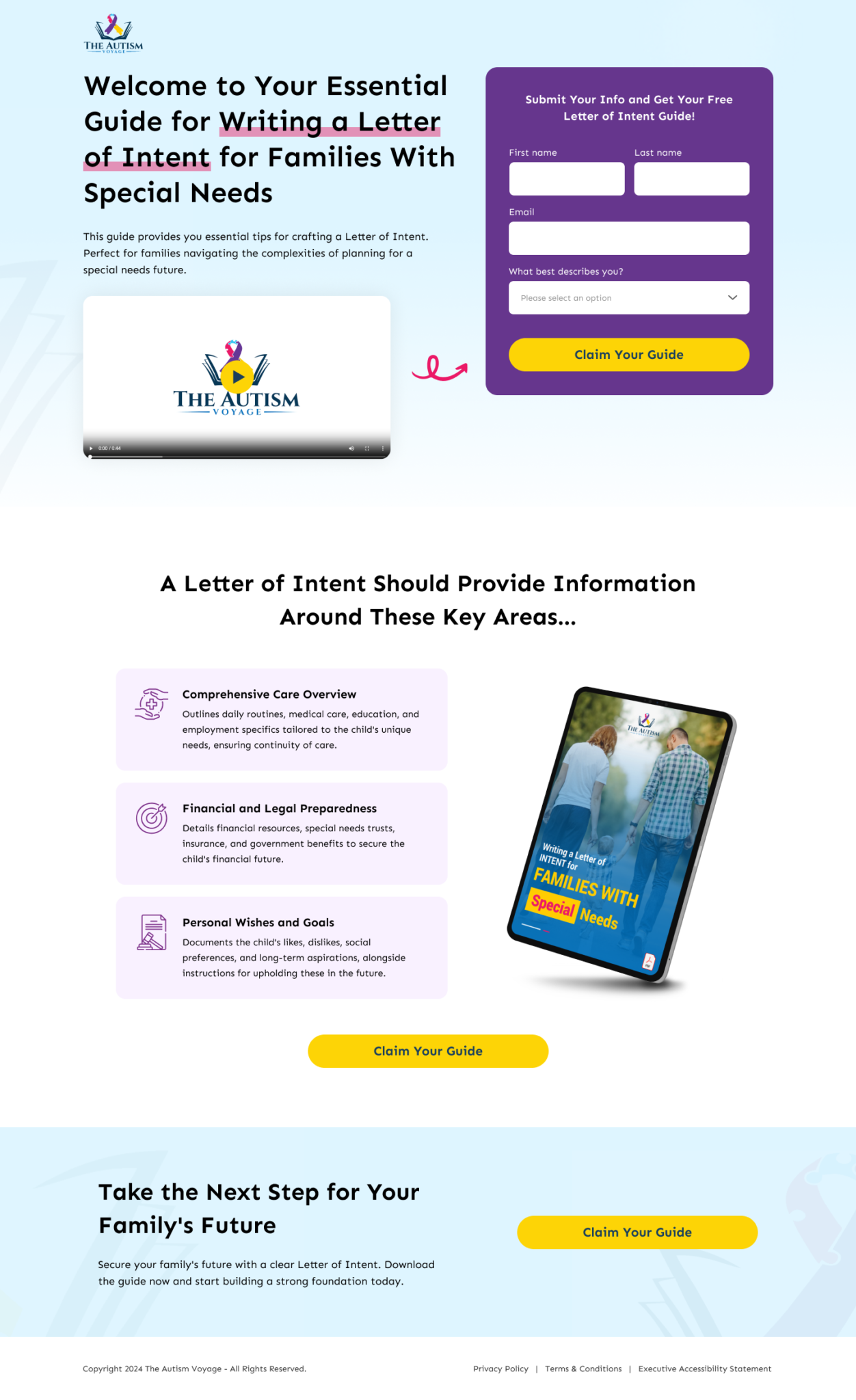
The page is deliberately minimal. The audience (parents moving through a complex and emotionally taxing planning process) needs clarity, not stimulation. Every element that isn’t directly pointing toward either the value proposition or the conversion mechanism has been removed.
Design decisions
The split layout uses a white left panel with headline and benefit icons
The purple colour palette (used for The Autism Voyage’s brand identity) creates warmth and approachability without the clinical coldness medical or legal topics can unintentionally project. The brand colour choice signals this organisation’s approach is personal and community-centred, not institutional.
The headline addresses both the parent and the complexity of their situation
“Welcome to Your Essential Guide for Writing a Letter of Intent for Families With Special Needs” is longer than most landing page headlines. The length is justified. This audience needs to understand immediately that the guide is precisely for their situation. A short, pithy headline (“Get Your Free Planning Guide”) wouldn’t convey the specificity that makes this resource relevant to someone who has been searching for exactly this type of help.
The guide cover is shown as a physical book mockup with a family photograph
The photograph on the guide shows a parent and child, specifically the kind of family situation the guide is designed to help. That’s deliberate. Seeing a relatable family on the resource communicates “this was made by people who understand your situation” more efficiently than any written claim. The physical book mockup also signals a substantive resource, not a two-page checklist.
The four coverage areas use icons and brief headlines without explanatory copy
Full Care Overview, Financial and Legal Preparedness, Personal Wishes and Goals (three visible, one implied from the guide page count). Each area gets an icon and a one-line description of what it covers. That design choice respects the visitor’s cognitive load. They’re already managing a complex life situation. A dense paragraph explaining each area would be overwhelming. Icons plus brief labels communicate “this is covered” without requiring full comprehension of every element.
The form asks for First Name, Last Name, Email, and “What best describes you?”
The qualifying question at the bottom of the form is load-bearing. It segments leads into categories The Autism Voyage’s consulting services can address differently. A parent at early diagnosis has different needs than a parent preparing for a life transition planning meeting. The qualification question doesn’t create friction. It shows the visitor the organisation will personalise its follow-up based on their situation.
The "A Letter of Intent Should Provide Information Around These Key Areas" section on the lower half of the page extends the value demonstration. It's not just showing what the guide covers. It's demonstrating knowledge by elaborating on each area with specific detail. A parent reading the section is receiving useful information before they've even submitted the form. That knowledge preview confirms the guide will be genuinely useful and not generic.
Trust architecture
Layer 1: The Autism Voyage brand identity in the header
The brand name immediately signals specialisation in this specific planning space. A generalist financial planning firm offering the same guide would convert less well. The specialist positioning communicates that The Autism Voyage specifically serves families moving through this experience.
Layer 2: visual guide showing a real family
The photograph on the guide cover is the primary emotional trust signal. It communicates: “This resource was created with real families in mind.” For a planning resource in a sensitive area, that visual empathy matters as much as the content claims.
Layer 3: specific coverage areas before the form
The four coverage areas (Full Care, Financial and Legal, Personal Wishes) demonstrate the guide is full before the parent has to request it. Visitors who can see the guide’s scope are committing to a specific, known resource rather than an unknown download. That specificity reduces the “what if this isn’t useful?” concern that delays form submissions on lead magnet pages.

"Lead magnets for emotionally sensitive planning topics must do something that most lead magnets skip: demonstrate genuine expertise in the preview content. The lower section of this page shows specific Letter of Intent coverage areas with real planning terminology. A parent reading that section is already receiving value. By the time they encounter the form. They're not thinking 'should I give them my email?' They're thinking 'how do I get the full guide?'"
What we would test today
1. Add a parent testimonial adjacent to the form
A brief quote from a parent who downloaded and used the guide (“I finally knew what to include after years of not knowing where to start”) would provide the emotional validation that converts a parent who is close to submitting but still hesitant. One genuine testimonial near the form CTA can meaningfully lift submission rates on emotionally sensitive lead magnet pages.
2. Test a two-part form that separates the guide request from the consultation inquiry
Some parents want the guide for independent use and aren’t ready for consulting. Others are actively seeking professional guidance. A form that delivers the guide immediately and then asks “Would you like a free 20-minute consultation?” on the thank-you page captures both groups without requiring them to commit to consulting before they’ve seen the guide quality.
3. Add a “What happens after you claim your guide” statement
A brief, honest note (“We’ll send your guide immediately. You’ll receive occasional email tips about special needs planning. No spam.”) reduces the privacy anxiety that prevents some parents from submitting. Honesty about the post-conversion experience builds the trust that leads to long-term consulting relationships.
Browse our full collection of landing page examples to see how we design lead magnet and consulting pages for sensitive and specialised verticals.
Waseem founded Apexure in 2015 and has led its work on 3,000+ pages for 300+ clients since. He writes about what the team sees after the click, which is pages, forms, tracking and the systems behind them.
What the page leans on
The principles at work on this page, each named in the analysis above.
Authority bias
People trust credible experts. Certifications, awards, media mentions, and expert endorsements boost credibility.
Reciprocity
Giving something valuable first (free guide, tool, audit) creates an obligation to reciprocate.
Emotional resonance
This principle influences visitor behaviour and supports the page's conversion goal.
Cognitive load reduction
Simpler pages convert better. Reducing visual noise, breaking forms into steps, and clear copy lower mental effort.
What people ask about pages like this
Parents moving through the special needs planning process carry an enormous amount of emotional weight. 'A Guide to Letter of Intent' is informational framing, it positions the resource as educational content. 'Your Essential Guide' is personal and urgent framing, it tells the parent that this document is specifically for them and that they need it. The possessive 'Your' applies the endowment effect before the parent has even seen the guide. Combining 'Essential' with 'Your' communicates both necessity and ownership. This headline choice converts better with parents in the planning mode because it meets them at the emotional register they're in, not a detached informational one.
A Letter of Intent for special needs planning is a document that many parents know they need but don't know how to structure. Showing four coverage areas, Full Care, Financial and Legal Preparedness, Personal Wishes and Goals, and the fourth (visible on the guide image), immediately answers 'is this guide full enough for my situation?' Each area maps to a specific concern a parent has: daily care routines, financial resources, the child's expressed wishes. When the visitor sees that their specific worry is covered, the guide becomes personally relevant rather than generically useful.
Split layouts with content left and form right maintain the F-pattern reading sequence while keeping the form continuously visible as the visitor reads. On a mobile device this stacking order inverts, content first, form below, which preserves the persuasion sequence on smaller screens. The specific advantage of a persistent right-side form on desktop is that the visitor never has to scroll to find the submission mechanism. Once they've read the headline and the four coverage areas, the form is immediately to their right. The 'Claim Your Guide' button in yellow on a purple background provides strong CTA contrast within the form card.
The guide is relevant to families moving through planning for autism, Down's syndrome, cerebral palsy, intellectual disabilities, and a wide range of other conditions. Naming a specific condition would make the resource feel exclusive to that group. 'Families with Special Needs' is inclusive enough to capture the full audience while specific enough to be immediately self-identifying for anyone in that situation. The Autism Voyage brand name makes the primary audience clear; the guide's headline broadens the relevant audience. This balance maximises the lead volume while maintaining audience relevance.
Three more, taken apart the same way



Want one like this?
Tell us what the page has to do and where the traffic comes from. Within 48 hours you get a written quote from the people who wrote this breakdown. Already have a page that is not converting? Send it for a free audit instead.
UK hours, which is the East Coast morning.
"Pages for this audience need to feel safe before they feel clever. A parent researching special needs planning is often in an emotionally vulnerable state. The design has to communicate warmth, competence, and respect at the same time. We stripped everything back to the essential: the guide cover, the value statement, the four coverage areas, the form. Nothing that doesn't serve the visitor's immediate need."