
One email field, no navigation, 7890 downloads.
Techyon's squeeze page for the '3 IES Secrets' LED selection guide, built on Unbounce for lighting specifiers. Why a technical title filters readers, where the counter sits, and the author credential we would add.
- Primary CTAGet It Nowthe button the page is built around
- GoalLead Generationwhat counts as a conversion
- PlatformUnbouncesqueeze page page
- Built forB2BConsulting
- The page as built, not a mockup.Analysed by Apexure, not by Techyon.
- Client
- TechyonConsulting
- Industry
- Consulting11 examples
- Audience
- B2BLead Generation
- Platform
- Unbounce132 examples
- Page type
- Squeeze pageLead Generation
- Analysed by
- Waseem BashirMarch 2026
What the page does, and why
Why we built this LED selection guide squeeze page
Technical LED selection is a specialist decision. A facilities manager specifying commercial lighting for a large installation needs to evaluate beam angle, photometric data, and lighting efficiency before purchasing. Techyon’s position in this market, providing IES file analysis tools and LED quality verification, is genuinely differentiated, but the audience has no reason to know that from a generic contact form.
The squeeze page solves a specific lead generation problem: how do you get a technical specifier to share their email address when they are inherently sceptical of vendor marketing? The answer is reciprocity, offer genuine technical value before asking for contact information. The “3 IES Secrets to Help You Select the Best LEDs” guide provides that value. The visitor receives actionable technical guidance; Techyon receives a qualified, self-identified lead.
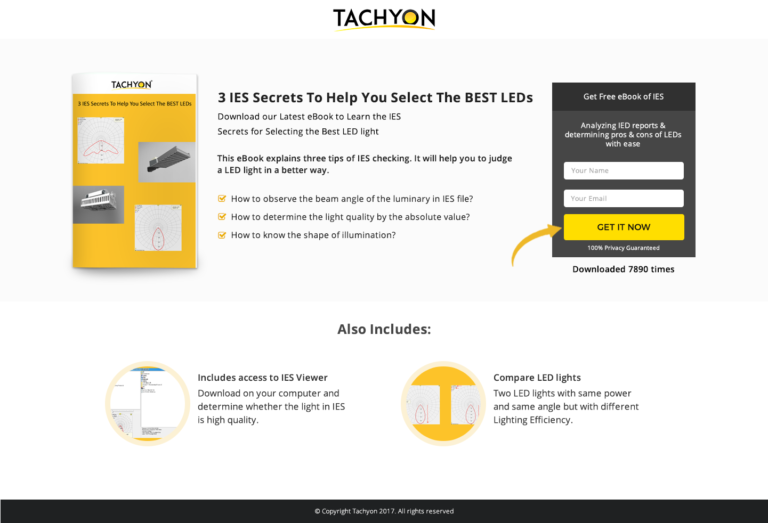
The page’s narrowness is its strength. No navigation, no secondary offers, no company history. The entire page is a single value exchange: give us your email, receive the guide. The download counter, 7890 times, provides social proof that the exchange is worthwhile.
Design decisions
The two-column layout puts a visual guide preview on the left and a form on the right
The guide cover shows actual IES data visualisations, a polar diagram and a lighting distribution chart. These are not decorative; they signal that the guide contains real technical content, not marketing material repackaged as a whitepaper. Technical buyers will identify the IES diagram immediately and understand that the guide addresses their actual workflow.
Three benefit bullets beneath the headline are written as knowledge gaps
“How to observe the beam angle of the luminaire in IES file / How to determine the light quality by the absolute value? / How to know the shape of illumination!” Each bullet names a specific thing the reader will learn. The question mark styling creates mild uncertainty, the reader who doesn’t know how to determine light quality from an absolute value experiences a knowledge gap that the guide fills. That gap is the motivation to submit the form.
The form requires only an email address, no name, no company, no phone
Single-field forms on lead magnet pages consistently achieve higher submission rates than multi-field equivalents. A technical specifier who values their time will not complete a five-field form for a free guide. An email-only form reduces the perceived commitment to near zero while still capturing the lead. The yellow “Get It Now” button on a white form card provides sufficient contrast to be immediately identifiable without aggressive styling.
The “Also Includes” section below the main offer adds the IES Viewer and comparison tool as bonus features
This secondary value addition is positioned below the fold after the form, serving two purposes: it gives visitors who scrolled past the form a reason to scroll back up, and it increases the perceived value of the download for visitors who haven’t yet submitted. Adding bonus deliverables, without increasing the ask, is one of the most reliable conversion lifts on lead magnet pages.
The download counter “Downloaded 7890 times” sits adjacent to the main CTA
Social proof at the point of conversion is not a coincidence. It is the last reassurance before the visitor submits. A counter that demonstrates established popularity answers the implicit question: “Is this worth my email address?” Nearly 8,000 other technical professionals have made the same exchange.
The page header carries Techyon's logo and the guide title, and nothing else. There is no navigation, no link back to the main website, no footer links. This is a deliberate constraint. Every link on a squeeze page is a potential exit point. A visitor who clicks a navigation link to read the company's about page has left the conversion funnel. Removing all exits forces a binary choice: submit the form or close the tab.
Trust architecture
Layer 1: Technical content as the credibility signal
The IES file framing in the headline is itself a trust mechanism. Only a company with genuine expertise in LED photometrics would structure a lead magnet around IES file analysis. The guide cover showing real data visualisations reinforces this, the visitor can see that the content is substantive before they download it.
Layer 2: Download count as peer validation
“Downloaded 7890 times” places Techyon’s guide in the context of a large technical community. For a B2B specifier who doesn’t know the brand, this count signals that Techyon has a relationship with their professional peer group. In technical communities, being used by nearly 8,000 peers is the equivalent of a product recommendation from someone in the same field.
Layer 3: Privacy protection statement near the form
“100% Privacy Guaranteed. We’ll Never Spam You” appears below the submit button. For a business email address submission, the anti-spam assurance is relevant, technical buyers are protective of their professional email and will not submit it to a list they expect to be sold to. The privacy statement addresses that concern directly at the point of submission.

"Squeeze pages for technical B2B audiences succeed or fail on the specificity of the offer. 'Download our LED guide' fails. '3 IES Secrets for selecting the best LED' works because it names a specific data format that only practitioners use, implies there are things the reader doesn't know, and gives a specific number of insights. Each word in that headline is earning its conversion."
What we would test today
1. Add a visible expert credential beneath the title
The guide is more credible if attributed to a named expert with a listed qualification, “By [Name], Certified Lighting Designer, IESNA Member.” Authorship credentials on technical guides increase submission rates because they answer the implicit question: who wrote this, and do they know what they’re talking about?
2. Test a two-step opt-in where the CTA reveals the form
Rather than showing the form immediately, a version where clicking “Get It Now” reveals the form below could increase clicks-to-view (by hiding the form friction initially) without reducing actual submission rate. This approach works particularly well on mobile where the form may be below the fold.
3. Add a “What’s Inside” section with a table of contents preview
A short preview of the guide’s sections, without revealing the content, gives the visitor enough to confirm the guide addresses their specific problem before submitting. A visitor who can see “Section 2: How to Read Absolute Candela Values” knows their question will be answered. That certainty increases submission rate for the exact visitor the guide was written for.
Browse our full collection of landing page examples to see how we design B2B lead magnet and squeeze pages across technical and industrial verticals.
Waseem founded Apexure in 2015 and has led its work on 3,000+ pages for 300+ clients since. He writes about what the team sees after the click, which is pages, forms, tracking and the systems behind them.
What the page leans on
The principles at work on this page, each named in the analysis above.
Reciprocity
Giving something valuable first (free guide, tool, audit) creates an obligation to reciprocate.
Authority bias
People trust credible experts. Certifications, awards, media mentions, and expert endorsements boost credibility.
Cognitive load reduction
Simpler pages convert better. Reducing visual noise, breaking forms into steps, and clear copy lower mental effort.
Scarcity & urgency
Limited availability increases perceived value. Countdown timers, limited spots, and exclusive offers drive urgency.
What people ask about pages like this
Commercial lighting specifiers and facilities managers don't convert from cold contact forms. They need to establish technical competence before they'll share contact information with a vendor. A free guide, '3 IES Secrets to Help You Select the Best LEDs', provides immediate technical value while qualifying the reader as someone who cares enough about lighting specification to request technical documentation. The ebook lead is also a warmer sales conversation starter: the follow-up call references the guide the prospect has received, rather than starting from zero.
An IES (Illuminating Engineering Society) file is a standardised data format that describes a luminaire's photometric output. Lighting specifiers, architects, electrical engineers, facilities managers, use IES files to model how LED luminaires will perform in a space before purchasing. Leading the squeeze page headline with 'IES Secrets' immediately signals that Techyon is speaking the language of a technical specifier, not a general consumer. Anyone who doesn't know what an IES file is will exit immediately, and that self-selection is valuable. The page converts the precise audience that Techyon wants to reach.
Rounded numbers feel estimated; specific numbers feel counted. '7890 times downloaded' creates a credibility signal that '8,000 downloads' does not. The psychological mechanism is that a company willing to display a precise count is implicitly claiming they measured it accurately. For technical buyers who are sceptical of marketing claims by nature, specificity in social proof statistics reduces doubt. The count is also a meaningful scale signal: a guide downloaded nearly 8,000 times has established category authority.
F-pattern reading behaviour means visitors scan from left to right across the top, then down the left side. A two-column layout that puts the value proposition on the left, headline, guide preview image, benefit bullets, and the form on the right matches this reading pattern. The visitor reads the case for the guide before encountering the form. The form appears at the natural end of the left-to-right scan, positioned as a response to the value presented rather than an interruption of it. For B2B technical audiences who read methodically, this sequencing matters.
Three more, taken apart the same way



Want one like this?
Tell us what the page has to do and where the traffic comes from. Within 48 hours you get a written quote from the people who wrote this breakdown. Already have a page that is not converting? Send it for a free audit instead.
UK hours, which is the East Coast morning.
"Technical lead magnets for specialist B2B audiences work when the resource is specific enough to make a non-expert feel inadequate. '3 IES Secrets' implies there are things a specifier doesn't know about LED selection, and that Techyon knows them. That knowledge gap is the conversion engine. A guide called 'LED Buying Tips' wouldn't have the same pull."