
Five process steps instead of a service list.
TC Success's marketing agency website, built on WordPress for business owners let down by a previous agency. How the tabbed capabilities explorer and dual CTAs serve buyers, and the client results still missing.
- Primary CTAGet In Touchthe button the page is built around
- GoalClick-Throughwhat counts as a conversion
- PlatformWordPressclick-through page
- Built forB2BMarketing Agency
- The page as built, not a mockup.Analysed by Apexure, not by TC Success.
- Client
- TC SuccessMarketing Agency
- Industry
- Marketing Agency25 examples
- Audience
- B2BClick-Through
- Platform
- WordPress96 examples
- Page type
- Click-throughClick-Through
- Analysed by
- Waseem BashirMarch 2026
What the page does, and why
Why we built this digital marketing agency website
Marketing agencies selling digital services face a peculiar paradox: their own marketing is the primary demonstration of their capability. A poorly converting agency website is a self-defeating proposition. TC Success needed a site that communicated sophisticated digital strategy capability while remaining accessible enough to convert business owners who are not themselves digital marketers.
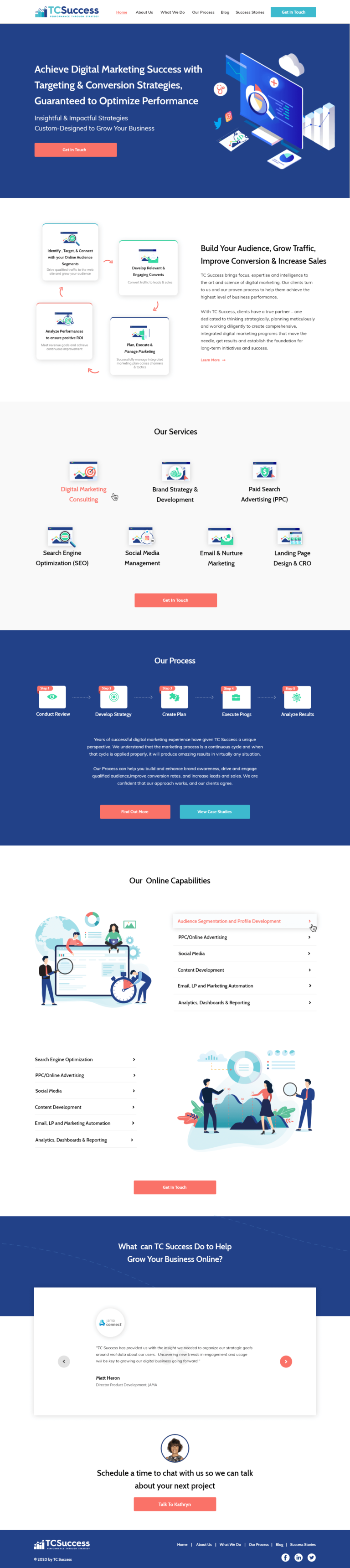
The headline, “Achieve Digital Marketing Success with Targeting & Conversion Strategies, Guaranteed to Optimize Performance”, names the outputs the client cares about (success, targeting, conversion, performance) while the “guaranteed” commitment differentiates from agencies that promise results but hedge every claim. The two supporting lines, “Insightful and Impactful Strategies” and “Custom-Designed to Grow Your Business”, address the two most common agency objections: are you strategic or tactical, and will you understand my specific business?
The service range (Digital Marketing Consulting, Brand Strategy, PPC, SEO, Social Media, Email Marketing, Landing Page Design and CRO) is broad. The site’s challenge is to present that breadth without feeling unfocused. The solution is process-led rather than service-led positioning: TC Success doesn’t sell services, they sell a systematic approach that applies whichever services the client needs.
Design decisions
The hero uses a dark blue background with a 3D isometric illustration of a monitor surrounded by marketing icons
Rather than using stock photography of people at computers, which every agency site uses, TC Success chose an illustrated approach that communicates the interconnected nature of their digital service offering. The illustration shows a central platform with orbiting elements: analytics, social, ads, content. This visual metaphor communicates the integrated approach without a word of copy.
The process diagram uses a five-node horizontal flow with numbered badges and connecting arrows
Conduct Review (1) → Develop Strategy (2) → Create Plan (3) → Execute Program (4) → Analyse Results (5). The numbered sequential flow communicates both methodology and accountability. Each node is colour-coded and connected, the visual implies that skipping a step breaks the chain. For a business owner burned by an agency that executed without a strategy, this process diagram is a direct reassurance.
The services section uses a tabbed interactive capability explorer
Rather than listing all capabilities in a flat grid, the capabilities section uses expandable categories, Audience Segmentation and Profile Development, PPC/Online Advertising, Social Media, Content Development, Email, Analytics. This progressive disclosure design means the visitor can explore depth in their area of interest without being overwhelmed by the full service catalogue. It also signals that TC Success is a specialist in each area, not a generalist with shallow expertise.
The “build your audience
This section aligns TC Success’s capabilities with the client’s outcomes rather than the agency’s internal service structure. The visitor doesn’t think in terms of “I need PPC.” They think “I need more leads.” Translating services into business outcomes (audience growth, traffic, conversion, sales) reduces the translation effort the client would otherwise have to do.
Dual CTAs in the process section
A visitor who wants to understand TC Success before committing needs more information. A visitor who is already evaluating wants evidence. Two CTAs serving different visitor needs in the same section reduces the bounce rate from visitors who have read enough to want validation but not yet enough to contact.
The "Our Online Capabilities" section with the tabbed service explorer is where informed buyers spend the most time. A business owner who already knows they need PPC management will click through to that tab and read the capability description. Structuring this section as an interactive explorer rather than a flat list acknowledges that visitors arrive with different information needs and respect their ability to self-direct.
Trust architecture
Layer 1: Guaranteed outcomes in the hero headline
“Guaranteed to Optimize Performance” is a commitment claim in the opening line. For a sector where agencies routinely overpromise, a guarantee, even a process guarantee rather than an outcome guarantee, signals that TC Success is willing to be held accountable. This separates them from agencies that use hedging language like “we aim to” or “we strive to.”
Layer 2: Named process with accountability steps
The five-step process is trust architecture because each step implies a deliverable. “Conduct Review” implies a documented review. “Analyse Results” implies reporting. Visitors reading this process are mentally checking whether their last agency did these things. If the answer is “no,” TC Success immediately feels more rigorous.
Layer 3: Case studies CTA as a parallel trust path
Not all B2B buyers want to contact before seeing evidence. The “View Case Studies” CTA alongside “Find Out More” gives evidence-first buyers a trust-building path that doesn’t require immediate enquiry. This two-path trust architecture, process evidence and outcome evidence, serves the two dominant evaluation styles in digital marketing procurement.

"Marketing agency sites should never have a single CTA. The buyer journey in agency selection is non-linear, someone evaluates a case study, then reads the about page, then checks LinkedIn, then reads the services, then contacts. Every section should have a relevant next step, whether that's 'read a case study,' 'explore our process,' or 'get in touch.' The buyer self-sequences; we just make sure every path leads somewhere productive."
What we would test today
1. Add a client results section with quantified outcomes
The current site describes process and services but doesn’t surface specific client results, percentage traffic increases, CPL reductions, or revenue growth figures. Since this build, the clearest conversion improvement we see on marketing agency sites is outcome data adjacent to service descriptions. “We increased [client type]’s lead volume by 47% in 6 months” converts better than a well-described process.
2. Test a “We work with businesses like yours” industry selector
TC Success appears to serve multiple industry verticals. A brief industry selector, Retail, Professional Services, E-commerce, SaaS, that filters the case studies and testimonials shown would give each visitor industry-relevant evidence rather than generic agency proof. Personalised social proof outperforms generic social proof by a significant margin in agency selection.
3. Add a response time or consultation process description near the “Get In Touch” CTA
The CTA currently asks visitors to get in touch without explaining what happens next. Adding “We respond within 24 hours. Our initial consultation is free and confidential.” reduces the unknown-future anxiety that prevents form submissions from interested but cautious buyers.
Browse our full collection of landing page examples to see how we design marketing agency and professional services pages across verticals. Also see B2B Landing Page Examples for more on the principles used here.
Waseem founded Apexure in 2015 and has led its work on 3,000+ pages for 300+ clients since. He writes about what the team sees after the click, which is pages, forms, tracking and the systems behind them.
What the page leans on
The principles at work on this page, each named in the analysis above.
Authority bias
People trust credible experts. Certifications, awards, media mentions, and expert endorsements boost credibility.
Social proof
People follow the actions of others. Testimonials, reviews, and client logos build trust and reduce hesitation.
F-pattern layout
Eye-tracking shows people scan pages in an F-shape. Placing key content along this path increases engagement.
Cognitive load reduction
Simpler pages convert better. Reducing visual noise, breaking forms into steps, and clear copy lower mental effort.
What people ask about pages like this
A marketing agency website serves multiple purposes: attracting inbound leads, establishing thought leadership, describing services, and building brand credibility. Unlike a focused landing page with a single CTA, a website like TC Success's needs to accommodate visitors at different stages of the buying journey, someone researching 'digital marketing agencies' has different needs from someone who has been referred and is checking credentials before calling. The TC Success site structures itself around that journey: the homepage establishes the promise, the services section details capabilities, the process section explains methodology, and multiple 'Get In Touch' CTAs capture visitors at whichever point they reach conviction.
Digital marketing agencies that promise specific ROI figures ('3x your revenue') attract scepticism from experienced marketing buyers who know results depend on their product, market, budget, and competitive environment. 'Guaranteed to Optimize Performance' is a commitment that the agency can substantiate: they will apply systematic improvement to every campaign they run. This framing appeals to the marketing director who wants a serious, process-driven partner rather than a vendor making claims they can't back up. The supporting subheadline, 'Insightful and Impactful Strategies, Custom-Designed to Grow Your Business', adds the customisation assurance that rules out templated approaches.
A service list tells a buyer what TC Success does. A five-step process, Conduct Review, Develop Strategy, Create Plan, Execute Program, Analyse Results, tells them how TC Success works. These are different conversations. The 'how' matters enormously to a business that is considering handing over its digital marketing to an external agency. The process shows that TC Success begins with a review of the existing situation (no assumptions), develops a strategy before executing (no spray-and-pray), and closes the loop with analysis (accountability). Each step is a commitment to a behaviour, not just a capability.
Businesses that have been burned by agencies, and many have, typically identify the same failure point: the agency didn't understand their specific situation before starting work. 'Conduct Review' as the explicit first step signals that TC Success doesn't template their approach. It addresses the 'you won't understand our industry' objection before the prospect raises it. For a business owner who has paid an agency to run generic campaigns that felt irrelevant to their business, a process that starts with listening is a meaningful differentiator.
Three more, taken apart the same way



Want one like this?
Tell us what the page has to do and where the traffic comes from. Within 48 hours you get a written quote from the people who wrote this breakdown. Already have a page that is not converting? Send it for a free audit instead.
UK hours, which is the East Coast morning.
"Marketing agency websites have a credibility test baked into the visit: the visitor is evaluating whether the agency knows what they're doing by looking at the agency's own site. A slow page, a confusing layout, or generic service descriptions immediately undermines the sales conversation. TC Success's site needed to demonstrate the capability it was selling, strategic, conversion-focused digital marketing."