
Six steps of what happens after the form.
eSpark's Amazon brand management page for brand owners, built in WordPress around a multi-step intake. Covers the Clutch and Trustpilot badges, the Amazon partner status, the 47% figure and the case study we would add.
- Primary CTASchedule a FREE Callthe button the page is built around
- GoalLead Generationwhat counts as a conversion
- PlatformWordPresslead generation page
- Built forB2BMarketing Agency
- The page as built, not a mockup.Analysed by Apexure, not by eSpark.
- Client
- eSparkMarketing Agency
- Industry
- Marketing Agency25 examples
- Audience
- B2BLead Generation
- Platform
- WordPress96 examples
- Page type
- Lead generationLead Generation
- Analysed by
- Waseem BashirMarch 2026
What the page does, and why
What this page is doing
eSpark manages Amazon channels for consumer brands that have either struggled to grow on the platform or lack the internal expertise to manage it effectively. The target visitor is a brand owner, founder, or marketing director who is either dissatisfied with their Amazon performance or is new to Amazon and wants a specialist to build the channel correctly from the start.
The page needs to establish two things quickly: that eSpark genuinely understands Amazon’s complexity (advertising, content, SEO, account health, suspensions), and that they have a track record of producing results for brands like the visitor’s. Both are addressed within the first scroll.
The dark blue hero creates a premium, professional first impression for a service that commands significant monthly retainers. The visual register communicates that this is a serious growth partner, not a freelance account manager.
Design decisions
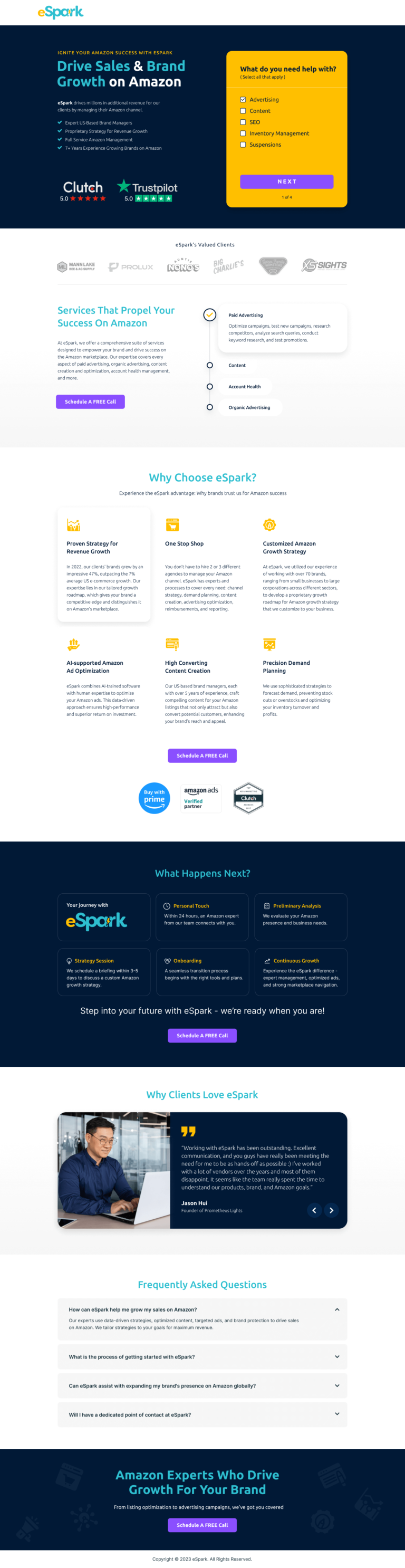
The hero multi-step form, starting with “What do you need help with?” and five service area checkboxes, immediately segments the visitor’s specific need before asking for contact details. An Amazon brand owner who selects “Suspensions” gets a different initial conversation than one who selects “Advertising.” This specificity creates the perception of a personalised service from the first interaction.
The Clutch 5.0 and Trustpilot 5.0 badges sit in the hero. For a B2B service page, third-party review platform badges carry significantly more weight than in-house testimonials because they’re verifiable by the visitor. A brand owner who can click through to a Clutch profile and read unedited reviews is a brand owner who can independently verify the claims. Verifiability is its own trust signal.
The client logo row, showing recognisable brands managed by eSpark, answers the implicit “have you done this for someone like me?” question that every agency prospect has. Specific brand logos communicate scale and experience more effectively than “we’ve worked with over 50 brands.”
The “Why Choose eSpark?” section with six service cards (Proven Strategy, One Stop Shop, Customised Growth Strategy, AI-Supported Ad Optimisation, High Converting Content, Precision Demand Planning) translates the agency’s capabilities into specific value propositions for a brand owner evaluating their options. Each card addresses a real Amazon brand management challenge.
The “What Happens Next?” journey section, six steps from initial contact through continuous growth, is positioned after the social proof section. By this point, the visitor who is still reading has been convinced that eSpark can help. The journey section converts them by making the next step feel like the beginning of a structured process, not a sales call.
The page includes three platform badges: Buy with Prime, Amazon Ads Verified Partner, and a third marketplace certification. These aren't generic partner logos. They're Amazon-specific certifications that communicate official platform expertise. For a brand owner evaluating an Amazon agency, official Amazon partner status is a meaningful differentiator that reduces the risk of working with an agency that lacks platform access or support.
Trust architecture
Amazon agency trust operates on three levels. The first is verified platform authority: the Amazon Ads Verified Partner badge and Amazon certification logos confirm that eSpark has earned official recognition from the platform they claim to manage.
The second is peer verification: the Clutch and Trustpilot 5.0 ratings are verifiable on external platforms. A brand owner who is sceptical of in-house testimonials can independently verify the review quality on platforms they trust.
The third is outcome specificity: the 47% average client growth figure, cited as specific performance data, is significantly more persuasive than general “we grow brands” language. Specific numbers require evidence to back them up, their presence implies the evidence exists.

"The Jason Hui testimonial, from Prometheus Lights, a real named company, is the best piece of social proof on the page. It's specific about the relationship: 'you guys have really been meeting the need for me to be hands-off as possible.' That language tells every brand owner who wants to delegate their Amazon channel: this agency delivers on the hands-off promise. The testimonial proves the core proposition."
The "Schedule a FREE Call" CTA is positioned throughout the page with one consistent framing. The "FREE" qualifier matters in a context where brand owners are cautious about agency commitments. "A free call" communicates that the initial conversation has no obligation attached. It's exploratory, not contractual. This framing tends to outperform "Book a Consultation" in B2B marketing agency contexts.
Conversion strategy
The conversion architecture is multi-touch: multi-step form in the hero, CTA after the services section, CTA after the client journey section, and CTA at the page close. Each placement reaches a different visitor at a different stage of conviction.
The FAQ section (four questions about Amazon growth, getting started, global expansion, and dedicated account contact) handles the practical objections of a visitor who is interested but has specific operational questions. Answering these on the page keeps the visitor engaged rather than prompting an email exchange before the first call.
"The 'One Stop Shop' value card is doing important positioning work. Amazon brand management fragments across advertising agencies, content studios, and account management consultants. Brands that have tried to piece together multiple vendors know how painful the coordination is. 'One Stop Shop' directly addresses this by saying: you don't need three vendors. You need one team that does it all. That single message converts the brand owner who is currently managing multiple Amazon service providers."
Platform: WordPress
WordPress was chosen for the design flexibility needed to build the multi-step form logic, the service card grid, the journey section, and the certification badge layout, all of which required custom implementation.
Mobile experience
Brand owners and marketing directors research agency options across devices. We made sure the multi-step service selection form worked cleanly on mobile, the client logos and certification badges remained identifiable at small sizes, and the “What Happens Next” journey section reformatted to a vertical sequence that was scannable on a phone screen.
Dark hero sections with overlay text need careful contrast management, text legibility on a dark background must be guaranteed across all screen brightness settings. We used text-shadow and background overlay techniques rather than relying on contrast ratio alone, making sure the headline was legible on both high-brightness and low-brightness screens without the background appearing washed out.
What we’d evolve
Three areas for the next iteration:
- Industry-specific case study: The 47% growth figure is compelling but generic. A case study showing a specific brand category, beauty, home goods, electronics, with the challenge, the approach, and the measurable result would convert brand owners in that category far more effectively than general performance data
- Revenue tier segmentation: Amazon brand management needs vary significantly between a $100K/year brand and a $5M/year brand. A brief qualifier, “What is your current Amazon revenue?”, would allow eSpark to route different conversations appropriately and signal to enterprise-level brands that their needs are understood
- Video testimonial from Jason Hui: The written Jason Hui quote is strong. A video would be significantly stronger, seeing a real founder describe their experience with eSpark in their own words and cadence converts at rates that text quotes cannot match for a high-retainer service relationship
"The 'Precision Demand Planning' service card is one of those features that separates a sophisticated Amazon agency from a basic one. Most brands don't know this exists. Including it on the page does something clever: it positions eSpark as operating at a level of Amazon intelligence the visitor probably didn't know was available. That positioning creates aspirational demand, the brand owner didn't know they needed demand planning until they read that someone offers it."
Browse our full collection of landing page examples to see how these principles apply across industries. For the theory behind B2B agency pages, read our guide to B2B Landing Page Examples.
Waseem founded Apexure in 2015 and has led its work on 3,000+ pages for 300+ clients since. He writes about what the team sees after the click, which is pages, forms, tracking and the systems behind them.
What the page leans on
The principles at work on this page, each named in the analysis above.
Authority bias
People trust credible experts. Certifications, awards, media mentions, and expert endorsements boost credibility.
Social proof
People follow the actions of others. Testimonials, reviews, and client logos build trust and reduce hesitation.
F-pattern layout
Eye-tracking shows people scan pages in an F-shape. Placing key content along this path increases engagement.
Cognitive load reduction
Simpler pages convert better. Reducing visual noise, breaking forms into steps, and clear copy lower mental effort.
What people ask about pages like this
eSpark offers full-service Amazon channel management covering paid advertising, content creation, account health management, organic advertising (SEO), and suspension resolution. For brand owners who want to grow on Amazon without managing the complexity themselves, campaigns, listings, compliance, and inventory, eSpark provides the expertise and execution across all five disciplines. Their model is designed to allow brands to scale their Amazon revenue without building an in-house Amazon team.
eSpark cites a specific performance benchmark: their clients' brands grew by an impressive 47%, outperforming the 5% average growth they'd experienced previously. This is a cited, specific outcome from real client experience, not a generic claim. The type of improvement available depends on the brand's current state: under-optimised listings, poorly structured campaigns, and reactive rather than proactive account management are all areas where specialist management produces measurable uplift.
The multi-step form, starting with service area selection (Advertising, Content, SEO, Inventory Management, Suspensions), serves two conversion goals simultaneously. For the visitor, it personalises the service conversation before they've provided contact details. For eSpark, it pre-qualifies the lead by identifying the specific area of Amazon management where the brand owner has the most immediate need. Better-qualified initial conversations produce higher close rates for agency services.
The 'What Happens Next?' section, showing six steps from initial contact through strategy sessions to onboarding and continuous growth, answers the specific question that holds back most B2B service buyers: 'what am I actually committing to when I fill in this form?' By making the post-conversion experience explicit and structured, eSpark reduces the anxiety of the unknown that prevents motivated buyers from submitting. Knowing exactly what the next six steps look like makes the first step feel small.
Three more, taken apart the same way



Want one like this?
Tell us what the page has to do and where the traffic comes from. Within 48 hours you get a written quote from the people who wrote this breakdown. Already have a page that is not converting? Send it for a free audit instead.
UK hours, which is the East Coast morning.
"Amazon agency pages have a specific credibility problem: every freelancer and small agency claims to 'grow your Amazon sales.' eSpark differentiates on specificity, they cite a 47% growth figure, Clutch and Trustpilot badges from real reviews, and a named client roster. That level of verifiable, third-party evidence is what separates a serious agency from the noise."