
A finished estimate up top, and a 30% claim.
StickyBid's estimating software page for interior designers, built on Unbounce around a 14-day free trial. How the win-rate headline, the four-step process and same-industry testimonials make the case, and the comparison we would test.
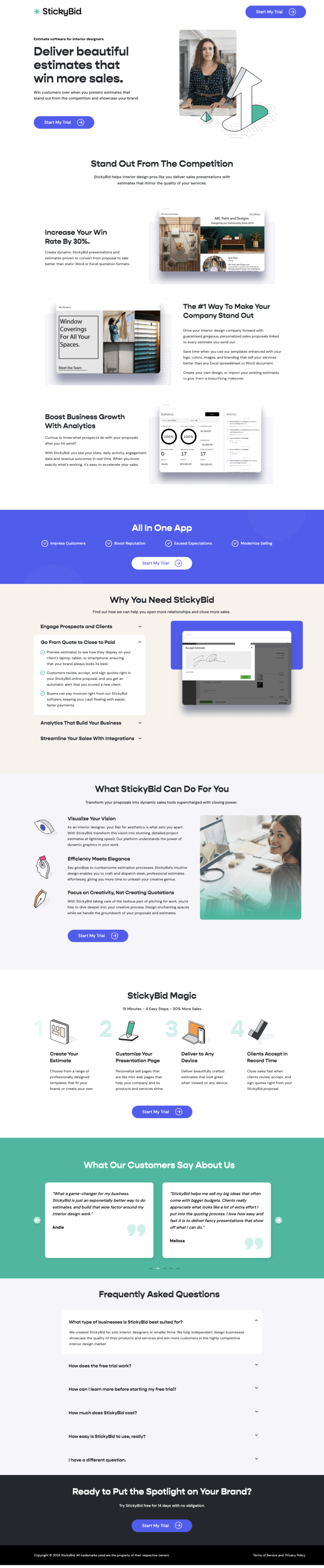
- Primary CTAStart My Trialthe button the page is built around
- GoalFree Trial Sign-Upwhat counts as a conversion
- PlatformUnbounceclick-through page
- Built forB2BSaaS
- The page as built, not a mockup.Analysed by Apexure, not by StickyBid.
- Client
- StickyBidSaaS
- Industry
- SaaS30 examples
- Audience
- B2BFree Trial Sign-Up
- Platform
- Unbounce132 examples
- Page type
- Click-throughFree Trial Sign-Up
- Analysed by
- Waseem BashirMarch 2026
What the page does, and why
Why we built this SaaS Click-Through
Interior designers have a specific professional gap: their creative output is exceptional but their business tooling is often cobbled together from general-purpose software. Estimates go out as Word documents or spreadsheets. Proposals have no visual connection to the brand experience the designer creates for clients. The business side of the practice doesn’t match the standard of the creative side, and that inconsistency costs them projects.
StickyBid was built to close that gap: a proposing and estimating platform specifically designed for interior designers that produces branded, visual estimates that match the professional quality of the designer’s work. The conversion challenge was reaching interior designers who had normalised their current process and helping them see the cost of their current approach before introducing the solution.
The page also needed to move through a specific SaaS challenge: the free trial conversion. Interior designers aren’t habitual SaaS buyers, many run boutique practices where every tool adoption involves real workflow change. The page needed to lower the barrier to trying while raising the perceived value enough to motivate that barrier-crossing.
Design decisions
The hero leads with a specific, falsifiable claim: “Increase your win rate by 30%.”
This number is the page’s primary conversion driver because it translates an aesthetic improvement (beautiful proposals) into a business outcome (more closed deals). Interior designers don’t need prettier documents. They need more projects. The 30% win rate improvement anchors the value proposition in the designer’s revenue rather than their workflow satisfaction. Everything else on the page builds the case that this claim is real.
An actual estimate/proposal screenshot appears in the hero section
We positioned a real StickyBid output, a professional, branded proposal page showing the estimate layout, line items, and visual treatment, in the hero alongside the headline. This screenshot does more conversion work than any copy could achieve alone because it answers “what does it actually produce?” before the visitor has decided whether to read further. Visitors who see the output quality and think “my proposals look nothing like this” are already sold; the rest of the page just confirms the decision.
The four-step “StickyBid Magic” process
Create Your Estimate, Customise Your Presentation Page, Deliver to Any Device, Clients Accept in Record Time. The four steps use the commitment-consistency principle sequentially. Each step sounds simple. The cumulative effect is: “I can create something this good, send it easily, and get clients to accept it fast?” That’s a compelling workflow picture delivered in four sentences. We deliberately kept each step description to one sentence because complexity in the “how it works” section creates hesitation; simplicity creates confidence.
The “stand out from the competition”
section uses a direct comparison showing a StickyBid estimate versus a standard competitor estimate format. This comparison does competitive differentiation work without naming any competitor, the visitor’s own current estimate format is the implicit comparison. Every interior designer who looks at the StickyBid vs “standard” comparison and recognises their own estimate format in the right column has just experienced the page’s core persuasion.
Testimonials from identifiable designer/business names
Andie describing “game-changer for my business,” Melissa describing “big ideas that often come with a lot of extra effort” being removed, are specific to the software’s impact on design business operations. Neither testimonial is generic SaaS praise; both are specific to how StickyBid changed their proposal workflow and sales rate. The specificity makes them credible.
Trust architecture
Layer 1: Instant credibility
The proposal screenshot in the hero establishes product quality before any claim is made. Visitors can evaluate the output immediately. For a design tool, the output IS the product, showing it in the hero removes the “will it actually look good?” uncertainty before the visitor has read a word.
Layer 2: Business outcome quantification
The “Increase Your Win Rate by 30%” headline metric, combined with the mention of “active proposals” converting better than static Word documents, makes the business case with a measurable benchmark. Interior designers who track their proposal-to-project conversion rate can immediately benchmark this claim against their own numbers.
Layer 3: Peer validation from same-industry users
The testimonials from practising interior designers, not generic software users, provide vertical-specific social proof. An interior designer reading Melissa’s comment about “taking care of the tedious part of pitching my projects” is hearing their specific situation described by someone in their profession. That specificity converts at a different level than general business software testimonials.

"The 'All In One App' section benefits banner (Impress Customers, Boost Reputation, Exceed Expectations, Modernise Selling) is doing brand positioning work at the point where the visitor has just absorbed the product's core mechanics. It reframes the tool from 'estimating software' to 'competitive advantage tool.' That reframe matters because it changes how the designer evaluates the price: they're not buying estimating software (a cost). They're buying a competitive advantage (an investment). The section heading in the context of the page changes the price-value evaluation."
What we would test today
Our data from SaaS free trial pages in the creative professional tools category since this build points to three improvements:
Test 1: A before/after proposal comparison side-by-side
The current page shows a single StickyBid output. A split comparison showing a typical Word document estimate on the left and a StickyBid estimate on the right would make the quality gap visceral rather than abstract. For a page selling on aesthetic quality improvement, the comparison format is the most direct version of that argument. High impact for visitors who have mental picture of their current estimate output.
Test 2: A project size calculator
“How many proposals do you send per month?” with an average project value input, outputting “A 30% win rate improvement would generate $X in additional revenue”, would personalise the headline claim. An interior designer who sees “a 30% win rate improvement would generate $54,000 in additional annual revenue for your practice” is experiencing the value proposition as a personal business case, not a marketing claim. High impact for driving trial sign-up decisions.
Test 3: A three-minute video walkthrough
The current page relies on screenshots and step descriptions to convey product experience. A short video of a designer actually using StickyBid (creating an estimate, customising the layout, sending it, and showing the client-facing view) would reduce the effort-to-understand barrier that stops some designers from starting the trial. For a workflow tool where the value is experiential, showing the experience is more persuasive than describing it.
"The FAQ section closing question, 'I have a different question', is a conversion mechanism disguised as a customer service option. Any visitor who clicks it is an engaged prospect with an unresolved objection. That click is a purchase-intent signal. Capturing those clicks with a live chat or quick email response converts a meaningful proportion of the 'interested but uncertain' segment that would otherwise bounce without converting. Don't let FAQ 'other' clicks go to a generic contact form, route them to a fast response that resolves the specific objection."
Want a SaaS free trial page that converts creative professionals who’ve normalised their current workflow? Talk to our team.
Waseem founded Apexure in 2015 and has led its work on 3,000+ pages for 300+ clients since. He writes about what the team sees after the click, which is pages, forms, tracking and the systems behind them.
What the page leans on
The principles at work on this page, each named in the analysis above.
Anchoring effect
The first piece of information shapes all subsequent judgements. Price comparisons and headline stats set expectations.
Social proof
People follow the actions of others. Testimonials, reviews, and client logos build trust and reduce hesitation.
Authority bias
People trust credible experts. Certifications, awards, media mentions, and expert endorsements boost credibility.
Commitment consistency
This principle influences visitor behaviour and supports the page's conversion goal.
Processing fluency
This principle influences visitor behaviour and supports the page's conversion goal.
What people ask about pages like this
Most interior designers are trained in design, not sales. Their estimates and proposals are typically sent as flat PDF documents or Word files that have no visual relationship to the quality of their design work. A client who has seen beautiful concept boards from an interior designer and then receives a plain-text estimate is experiencing a jarring brand inconsistency. They start asking questions they wouldn't have asked if the proposal matched the design quality: 'Is this price right?' 'Can I trust their project management if their paperwork looks this basic?' StickyBid bridges that gap, proposals that look as considered as the design work they represent.
For an interior designer sending 10 proposals per month with an average project value of $15,000, a 30% improvement in win rate means 3 additional projects per month. At $15,000 per project, that's $45,000 in additional monthly revenue from the same lead volume. The win rate improvement is achieved not through better selling, the designer's skills don't change, but through the presentation quality of the proposal itself. Clients who receive a beautifully formatted digital estimate on StickyBid are evaluating a professional whose proposal shows the same aesthetic care they'll bring to the project.
General contractor estimating software is built around materials, labour hours, and cost codes. Interior design projects involve a completely different cost structure: procurement coordination, product markups, trade discounts, installation sub-contractors, and design fee structures that vary by designer. Software designed for general contractors forces interior designers into an inappropriate framework that creates extra work rather than reducing it. StickyBid is built around the interior designer's actual cost categories, markup structures, and presentation requirements, which is why it converts designers faster than repurposed construction software.
Habit is the primary conversion barrier for estimating software, designers have a workflow that 'works well enough' and switching feels like risk and effort. A 14-day free trial without a credit card reduces both: there's no financial commitment, and the trial period is long enough to create a new habit. The conversion mechanism that makes free trials work for workflow tools is the first successful use: the moment a designer sends their first StickyBid proposal and a client responds positively, the habit switch is essentially complete. We design trial onboarding around getting to that first successful proposal as quickly as possible.
Three more, taken apart the same way



Want one like this?
Tell us what the page has to do and where the traffic comes from. Within 48 hours you get a written quote from the people who wrote this breakdown. Already have a page that is not converting? Send it for a free audit instead.
UK hours, which is the East Coast morning.
"'Deliver Beautiful Estimates That Win More Sales' as the hero headline is solving two problems simultaneously. 'Beautiful estimates' addresses the brand inconsistency problem, the designer knows their estimates look basic compared to their design work. 'Win more sales' addresses the business outcome. The combination says: 'we'll fix the thing you know is wrong about your proposals, and that fix will make you money.' Both halves are necessary, beautiful alone is insufficient for a business tool, and win more sales alone doesn't distinguish from generic CRM software."