
One card for buyers, one for suppliers.
STENN's consultation page for supply chain finance, built on Unbounce for retailers sourcing from Asia and their suppliers. How the live ticker and three-field form work, and the split CTAs we would test.
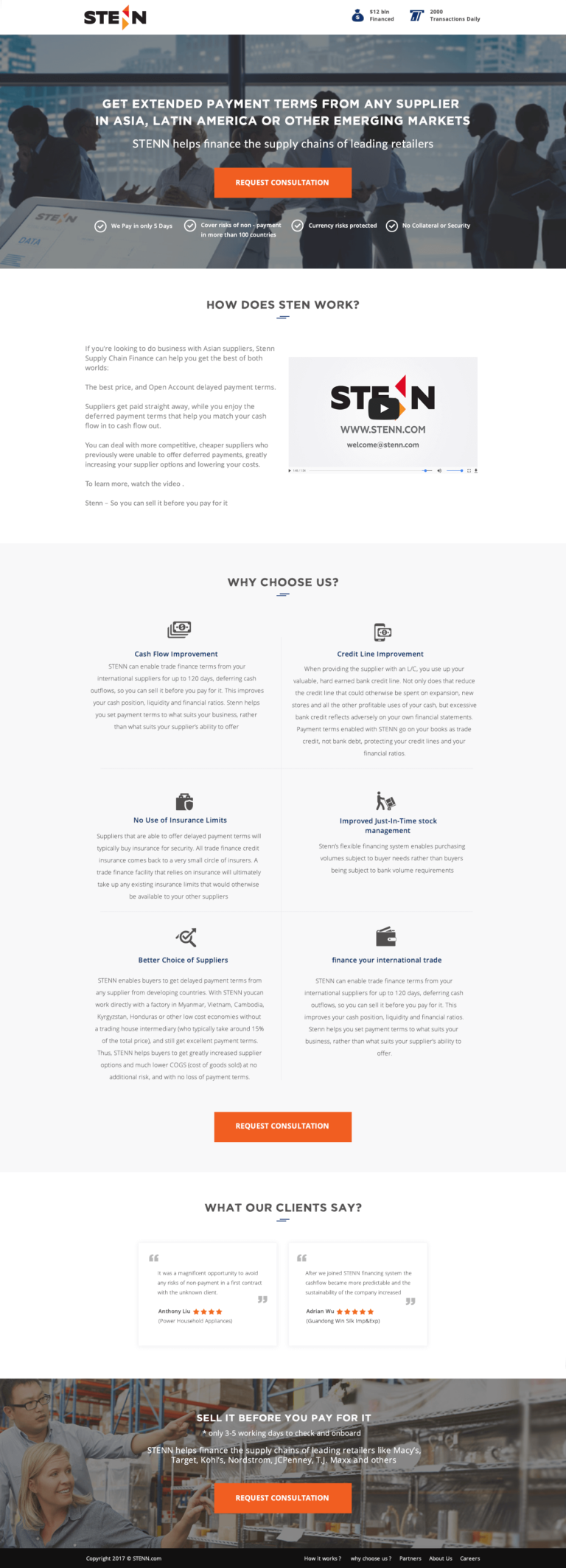
- Primary CTARequest Consultationthe button the page is built around
- GoalLead Generationwhat counts as a conversion
- PlatformUnbouncelead generation page
- Built forB2BConsulting
- The page as built, not a mockup.Analysed by Apexure, not by STENN.
- Client
- STENNConsulting
- Industry
- Consulting11 examples
- Audience
- B2BLead Generation
- Platform
- Unbounce132 examples
- Page type
- Lead generationLead Generation
- Analysed by
- Waseem BashirMarch 2026
What the page does, and why
Why we built this consulting lead generation
Trade finance occupies a specific niche in B2B financial services. The buyers are sophisticated (CFOs, supply chain directors, procurement leads at retailers and manufacturers) and they come to this category with a concrete problem: their supply chain needs financing that traditional banks either can’t provide in the geographies they operate in, or can’t provide quickly enough to match their operational timelines.
STENN’s specific value is their reach into emerging markets (Asia, Latin America, and other emerging economies) combined with a genuinely fast process. Their claim: “supply chain finance in as little as 24 hours.” In a category where traditional bank processes take weeks, that speed claim is genuinely differentiated and becomes the central conversion driver for any buyer who has experienced the pain of a slow financing approval during a time-sensitive sourcing relationship.
The page had to serve two audiences in parallel: the buyer (the retailer who wants extended payment terms) and the seller (the supplier who wants early payment). Rather than forcing both through generic “supply chain finance” copy, we structured the page around dual benefit cards, one for each party’s value proposition, so each visitor can find their specific value quickly.
Design decisions
The headline “get extended payment terms from any supplier in asia”
The headline is a geography-specific value proposition that immediately qualifies the right buyer. Not all businesses need emerging market supply chain finance. Those that source from Asia and Latin America do. By naming the geographies in the headline, the page filters out irrelevant visitors and lands immediately with the exact decision-maker dealing with an Asian or Latin American supplier relationship.
The dual benefit cards
“Cash Flow Improvement” (for buyers) and “Credit Line Improvement” (for suppliers) acknowledge that the page serves two distinct audiences. Rather than forcing both through the same copy, the dual card structure lets each visitor self-identify with the relevant benefit. A retail CFO sees the cash flow card and reads about extended payment terms. A manufacturer’s finance director sees the credit line card and reads about early payment access. Each gets the explanation of how STENN bridges their specific financing gap.
The “We Pay in 3 Easy Steps” section
The animated explainer reduces what could be a complex financial process into three visible steps. Supply chain finance intimidates buyers who have never used it. The process seems like it would involve extensive documentation, credit checks, and weeks of approval time. The visual simplification of “three steps” removes that anxiety before it becomes an objection. The animated explainer shows the interaction between buyer, STENN, and supplier in a way that makes the three-party relationship clear at a glance.
The stat bar
3,000 transactions daily, operating across 80+ countries. The stats appear below the hero and establish scale before any capability claim is made. Scale matters for financial services because it implies both institutional trust and operational resilience. A trade finance provider processing 3,000 transactions per day isn’t a startup experiment. It’s a functioning financial infrastructure enterprise buyers can rely on.
Minimal form: three fields only
Name, email, company. For a B2B financial services inquiry where the consultation will gather detailed information, asking for more upfront creates unnecessary friction. The consultation call is where qualification happens. The form captures just enough to route the inquiry. The call does the detailed intake. Form for contact, call for qualification. That principle consistently raises consultation request rates over forms that try to pre-qualify with ten fields.
Trust architecture
Layer 1: instant credibility
The “300 Transactions Daily” live ticker in the header banner signals active, current operations. Financial buyers are looking for evidence that a finance provider is operational at scale, not just launched. Live transaction data in the header is the most immediate scale signal available.
Layer 2: geographic coverage
“80+ countries” combined with the specific emerging market geography in the hero headline validates STENN’s coverage claim for buyers operating in Asia and Latin America. For buyers whose specific supply chain challenge involves a country most trade finance providers don’t cover, geographic specificity is the most important capability signal.
Layer 3: process transparency
The three-step visual and video explainer reduce the complexity anxiety that prevents sophisticated buyers from starting the consultation process. Financial services buyers are conservative by nature. They want to understand a process before they engage with it. Showing the process visually before asking for contact information converts the careful evaluator who would otherwise spend a week researching before submitting a form.

"The 'No Collateral or Security Required' trust badge below the hero CTA addresses the single most common objection in emerging market trade finance: collateral requirements that most suppliers in those markets cannot meet. It isn't prominently displayed, but for the visitor who scrolls past the CTA without clicking, that badge catches their eye and removes an objection they hadn't yet asked. Pre-emptive objection handling in trust-badge format is one of the highest-value micro-decisions on a finance page."
What we would test today
Our data from B2B financial services and trade finance pages since this build points to three specific improvements.
Test 1: buyer and supplier separate CTAs
Currently, both buyer and supplier audiences see the same “Request Consultation” CTA. A version where the buyer card has “Get Extended Terms” as its CTA and the supplier card has “Get Paid Faster” as its CTA would maintain the dual-audience structure through the conversion action. CTA copy matching the audience’s specific goal would reduce the ambiguity of a generic consultation request. High impact for a dual-audience page where the two value propositions are structurally different.
Test 2: a case study featuring a specific trade route
A brief case study showing an actual STENN-financed transaction (“How a Vietnamese textile manufacturer received payment in 2 days instead of waiting 90 days while their UK retail buyer got 90-day terms”) would make the financing mechanism concrete. Abstract financial service descriptions require effort to visualise. A specific, named trade route with actual timelines and financing amounts converts the sceptical evaluator faster than general capability claims.
Test 3: a qualification calculator
“How long are you currently waiting to receive payment?” for suppliers, or “What payment terms are you currently offering your suppliers?” for buyers. Outputting “STENN could reduce your wait to X days” or “We could extend your terms to Y days” would personalise the value proposition. For a financial service where the benefit is measured in cash-flow days, a personalised days-improvement figure is more motivating than aggregate statistics.
"Supply chain finance pages serve a buyer who has been doing their research for weeks before they submit a form. That long pre-conversion period means the page's job isn't to make the sale. It's to be the last page the buyer visits before deciding STENN is worth a consultation. The page needs to be complete enough that the buyer finishes their research on it rather than going to five other providers. Every unanswered question is a reason to leave and compare."
Need a financial services landing page that serves sophisticated B2B buyers in a long-evaluation category? Talk to our team.
Waseem founded Apexure in 2015 and has led its work on 3,000+ pages for 300+ clients since. He writes about what the team sees after the click, which is pages, forms, tracking and the systems behind them.
What the page leans on
The principles at work on this page, each named in the analysis above.
Authority bias
People trust credible experts. Certifications, awards, media mentions, and expert endorsements boost credibility.
Anchoring effect
The first piece of information shapes all subsequent judgements. Price comparisons and headline stats set expectations.
Loss aversion
People feel losses more strongly than gains. Framing around what they will miss motivates action.
Processing fluency
This principle influences visitor behaviour and supports the page's conversion goal.
Social proof
People follow the actions of others. Testimonials, reviews, and client logos build trust and reduce hesitation.
What people ask about pages like this
Supply chain finance typically attracts two types of buyers simultaneously: retailers and importers who want extended payment terms from overseas suppliers (buyers of goods), and suppliers in emerging markets who need early payment rather than waiting 60-90 days to be paid (sellers of goods). STENN's specific positioning serves both: help retailers get better terms from Asian and Latin American suppliers while helping those suppliers get paid faster. The buying trigger is almost always a specific supply chain problem, a cash flow crunch, a supplier demanding shorter payment terms, or a new sourcing relationship needing financing structure.
Supply chain finance is complex enough that a corporate website typically presents it as one service line among many, which dilutes the message for a visitor with a specific, urgent supply chain financing need. A dedicated landing page can focus entirely on the specific buyer problem, extended payment terms, earlier supplier payment, emerging market access, and walk the visitor to a consultation request without competing navigation or secondary CTAs. The specificity of a landing page that speaks directly to the supply chain finance decision increases consultation request rates substantially over a general contact page.
The fundamental problem STENN solves is a timing mismatch: retailers want to pay suppliers after they've sold the goods; suppliers want to be paid before they ship. Traditional bank financing for this gap requires collateral and lengthy approval processes that emerging market suppliers often can't access. STENN provides the financing layer that bridges the timing gap, allowing retailers to negotiate up to 120-day payment terms while suppliers receive payment within days. That bridge converts a zero-sum negotiation, you pay first or I ship first, into a win-win structure financed by a third party.
Enterprise procurement teams evaluating a trade finance provider need to see: regulatory standing (are they a regulated financial entity), coverage geography (which countries and currencies do they operate in), institutional backing (are they funded by reputable investors), and transaction track record (volume of transactions processed, number of countries served). STENN's '300+ transactions daily, 80+ countries' stats directly address the scale and geography questions. Regulatory compliance signals, mentioned in the trust badges, address the regulatory standing question. Both are required by enterprise buyers before they'll involve a trade finance provider in their supply chain.
Three more, taken apart the same way



Want one like this?
Tell us what the page has to do and where the traffic comes from. Within 48 hours you get a written quote from the people who wrote this breakdown. Already have a page that is not converting? Send it for a free audit instead.
UK hours, which is the East Coast morning.
"The news ticker banner at the top of the STENN page, showing the current date and live transaction count, is one of the most effective active trust signals we've implemented on a finance page. '3,000 transactions daily' in a live-updating ticker tells the visitor the platform is actively processing real trades right now, at scale. For a financial service, that live-activity signal communicates exactly what the enterprise buyer needs to hear: this is an operating, high-volume platform, not a website for a company that processes a handful of transactions per month."