
A case study behind six fields, not a demo.
SparkCognition's enterprise AI lead generation page, built in Unbounce for executives gathering evidence. How client logos, partner badges and outcome cards earn the download, and the shorter form we would test.
- Primary CTARead Our Case Studythe button the page is built around
- GoalLead Generationwhat counts as a conversion
- PlatformUnbouncelead generation page
- Built forB2BTechnology Consulting
- The page as built, not a mockup.Analysed by Apexure, not by SparkCognition.
- Client
- SparkCognitionTechnology Consulting
- Industry
- Technology Consulting12 examples
- Audience
- B2BLead Generation
- Platform
- Unbounce132 examples
- Page type
- Lead generationLead Generation
- Analysed by
- Waseem BashirMarch 2026
What the page does, and why
Why we built this technology consulting lead generation
Enterprise AI consulting sells to a specific type of buyer: technically sophisticated, genuinely sceptical, under real organisational pressure to justify AI investment, and surrounded by vendors making similar claims. SparkCognition was competing in a category where “machine learning” and “artificial intelligence” had become so overused the words themselves had lost meaning for the enterprise buyers they were trying to reach.
The conversion challenge was establishing genuine technical differentiation in a market of identical-sounding AI vendors. Generic AI positioning (“data-driven insights,” “machine learning at scale,” “AI-powered transformation”) converts no one in an enterprise B2B context, because every competitor uses the same language. The page had to show specific capabilities, specific industries, and specific measurable outcomes without overpromising in a way that triggers the “this sounds like every other AI vendor” response.
We designed around the gated case study as the primary conversion event because enterprise AI buyers are evidence gatherers. The decision to evaluate SparkCognition seriously is made internally, requires justification to a committee, and needs documented proof points. A case study is that proof. The form to access it is a low-friction, high-intent conversion that qualifies visitors by their willingness to provide contact information for substantive content.
Design decisions
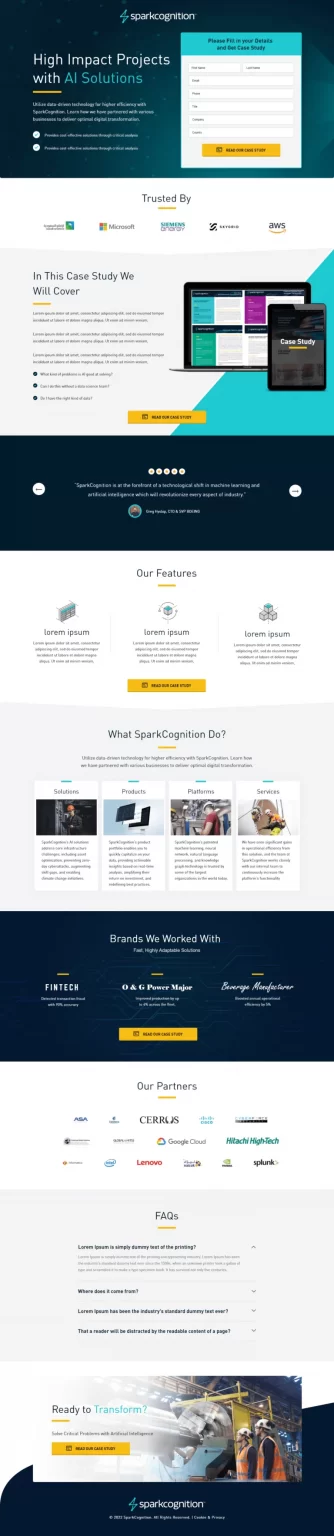
“High impact projects with AI solutions”
The hero headline is direct about outcome (high impact) and mechanism (AI solutions) without making specific promises the page hasn’t yet earned. The supporting copy (“use data-driven technology for higher efficiency with SparkCognition”) adds the value mechanism. We chose that framing over either vague (“transform your business with AI”) or overly specific (“reduce operational costs by X%”) because the case study on the page provides the specific proof. The hero shouldn’t try to carry that weight before the visitor has seen it.
The above-fold form with six fields
First Name, Last Name, Email, Phone, Title, Company. The form captures the full professional profile needed for enterprise sales qualification. Six fields is more than optimal for consumer lead generation, but appropriate for enterprise B2B gated content where both parties understand the exchange: you give complete contact information, you receive a substantive case study. The form sits in the hero right column, making the conversion mechanism visible immediately without any scrolling.
The trusted-by logo strip
Saudi Aramco, Microsoft, Siemens Energy, SKYRIO, AWS. The logo strip serves a specific function for enterprise buyers. Those organisations have rigorous vendor assessment processes. Their presence as named clients signals SparkCognition has passed the procurement and security evaluation standards of global energy companies and hyperscale cloud providers. For an enterprise buyer weighing SparkCognition’s capabilities, “Siemens Energy is a client” is a more compelling due diligence data point than any claim the company makes about itself.
The three vertical outcome cards
Fintech (99% fraud detection accuracy), Oil & Gas Power Major (4% production improvement), Beverage Manufacturer (5% operational efficiency improvement). Each card is a compressed case study with a headline metric. The three industries covered (fintech, O&G, consumer goods) signal cross-vertical applicability while providing the specific, falsifiable numbers technical enterprise buyers evaluate. Abstract AI claims don’t convert this audience. Specific industry outcomes do.
The solutions grid
AI solutions (products, platforms, services, each with a brief capability description) addresses the “what exactly do they do?” question every enterprise evaluator brings to the page. The grid covers enough scope to demonstrate breadth of capability without providing enough detail to create confusion. The case study provides the depth. The grid provides the orientation.
Trust architecture
Layer 1: instant credibility
The enterprise client logos in the hero establish that SparkCognition has already sold to and delivered for organisations with stringent vendor qualification standards. For an enterprise buyer who is also subject to those standards, this peer credibility is the most relevant trust signal available in the hero.
Layer 2: partner ecosystem validation
The technology partner logos (ASA, Intel, Google Cloud, Hitachi High-Tech, Cerros, Cisco, Lenovo, Splunk, NVIDIA) represent the engineering infrastructure layer of the AI ecosystem. An AI company with Google Cloud and Cisco as certified partners has been technically validated by the organisations that build the infrastructure the AI runs on. That’s technical credibility that goes beyond marketing claims.
Layer 3: vertical-specific outcome evidence
The three industry outcome cards close the trust cycle for vertical-specific evaluation. A Chief Data Officer at a manufacturing company sees the beverage manufacturer card and evaluates it against their own operational metrics. A VP of Risk at a financial institution sees the fintech fraud detection card and benchmarks 99% accuracy against their current detection rates. The vertical matching converts because it makes the general claim personal to the visitor’s specific context.

"The 'Ready to Transform?' final CTA section uses a photograph of an industrial facility worker, not a business executive in a boardroom. That choice is deliberate. SparkCognition's AI solutions operate at the operational level, not just the strategic level. Showing the person whose work the AI actually affects (the floor supervisor, the quality control operator) grounds the transformation claim in operational reality rather than boardroom aspiration. Enterprise buyers who are accountable for operational outcomes respond to that grounding."
What we would test today
Our data from enterprise AI and technology consulting pages since this build points to three improvements.
Test 1: industry-specific landing page variants
The current page serves multiple verticals from one page. Traffic from oil and gas industry publications or events landing on a variant with “AI Solutions for Oil & Gas Operations” as the headline, with only the O&G case study and outcome visible, would tend to convert better through message match. Enterprise buyers evaluate AI vendors in the context of their specific industry. Industry-matched pages outperform general pages by 30-50% for this audience type.
Test 2: a video of the CEO or Chief Scientist
Enterprise AI evaluation involves personal credibility as well as technical credibility. A 2-minute video of a SparkCognition executive explaining their specific approach to AI implementation (not a sales pitch, but a technical perspective on what makes AI implementations succeed or fail in industrial settings) would establish thought leadership in the hero section. For a technical audience evaluating a long-term partner, seeing the people and thinking behind the company is a meaningful trust factor.
Test 3: progressive form revealing based on engagement
The current six-field form is front-loaded. A version that shows only Email and Company Name initially, with the remaining fields revealed after the visitor clicks “Get Case Study,” would reduce initial friction while still capturing the full profile needed for sales qualification. The commitment-consistency principle applies: once a visitor clicks to proceed to step two. They’re much more likely to complete the remaining fields. Medium-high impact for top-of-funnel conversion rate.
"Enterprise AI pages that include genuine FAQ content (not just 'what is machine learning' basics, but questions like 'how long does an AI implementation typically take?' and 'do we need a data science team to work with you?') convert the self-qualifying visitor who is trying to determine whether SparkCognition is operationally compatible with their organisation. Those are the questions asked in vendor evaluation meetings. Answering them on the page removes friction from the buying committee's evaluation process."
Need an enterprise B2B technology page that converts evaluation-mode buyers into qualified pipeline? Talk to our team.
Waseem founded Apexure in 2015 and has led its work on 3,000+ pages for 300+ clients since. He writes about what the team sees after the click, which is pages, forms, tracking and the systems behind them.
What the page leans on
The principles at work on this page, each named in the analysis above.
Authority bias
People trust credible experts. Certifications, awards, media mentions, and expert endorsements boost credibility.
Social proof
People follow the actions of others. Testimonials, reviews, and client logos build trust and reduce hesitation.
Anchoring effect
The first piece of information shapes all subsequent judgements. Price comparisons and headline stats set expectations.
Commitment consistency
This principle influences visitor behaviour and supports the page's conversion goal.
Loss aversion
People feel losses more strongly than gains. Framing around what they will miss motivates action.
What people ask about pages like this
Enterprise AI purchasing decisions involve multiple stakeholders, months of evaluation, and significant internal justification work. A direct 'book a demo' CTA assumes the visitor is ready to involve their organisation, most aren't on the first visit. A gated case study offers something of genuine value (documented AI implementation outcomes) in exchange for contact information and implicit permission to follow up. Visitors who download enterprise AI case studies are in active evaluation mode; they're gathering evidence for an internal business case. That's a much more qualified lead than a random demo request.
Executive AI buyers are deeply sceptical of transformation promises, they've sat through dozens of vendor presentations claiming revolutionary outcomes. The claims that convert are specific, named, and measurable: 'Detected transaction fraud with 99% accuracy for a fintech client' and 'Improved production by up to 4% across the fleet for an Oil & Gas major.' These are benchmarkable against what the visitor knows from their own industry. Generic 'AI will transform your business' claims actively reduce credibility for a technical buyer who can evaluate them. Specific, vertical-matched outcomes do the opposite.
Enterprise technology partners have procurement criteria and technical standards that exclude unqualified AI companies from their partner programmes. Microsoft, Google Cloud, and Cisco don't certify vendors they haven't validated. For a VP of Technology evaluating an AI provider, these partner logos answer the 'are they technically credible?' question in a way that client testimonials cannot. The partner logo communicates 'these platforms' engineering teams have assessed SparkCognition and found them qualified.' That technical peer endorsement carries more weight in B2B tech evaluation than any client review.
SparkCognition positions across multiple company sizes, enterprise, mid-market, and growing businesses. A prospect wondering 'are we big enough for enterprise AI?' or 'do they work with companies our size?' needs that question answered before they'll submit a form. Addressing company size directly in the case study or FAQ section removes a common self-disqualification objection. Many companies that would benefit from AI transformation exclude themselves from consideration because they assume enterprise AI vendors only serve large companies. Explicitly positioning for mid-market reduces this drop-off significantly.
Three more, taken apart the same way

Want one like this?
Tell us what the page has to do and where the traffic comes from. Within 48 hours you get a written quote from the people who wrote this breakdown. Already have a page that is not converting? Send it for a free audit instead.
UK hours, which is the East Coast morning.
"The dark navy hero with the yellow CTA is a specific design decision for enterprise tech. Enterprise buyers evaluate vendors partly on whether they look the part. A professional, premium brand aesthetic signals the company is established and well-funded. The yellow CTA against the dark background creates maximum contrast for the action element, but the dominant palette is authoritative navy. That combination signals 'serious company with a clear call to action' rather than 'startup optimising for clicks.'"