
Ends on the $3.92M cost of a breach.
ZIAAS's CyberArk implementation partner page, built on Unbounce for enterprise security buyers weighing privileged access management. Cited Forrester and IBM statistics, and the named customers we would add.
- Primary CTALet's Talkthe button the page is built around
- GoalLead Generationwhat counts as a conversion
- PlatformUnbouncelead generation page
- Built forB2BTechnology Consulting
- The page as built, not a mockup.Analysed by Apexure, not by CyberArk.
- Client
- CyberArkTechnology Consulting
- Industry
- Technology Consulting12 examples
- Audience
- B2BLead Generation
- Platform
- Unbounce132 examples
- Page type
- Lead generationLead Generation
- Analysed by
- Waseem BashirMarch 2026
What the page does, and why
What this page is doing
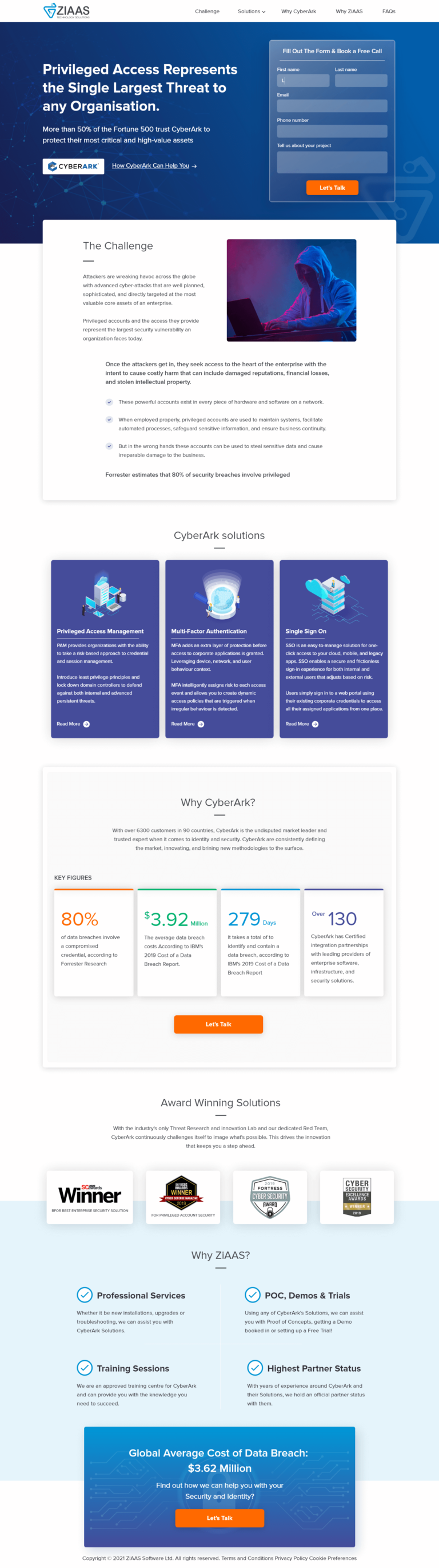
This page is built for ZIAAS (a CyberArk implementation partner) targeting enterprise security decision-makers evaluating privileged access management (PAM) solutions. The visitor arriving on this page already understands that privileged access is a risk area. The job of the page is to establish ZIAAS as the right partner to help them address it, and to get a qualified conversation started.
The dark blue gradient design creates an immediate visual association with enterprise security: authoritative, technical, and serious. This is not a product for SMBs. The visual register communicates enterprise from the first pixel.
The page structure is tight and purposeful. Hero with the core problem statement and a lead form. A challenge section that contextualises the threat. A solutions grid across three CyberArk product areas. A “Why CyberArk” section with cited statistics. Award badges. A “Why ZIAAS” section with four competency pillars. A final CTA section anchored by the $3.92M breach cost. Nothing is decorative.
Design decisions
Oversized typography
We used oversized typography in the hero headline (“Privileged Access Represents the Single Largest Threat to any Organisation”) because it needs to stop the visitor immediately. Enterprise security buyers move fast. A small headline in a sea of content gets skipped. This statement needs to be the first thing they read, and it needs to create recognition: “yes. This is exactly what I’m worried about.”
The gradient dark background
The gradient runs across the full page rather than just the hero. This creates a coherent visual environment that feels designed for purpose rather than assembled from templates. It also creates natural contrast for the accent statistics: the orange and amber numbers (80%, $3.92M, 279 days, 130+ integrations) stand out sharply against the dark field.
Stat callout boxes
We used stat callout boxes for the four key figures in the “Why CyberArk” section. Each statistic is given its own visual frame: the number large, the context below it, and a source citation. Unsourced statistics are ignored by enterprise buyers. Cited statistics from IBM and Forrester are accepted as credible because the visitor can verify them.
The award badge row
The row of cybersecurity industry awards performs an important function on a consulting partner page. It signals that CyberArk is not a niche solution but an industry-recognised market leader. For a decision-maker who needs to justify an investment to a board, “award-winning industry leader” is supporting evidence they can use internally.
The four-pillar ZIAAS competency grid
Professional Services, POC/Demos/Trials, Training Sessions, Highest Partner Status: the grid makes the partner relationship concrete. Visitors who know they need CyberArk but don’t know why to choose ZIAAS over another partner get a direct answer here.
The challenge section includes a specific Forrester statistic: 80% of security breaches involve compromised privileged credentials. Citing a recognisable research firm turns the risk framing from opinion to established fact. Enterprise buyers respond to cited research in a way they don't respond to vendor claims.
Trust architecture
Trust on an enterprise security page has three distinct requirements. The first is vendor credibility: CyberArk’s presence is established immediately with the logo in the hero. large companies trust CyberArk, and the page states this directly alongside the brand mark.
The second is partner credibility: ZIAAS’s status as a Highest Partner with CyberArk differentiates them from lower-tier resellers. The training and POC capabilities they list aren’t available from all partners. This creates a specific reason to choose ZIAAS over an alternative implementation firm.
The third is cost-of-inaction framing: the closing section anchors the conversation around the $3.92M global average cost of a data breach. This reframes the decision from “should we spend money on this?” to “can we afford not to?” For a security investment that may otherwise feel optional. This is the argument that opens budget approval conversations.

"The navigation on this page is functional: Challenge, Solutions, Why CyberArk, Why ZIAAS, FAQs. Enterprise visitors don't always scroll linearly. Some of them jump straight to 'Why ZIAAS' because they've already decided on CyberArk and are evaluating implementation partners. Keeping navigational anchors on a long enterprise page respects how these buyers actually move through content."
The "Let's Talk" CTA is softer than "Book a Demo" or "Get a Quote", and deliberately so. Enterprise security conversations don't start with a demo. They start with a discovery conversation where the partner understands the specific environment. "Let's Talk" signals a peer relationship, not a sales pitch, which reduces the perceived commitment barrier for a senior security leader.
Conversion strategy
The lead form sits in the top-right of the hero, collecting name, email, phone, and a project description field. The project description is key. It pre-qualifies the conversation and lets ZIAAS prepare for the call. An enterprise security buyer who writes “we have 200 privileged accounts across AWS and Azure and need a PAM solution” is handing the sales team a roadmap.
The CTA, “Let’s Talk”, repeats at the end of each major section. After the challenge context, after the solution overview, after the statistics, after the award badges. Each repetition catches visitors at a different stage of conviction without feeling repetitive because each surrounding context is different.
"Cybersecurity pages that lead with product features miss the enterprise buyer entirely. A CISO doesn't care about the feature list. They care about whether this solution will survive a board-level question about their security posture. This page is written to arm the buyer with the arguments they need to make internally, not just to explain what CyberArk does."
Platform: Unbounce
We chose Unbounce for ZIAAS because the client needed to run headline tests against different risk messaging without rebuilding the page. Unbounce’s A/B testing engine allowed parallel variants (one leading with the breach cost, one with the Forrester statistic) to run simultaneously on the same traffic.
Mobile experience
Enterprise security research is conducted on laptops and desktops more than most categories, but the mobile experience still needed to be clean. The dark gradient translates well to mobile screens. The statistics grid was restructured to a single-column layout on mobile while keeping the visual weight of each number. The lead form fields are sized for easy completion.
A full-page gradient achieved in CSS rather than a background image carries zero performance cost. We deliberately chose CSS gradient over photography for the background, keeping the visual weight on the page from images entirely in the product icons and badge graphics, all of which were were optimised SVGs.
What we’d evolve
Three iterations that would sharpen this page further:
Named customer references
The page states “over 6,300 customers in 90 countries” but doesn’t name any. Adding two or three recognisable brand names with a “trusted by” lead-in would significantly increase credibility for a visitor who doesn’t know ZIAAS yet.
Case study micro-section
A three-line summary of a specific enterprise deployment (“Financial services firm reduced privileged account risk by X% in 90 days”) would convert more visitors than the current statistics section alone. Outcome specificity beats generalised proof.
FAQ expansion
The existing FAQ covers generic CyberArk questions. A version that addresses the ZIAAS relationship specifically (“How is ZIAAS different from buying CyberArk directly?”) would reduce a key objection that enterprise buyers face when evaluating partner-led implementations.
"The closing section ('Global Average Cost of a Data Breach: $3.92 Million') is the most important piece of copy on the whole page. It doesn't ask anything of the visitor. It just puts a number in their head that makes every other conversation about security budget feel small by comparison. Finishing with the cost of inaction rather than the cost of the product is a strategy I'd apply to every enterprise security page we build."
Browse our full collection of landing page examples to see how these principles apply across industries. For the theory behind B2B enterprise pages, read our guide to B2B Landing Page Examples.
Waseem founded Apexure in 2015 and has led its work on 3,000+ pages for 300+ clients since. He writes about what the team sees after the click, which is pages, forms, tracking and the systems behind them.
What the page leans on
The principles at work on this page, each named in the analysis above.
Authority bias
People trust credible experts. Certifications, awards, media mentions, and expert endorsements boost credibility.
Loss aversion
People feel losses more strongly than gains. Framing around what they will miss motivates action.
Social proof
People follow the actions of others. Testimonials, reviews, and client logos build trust and reduce hesitation.
Visual hierarchy
Controlling what visitors see first, second, and third guides them toward the conversion goal.
What people ask about pages like this
The most effective cybersecurity pages use real data rather than vague threats. The ZIAAS/CyberArk page cites a Forrester Research figure (80% of data breaches involve privileged accounts) which anchors the risk in verified third-party research. This is credibility-backed urgency. 'You could be hacked' is ignored. 'Forrester says 80% of breaches start here, and here is how to close that gap' creates a specific, actionable reason to talk today.
This is a consulting partner page, not a vendor page. The visitor arrives needing implementation expertise, not product licensing. ZIAAS communicates their value through their status as a Highest Partner with CyberArk, meaning they can provide POC, demos, trials, and training in a way a direct CyberArk sales rep cannot. The page correctly positions the human expert relationship as the differentiator.
Enterprise security decision-makers (CISOs, security architects, IT directors) need to see three things before they'll book a call: credible vendor alignment (CyberArk is the #1 privileged access solution), specific data that validates the risk (the $3.92M average breach cost), and proof that the implementation partner has been doing this successfully at scale. This page delivers all three in a single scroll.
The $3.92M figure is the cost anchor. It reframes the conversation from 'cost of a CyberArk implementation' to 'cost of not implementing.' When the alternative to a security investment is a $3.92M breach, the conversation becomes very different. Closing a security page with a cost-of-inaction anchor is one of the most effective ways to create urgency without manufactured pressure.
Three more, taken apart the same way

Want one like this?
Tell us what the page has to do and where the traffic comes from. Within 48 hours you get a written quote from the people who wrote this breakdown. Already have a page that is not converting? Send it for a free audit instead.
UK hours, which is the East Coast morning.
"Enterprise security is one of the few verticals where leading with a threat isn't manipulative. It's accurate. The challenge section on this page doesn't manufacture fear; it accurately describes a real threat environment. The question is whether your audience recognises it as their situation. For a CISO reading 'attackers target privileged accounts at the most critical assets of an enterprise,' the answer is yes, every time."