
Revenue charts by industry instead of testimonials.
SmallBiz Triage's lead page for a 45-minute Mailchimp triage session, built on Unbounce for e-commerce owners burned by consultants before. Why the hero is red, how the $12,000 to $54,000 case charts work, and the quiz we would test.
- Primary CTASchedule Your Mailchimp Triage Sessionthe button the page is built around
- GoalLead Generationwhat counts as a conversion
- PlatformUnbouncelead generation page
- Built forB2BMarketing Agency
- The page as built, not a mockup.Analysed by Apexure, not by SmallBiz Triage.
- Client
- SmallBiz TriageMarketing Agency
- Industry
- Marketing Agency25 examples
- Audience
- B2BLead Generation
- Platform
- Unbounce132 examples
- Page type
- Lead generationLead Generation
- Analysed by
- Waseem BashirMarch 2026
What the page does, and why
Why we built this marketing agency lead generation
Mailchimp sits in a huge number of small businesses. Most of them are not extracting meaningful ROI from it. They set it up, ran a few campaigns, got mediocre open rates, and mentally filed email marketing as “a thing we do” rather than “a revenue channel.” SmallBiz Triage was built for exactly that business owner, the one who knows they have Mailchimp but doesn’t know why it isn’t generating what it should.
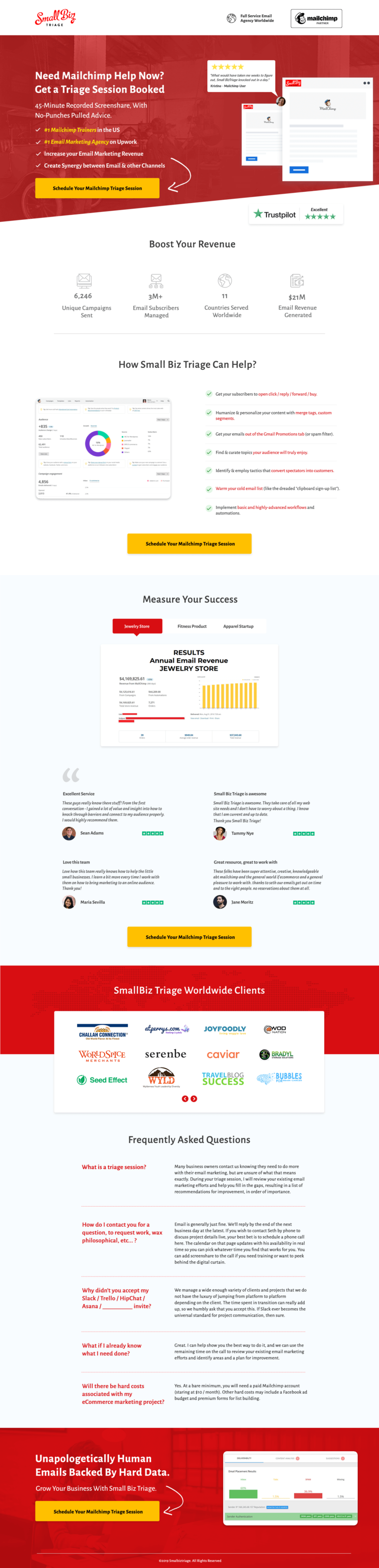
The conversion challenge was credibility and specificity. “Email marketing consultant” is a commodity category crowded with people who took a Mailchimp course and hung out a shingle. SmallBiz Triage’s differentiators were specific: #1 Mailchimp Trainer in the US, #1 Email Marketing Agency on Upwork, 6,246 unique campaigns sent, 5M+ email subscribers managed, $21M in email revenue generated across clients. The page needed to lead with those numbers, not bury them.
The audience, small business owners using Mailchimp for e-commerce, is sceptical of marketing consultants specifically because they’ve been burned before. They’ve paid for services that produced reports instead of results. The “triage session” framing was designed to position this service as definitively different: not a retainer, not a strategy deck, but a 45-minute recorded screenshare that produces an actionable fix list and walks them through implementing it.
Design decisions
The headline uses pain-first framing with a specific deliverable:
“Need Mailchimp Help Now? Get a Triage Session Booked. 45-Minute Recorded Screenshare. With No-Punches Pulled Advice.” This headline does several things simultaneously. It asks a qualifying question (“need Mailchimp help?”) that filters for the right visitor. It names the exact deliverable (45-minute recorded screenshare). It promises an approach (no punches pulled advice) that differentiates from polite consulting. Every sentence is doing active conversion work.
The four qualifier checklist
in the hero subhead, #1 Mailchimp Trainer in the US, #1 Email Marketing Agency on Upwork, “Increase your Email Marketing Revenue,” “Create Synergy between Email & other Channels”, uses authority badges first, outcome claims second. This ordering is important: authority badges (platform rankings) are verifiable by the visitor. Outcome claims are not. Leading with verifiable credentials makes the outcome claims more believable than they would be as standalone statements.
The stats bar
6,246 Unique Campaigns Sent, 5M+ Email Subscribers Managed, 11 Countries Served Worldwide, $21M Email Revenue Generated, appears directly below the hero CTA. We chose this placement because stats below a CTA work differently than stats below a headline. Visitors who’ve just absorbed the offer and are considering clicking see the stats as validation at the exact decision moment. Stats before the CTA inform; stats after the CTA confirm.
The vertical case study tab system
Jewelry Store, Fitness Product, Apparel Startup, with revenue bar charts for each is the most differentiated element on the page. Most consultant pages show testimonials. This page shows annual email revenue, before and after triage, for specific industry categories. The Jewelry Store shows from $12,000 to $54,000. The Fitness Product shows a similar trajectory. Each chart is a specific financial proof that the target audience, small e-commerce business owners, can immediately benchmark against their own situation.
The FAQ section
at the bottom answers not just product questions but process questions that reveal the consultant’s working style. “Why didn’t you accept my Slack / Trello / ClickUp / Monday / Asana / HubSpot invite?” is a real question with a direct answer: “Email is the universal standard for project communication.” That transparency about how the business operates builds trust through frankness, not polish. Visitors who see honest, direct answers to operational questions trust the advice they’ll receive more than visitors who read carefully crafted marketing copy.
Trust architecture
Layer 1: Platform-validated authority
The Mailchimp partnership badge in the header alongside “Full Service Email Agency Worldwide” signals official platform recognition before any claim is made. Mailchimp doesn’t partner with consultants who can’t demonstrate client results, the badge itself implies vetting. Combined with the Trustpilot “Excellent” rating below the hero CTA, the visitor sees two independent third-party validations before they’ve read any persuasion copy.
Layer 2: Revenue-denominated proof
The case study charts with specific dollar figures, not “client saw 4x revenue growth” but “$54,000 annual email revenue after triage”, are the most credible form of proof available for a marketing consultant. Dollar amounts are falsifiable, specific, and directly relevant to a business owner’s decision calculus. When proof is expressed in the same units as the prospect’s goals, trust and conversion both increase.
Layer 3: Worldwide client social proof
The client logo strip, Challan Connection, dparray.com, JoyFoodly, WGO, WorldSpace, Serenbe, Caviar, Bradyl, Seed Effect, Wild, Travel Blog Success and Bubbles, is geographically and industry diverse. That diversity signals broad capability rather than a narrow specialty. For a service marketed as the “#1 worldwide,” logos from recognisable US brands in multiple verticals validate the global claim.

"The Trustpilot 'Excellent' badge on this page is carrying weight specifically because it appears next to a specific star rating from a named platform. Any consultant can put a five-star rating on their website. A Trustpilot 'Excellent' badge is independently audited and links to a real review page the visitor can move through to and read. That verifiability makes it worth three times any self-reported rating in terms of conversion impact."
What we would test today
Our work with marketing consultants and agency lead generation pages since this build points to three specific evolutions:
Test 1: A mailchimp account health check quiz above the CTA
A five-question interactive quiz, “Do you have an abandoned cart automation running? Is your list segmented by purchase history? Have you cleaned inactive subscribers in the last 6 months?”, that outputs a “Mailchimp health score” would convert visitors who aren’t yet sure they need a triage session into qualified leads with a specific diagnosis. The quiz is a micro-commitment device: visitors who complete it have invested five decisions, which makes them significantly more likely to book the triage session to act on the results. High impact.
Test 2: A revenue calculator in the case study section
Under each case study, a simple input, “Enter your current annual email revenue”, outputting “Based on similar clients, after triage your email revenue potential is $X” would personalise the case study proof. A Jewelry Store owner who enters $10,000 current revenue seeing a projected $45,000 after triage is experiencing the ROI argument as personal, not illustrative. Medium-high impact.
Test 3: Recorded call excerpt in the hero
A 60-second audio or video clip of the triage session experience, the consultant looking at a real Mailchimp account (identifying a specific issue, and explaining the fix) would demonstrate the “no punches pulled advice” promise in concrete terms. For a service built on directness and expertise, showing rather than claiming that approach is significantly more persuasive. Medium impact, but it fills the specific gap of “what does this actually feel like?”
"The tagline 'Unapologetically Human Emails Backed By Hard Data' at the footer CTA section is doing brand and conversion work simultaneously. 'Unapologetically Human' differentiates from automation-first competitors. 'Backed By Hard Data' reassures the analytics-minded business owner that this isn't just warm copywriting advice. Two opposing ideas in one sentence, and the tension between them is exactly the positioning that makes SmallBiz Triage memorable in a category full of identical-sounding consultants."
Need a B2B service page that makes complex expertise feel immediately concrete and worth booking? Talk to our team.
Waseem founded Apexure in 2015 and has led its work on 3,000+ pages for 300+ clients since. He writes about what the team sees after the click, which is pages, forms, tracking and the systems behind them.
What the page leans on
The principles at work on this page, each named in the analysis above.
Anchoring effect
The first piece of information shapes all subsequent judgements. Price comparisons and headline stats set expectations.
Authority bias
People trust credible experts. Certifications, awards, media mentions, and expert endorsements boost credibility.
Social proof
People follow the actions of others. Testimonials, reviews, and client logos build trust and reduce hesitation.
Processing fluency
This principle influences visitor behaviour and supports the page's conversion goal.
Von restorff effect
This principle influences visitor behaviour and supports the page's conversion goal.
What people ask about pages like this
Mailchimp tutorials teach you what the features are. A consultant shows you which features to use in what sequence to produce revenue. Most e-commerce businesses have Mailchimp set up but not optimised, they're sending campaigns without segmentation, running automations that don't convert, and missing the open-click-buy chain that turns subscribers into repeat customers. A triage session identifies the specific gaps in their current setup and produces a prioritised fix list with expected revenue impact for each item. That's qualitatively different from watching a tutorial.
Triage implies urgency and diagnosis, the exact frame a small business owner needs when their email marketing isn't generating revenue. 'Consultation' sounds like a meeting where someone asks questions. 'Triage' sounds like someone identifying exactly what's wrong and telling you precisely how to fix it. For business owners under revenue pressure, the triage framing converts better because it promises a concrete deliverable: a prioritised list of issues and fixes, not a general conversation about marketing strategy.
Revenue charts showing before-and-after annual email revenue by client type, jewelry store, fitness product, apparel startup, let the visitor do their own extrapolation. A jewelry store owner seeing the jewelry store case study thinks 'that's my situation' before they read a word of copy. The chart shows real numbers: from $12,000 to $54,000 annual email revenue after triage. That specific, industry-matched, revenue-denominated proof is what separates serious marketing consultants from people with Mailchimp accounts who call themselves experts.
In our experience building email marketing pages and working with Mailchimp-focused consultants, the highest-ROI fixes are almost always: abandoned cart automations that aren't set up or are firing at the wrong intervals, welcome sequences that deliver value before asking for purchases, and segmentation that prevents the entire list from receiving every campaign. The fourth is deliverability, most small e-commerce lists have significant cold or invalid subscribers dragging down open rates and increasing spam complaints. Each of these can be diagnosed in a single triage session.
Three more, taken apart the same way



Want one like this?
Tell us what the page has to do and where the traffic comes from. Within 48 hours you get a written quote from the people who wrote this breakdown. Already have a page that is not converting? Send it for a free audit instead.
UK hours, which is the East Coast morning.
"The red hero on this page is a deliberate Von Restorff move. Every other email marketing consultant page on the internet uses white or navy or grey. We went red because SmallBiz Triage needed to feel different the moment you arrived. The colour psychology is secondary, the primary function is differentiation through contrast. When you're the only red page in a category of white pages. You get remembered. For a service sold on personality and directness, that distinctiveness is brand-aligned."