
45 sounds free, 153 for $1.99 a month.
Sleep Sounds' upgrade page for its premium Alexa skill, built on Unbounce for Echo owners on the free version. How named sounds and a no-questions-asked guarantee make the case, and the audio preview we would test.
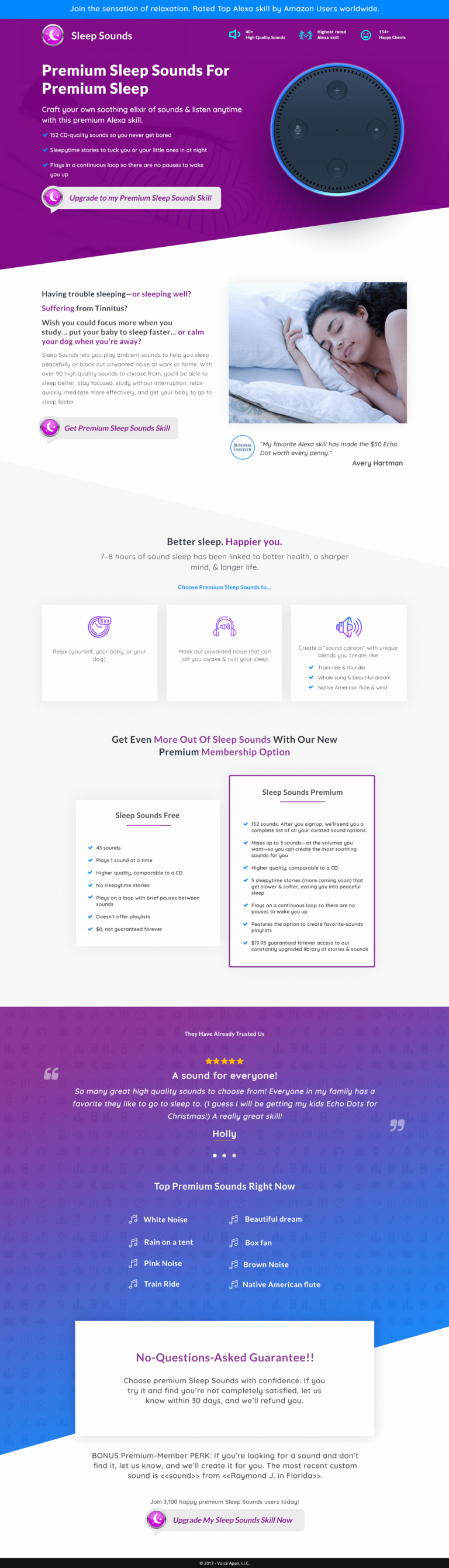
- Primary CTAUpgrade to My Premium Sleep Sounds Skillthe button the page is built around
- GoalApp Upgrade / Subscriptionwhat counts as a conversion
- PlatformUnbounceclick-through page
- Built forB2CE-Commerce
- The page as built, not a mockup.Analysed by Apexure, not by Sleep Sounds.
- Client
- Sleep SoundsE-Commerce
- Industry
- E-Commerce21 examples
- Audience
- B2CApp Upgrade / Subscription
- Platform
- Unbounce132 examples
- Page type
- Click-throughApp Upgrade / Subscription
- Analysed by
- Waseem BashirMarch 2026
What the page does, and why
Why we built this e-commerce click-through
Alexa skill upgrades are a specific and underexplored e-commerce conversion challenge. The user has already found the free version. They use it regularly enough to have received the upgrade prompt, and they’re genuinely interested in sleeping better. They’re not sceptical of the product category. They’ve already validated it through personal use. The conversion barrier is the classic upgrade psychology: “I’m already getting value from the free version, why pay for more?”
The answer needs to be specific. “More features” doesn’t work as an upgrade argument for someone already satisfied with the free tier. The page needed to make the free-to-premium gap feel like a genuine quality difference, not just feature gating. Sleep Sounds’ premium tier offered things the free tier structurally couldn’t: a continuous loop, higher audio quality, personalised sound creation, sleepytime stories, 153 sounds instead of 45. Each of those is a different experience, not just more of the same one.
We also had to work within the context of an Amazon Echo product. The audience already has the device in their bedroom. They’re already using voice commands before sleep. The upgrade page needed to meet them where they are (in bed, with their Echo on the nightstand) and show them a version of that experience that’s measurably better.
Design decisions
The hero leads with the audience-specific pain problem: not the product
“Having trouble sleeping, or sleeping well?” followed by three specific use cases (focused work, putting the baby to sleep, calming a dog) expands the audience beyond insomniacs to anyone who uses sound for relaxation or focus. This expansion is strategic: the free-tier user who got the skill for sleep might upgrade it for focus meditation or baby routine use cases they hadn’t considered. Each use case named is a new conversion reason.
The Amazon Echo photography anchors the product in the bedroom context
The photo places the product where it’s actually used. A photo of an Echo on a bedside table, next to a glass of water, with soft lighting: that context is more persuasive than a product shot on a white background because it places the experience in the visitor’s own life. We positioned the Echo device image prominently in the hero alongside the headline because the device itself is the trust signal: visitors who own an Echo recognise their own device and feel immediate product relevance.
The free vs premium comparison table
The table separates the two tiers with specific feature counts and named features rather than abstract categories. Free: 45 sounds, one at a time, no sleepytime stories, no loops. Premium: 153 sounds, continuous loop, sleepytime stories, custom sounds, mix and match. Every line item creates a specific gap the free-tier user may have already experienced as a limitation. The “$1.99 guaranteed forever” line at the bottom of the premium column uses anchoring: against the perceived value of 153 sounds and custom creation, $1.99 feels almost absurdly inexpensive.
The sound library preview grid
The grid lists actual sound names (White Noise, Rain on a Tent, Pink Noise, Box Fan, Brown Noise, Train Ride, Native American Flute) and converts through specificity. Visitors who have a preferred sound type immediately find their answer: “do they have the specific thing I want?” Listing generic category names (“nature sounds,” “ambient sounds”) forces the visitor to imagine and hope. Listing actual titles gives them certainty before they pay.
The “No-Questions-Asked Guarantee” section
The section sits above the fold on a purple-accented block that visually separates it from the feature content. The prominent placement is intentional: a money-back guarantee this visible says something specific about confidence in the product. Guarantees buried in fine print read as legal formality. A guarantee in a prominent section reads as genuine commitment. For a $1.99/month subscription, this removes the last conversion friction entirely.
Trust architecture
Layer 1: instant credibility
The hero carries “Rated Top Alexa Skill by Amazon Users Worldwide” in a notification banner at the top of the page, alongside two numeric stats: “Highest Rated Alexa Skill” and “220+ Happy Clients.” The Amazon rating positions this as platform-verified quality, not just self-reported. For users who found the skill through Amazon’s recommendation engine, this confirms they’re in the right place.
Layer 2: single testimonial with full attribution
The mid-page testimonial (“My favorite Alexa skill has made the $50 Echo dot worth every penny” from Avery Hartman) does specific conversion work. It resolves the implicit value calculation (“is the Echo hardware cost justified?”) while validating the skill quality. The dollar figure mentioned makes the testimonial feel real rather than editorial.
Layer 3: satisfaction and refund guarantee
The explicit 30-day money-back guarantee removes the residual “what if I don’t like it?” objection at the point of purchase. For a digital subscription at $1.99/month, the guarantee also signals confidence. A product team willing to give unconditional refunds believes strongly in their retention rate. That signal converts the final undecided segment.

"The '30-second' framing for feature experience descriptions is a micro-copywriting technique that reduces perceived effort. 'Mix up to 5 sounds together' requires the visitor to imagine the process. '30 seconds to create your perfect sound mix' tells them it's easy before they've tried it. Time estimates in feature descriptions consistently reduce the activation energy for trialling a feature, which matters enormously for subscription upgrades where the upgrade decision correlates with the visitor's belief that they'll actually use the premium features."
What we would test today
Since this build, our data from app upgrade and digital subscription pages has identified three specific improvements:
Test 1: an audio preview button
The single most obvious evolution for an audio product page is letting visitors hear the difference. A button that plays a 15-second sample of a premium sound (Rain on a Tent, Brown Noise) would reduce the abstraction of “higher quality audio” into a direct sensory experience. Visitors who hear the quality difference before paying have no remaining uncertainty about the value proposition. High impact: we’ve seen audio previews on music and meditation app pages increase upgrade rates by 25-40%.
Test 2: sleep stats or usage metrics in the hero
“Join 2.3 million people who fall asleep with Sleep Sounds” uses social proof at scale. The current page shows “220+ Happy Clients” which feels modest for a top-rated Alexa skill. Surfacing a usage volume figure (even daily active users or total sessions) in the hero would anchor the visitor’s perception of popularity and validate their existing use as part of something larger. Medium-high impact.
Test 3: a personalisation quiz leading to a recommended sound
A two-question quiz (“What do you mainly use Sleep Sounds for? (sleep / focus / baby / pets)” and “What’s your preferred sound style? (nature / white noise / music)”) outputting a specific recommended sound from the premium library would create a personalised upgrade reason. “Based on your answers, we recommend Thunderstorm Deluxe. It’s only available in the premium library” converts through specificity and personal relevance at a different level than generic upgrade copy.
"The bonus custom sound offer ('if you're looking for a sound and don't find it, let us know, we'll create it for you') is the highest-ROI line on the entire page. It makes the premium tier feel personal rather than packaged. For a product where the visitor's specific sound preference is everything, 'we'll make your sound' is an offer that no other sleep skill can match. Small copy, enormous differentiation."
Need an app or subscription upgrade page that converts existing users into paying customers? Talk to our team.
Waseem founded Apexure in 2015 and has led its work on 3,000+ pages for 300+ clients since. He writes about what the team sees after the click, which is pages, forms, tracking and the systems behind them.
What the page leans on
The principles at work on this page, each named in the analysis above.
Anchoring effect
The first piece of information shapes all subsequent judgements. Price comparisons and headline stats set expectations.
Loss aversion
People feel losses more strongly than gains. Framing around what they will miss motivates action.
Endowment effect
This principle influences visitor behaviour and supports the page's conversion goal.
Social proof
People follow the actions of others. Testimonials, reviews, and client logos build trust and reduce hesitation.
Paradox of choice
This principle influences visitor behaviour and supports the page's conversion goal.
What people ask about pages like this
Free app users who receive an upsell message inside the app are in usage mode. Their attention is on the experience, not a purchase decision. A dedicated landing page creates a deliberate upgrade context: here is exactly what you're getting, here is what changes, here is the guarantee. It also allows message matching from the specific upgrade CTA the user clicked, which dramatically improves the relevance of the page they land on. In-app upsell banners that link to skill store pages convert at 2-4%. Dedicated upgrade pages regularly hit 8-15% for engaged user bases.
Audio subscription upgrade pages live or die on the comparison table. The table needs to make three things immediately clear: free users are missing specific, named features (not vague 'advanced capabilities'); the premium features address real pain points that free users have probably already experienced; and the price-to-value ratio is defensible. For Sleep Sounds, we anchored the free tier with '45 sounds, one at a time, no sleepytime stories' against the premium tier's '153 sounds, continuous loops, sleepytime stories, custom sounds.' Every line item is a specific experience, not a feature category.
Digital product guarantees face a specific scepticism: 'you'll make me jump through hoops to get my refund.' The 'no questions asked' framing directly addresses that scepticism. It also removes the primary objection to trying: 'what if I don't like it?' When the risk of trying is genuinely zero, the decision calculation changes from 'should I spend $1.99?' to 'why wouldn't I try this?' For low-price subscriptions, a generous guarantee typically costs almost nothing in actual refunds while converting significantly more trials.
When the core product is an experience you can't demo on a static page, the best approach is specificity about what that experience includes. Listing the actual sound names (White Noise, Rain on a Tent, Pink Noise, Box Fan, Brown Noise, Train Ride, Native American Flute) does more conversion work than describing 'high quality ambient sounds.' Visitors who recognise a specific sound they've found helpful before immediately see their reason to upgrade. The specificity also signals that the library is hand-picked rather than generic, which justifies the premium over free alternatives.
Three more, taken apart the same way


Want one like this?
Tell us what the page has to do and where the traffic comes from. Within 48 hours you get a written quote from the people who wrote this breakdown. Already have a page that is not converting? Send it for a free audit instead.
UK hours, which is the East Coast morning.
"The CTA copy ('Upgrade to My Premium Sleep Sounds Skill') uses possessive language deliberately. 'My' creates endowment before the purchase happens. The visitor is mentally taking ownership of the premium version before they've paid for it. That's the endowment effect applied to a CTA, and we see it outperform 'Get Premium' or 'Upgrade Now' consistently on subscription upgrade pages because it makes the product feel already theirs."