
A booking widget where the headline usually goes.
ShutGo's airport parking comparison page, built in Unbounce for UK travellers already in decision mode. How four reassurance icons, airport photos and partner logos back the search form, and the review count it lacks.
- Primary CTABook Nowthe button the page is built around
- GoalLead Generationwhat counts as a conversion
- PlatformUnbouncelead generation page
- Built forB2CTravel
- The page as built, not a mockup.Analysed by Apexure, not by ShutGo.
- Client
- ShutGoTravel
- Industry
- Travel3 examples
- Audience
- B2CLead Generation
- Platform
- Unbounce132 examples
- Page type
- Lead generationLead Generation
- Analysed by
- Waseem BashirMarch 2026
What the page does, and why
Why we built this travel lead generation
Airport parking is a commodity-adjacent category: most travellers assume all car parks are roughly equivalent and therefore shop on price. ShutGo’s value proposition is comparison, they aggregate 200+ parking providers across 28 UK airports and guarantee the best price. That’s a strong offer, but it requires visitors to understand that ShutGo is the starting point for finding the best deal, not just another parking provider competing on price.
The conversion problem was positioning. Visitors arriving from paid search for “airport parking” have a specific mental model: click, compare options, book the cheapest. ShutGo needed to intercept that journey before the visitor went to a direct provider and communicate: “Start here, and you’ll always pay less.” The page had to establish platform authority first, then make the search tool the natural next action.
We also had to address the practical anxiety of airport parking specifically. This isn’t a casual purchase, travellers are calculating parking costs against their travel budget, worrying about getting back to their car on time, and wondering about security. The page needed to surface the “parking space guaranteed,” “lowest price guaranteed,” “highly trusted car park,” and “24/7 customer support” signals before the visitor committed to a search.
Design decisions
The booking widget is the hero
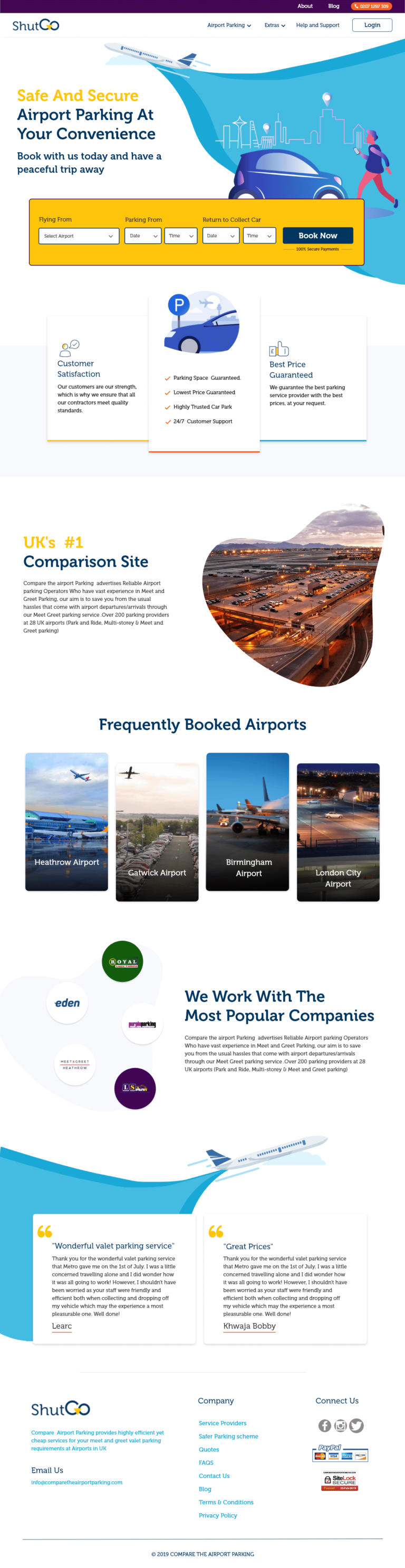
Most landing pages have a hero image or headline as the visual centrepiece, with a CTA below. ShutGo’s hero reverses this: the search form, Airport, Parking From (date/time), Return to Collect Car (date/time), Book Now, is the dominant hero element. This design decision shows a key insight about this visitor’s intent level: anyone searching for airport parking is already in decision mode. They don’t need to be convinced to want parking. They need a frictionless path to comparing prices. The widget placed directly in the hero serves that intent immediately.
The four-column icon strip below the hero
addresses the four most common anxiety points: parking space guaranteed, lowest price guaranteed, highly trusted car park, and 24/7 customer support. These four claims are specifically chosen to match the four questions a first-time user of a parking comparison platform asks before they trust it with their trip details. We formatted these as icons rather than text blocks because they need to be absorbed in a single scan, not read in sequence.
The airport gallery section
With photographic thumbnails of Heathrow, Gatwick, Birmingham, and London City, transforms an abstract “28 UK airports” claim into a visual confirmation that your specific airport is covered. Most visitors have one airport in mind. Seeing it named and photographed triggers a moment of recognition that functions as micro-personalisation at zero technical cost. We chose photography that shows the terminal exterior rather than car parks, because terminal photography triggers the emotional association with the travel experience.
The “UK’s #1 Comparison Site” section
uses the claim “Over 200 parking providers at 28 UK airports” alongside the “UK’s #1” positioning, which does something specific: it makes the claim testable. Any visitor who doubts the “#1” claim can verify the provider count independently. That testability makes the claim more credible than an unverifiable “#1” badge.
The partner logo strips
Hotel chains, airlines, travel brands, appear mid-page. These aren’t just brand recognition logos. They signal that companies with formal procurement processes and legal liability have chosen to recommend or partner with ShutGo. For a service where visitors are trusting a third party with their travel plans, that institutional endorsement carries specific weight that consumer testimonials alone cannot.
Trust architecture
Layer 1: Instant credibility
The hero carries “Safe & Secure Airport Parking” as the headline alongside the “SAVE Secure Payments” badge on the booking widget. These two signals together address the primary anxiety of an online parking booking: will my car actually be secure, and is my payment safe? Both questions answered in the same visual zone as the action element.
Layer 2: Volume and longevity
The “UK’s #1 Comparison Site” section with the stat “over 200 parking providers” signals scale. Scale is a specific trust signal for comparison platforms, a comparison platform with 5 providers is not meaningfully better than just going direct. 200+ providers means genuine price competition and genuine coverage. That scale claim converts sceptical visitors who worry the “comparison” is a front for a single preferred provider.
Layer 3: Peer validation near the footer
The two testimonials, from “Learc” and “Khwaja Bobby”, both mention specific staff names and describe specific experiences. The detail level matters: “Your staff were friendly and efficient both when collecting and dropping off my vehicle” is specific enough to be believable. We avoided generic “great service” quotes because they carry no weight with travel consumers who have seen thousands of them.

"Airport parking comparison pages have a specific secondary anxiety that most designs miss: 'what if I can't find my car when I come back at 2am?' The 24/7 customer support icon in the below-hero strip is there specifically for that person, the one who's worried about the edge cases. You don't need to write three paragraphs about it. An icon with four words does the job."
What we would test today
Our data from travel and booking pages since this build points to three meaningful improvements:
Test 1: Real-time pricing preview in the hero widget
Rather than requiring the visitor to complete the full search before seeing any prices, a active price indicator in the widget area, “Heathrow parking from £5/day”, would give immediate value before form completion. This is the reciprocity principle: give something useful before asking for commitment. Visitors who see a compelling price in the widget area have already begun mentally comparing it to alternatives, which creates investment in completing the search. High impact.
Test 2: A “most popular airports” quick-select below the widget
Visitors who land without a specific airport in mind, or who want to see prices across multiple airports for a trip decision, currently have to manually search each one. A row of airport quick-select buttons, “Heathrow · Gatwick · Birmingham · Manchester”, would reduce the widget completion effort for the majority of visitors. Medium impact, but particularly valuable for mobile users where typing an airport name has measurable friction.
Test 3: Customer review count in the hero area
The current page doesn’t show a review count or aggregate rating above the fold. Adding “Rated 4.8/5 by 3,200 travellers” near the widget CTA would provide the consumer validation signal that corporate partner logos cannot. Travellers trust other travellers for service quality. A specific review count makes the platform feel widely used and reliably reviewed before the visitor has invested any effort in the search. High impact for first-time visitors who are evaluating whether to trust the platform.
"One thing we consistently see on comparison platform pages is that visitors who interact with the search widget, even without completing it, are far more likely to return and convert than visitors who didn't. The widget is a micro-commitment device as much as a functional search tool. Getting the visitor to start entering their airport name means they're already invested in completing the search. That's why the widget placement is non-negotiable at the top of the page."
Building a travel comparison page that converts intent into bookings? Talk to our team.
Waseem founded Apexure in 2015 and has led its work on 3,000+ pages for 300+ clients since. He writes about what the team sees after the click, which is pages, forms, tracking and the systems behind them.
What the page leans on
The principles at work on this page, each named in the analysis above.
Processing fluency
This principle influences visitor behaviour and supports the page's conversion goal.
Social proof
People follow the actions of others. Testimonials, reviews, and client logos build trust and reduce hesitation.
Anchoring effect
The first piece of information shapes all subsequent judgements. Price comparisons and headline stats set expectations.
Mere exposure
This principle influences visitor behaviour and supports the page's conversion goal.
Authority bias
People trust credible experts. Certifications, awards, media mentions, and expert endorsements boost credibility.
What people ask about pages like this
Aggregator listings put ShutGo in a row with 15 competitors at the point of comparison. A dedicated landing page lets us make the case for using ShutGo as the starting point, UK's number one comparison site, 200+ providers, best price guaranteed, before the visitor goes anywhere. Visitors who arrive at the comparison stage already sold on ShutGo convert at 3-4x the rate of cold aggregator traffic because they've already chosen the platform, not just the parking.
The most common conversion killer on travel booking pages is the multi-step search widget requiring too many fields upfront. Airport selection, departure date, return date, and departure time are the minimum needed to produce results, but adding flight number, terminal, or vehicle type before showing any prices creates enough friction to lose the visitor before they see value. We set the widget to require only the essential fields for an initial quote, with optional fields available after the visitor is already engaged with results.
Partner logos from recognisable travel brands, airlines, hotels, travel agencies, are a specific type of social proof that's particularly powerful in travel: institutional trust transfer. If British Airways or a major hotel chain has partnered with or recommended ShutGo, the visitor's risk calculation changes. It's not just other consumers who trust this service, it's regulated, professional travel companies with liability reasons to choose reliable partners. That signal reduces the 'is this legitimate?' anxiety that new travel platforms always face.
Showing all covered airports can overwhelm visitors who have a specific airport in mind. Showing too few suggests limited coverage. We solved this by featuring the four highest-traffic UK airports, Heathrow, Gatwick, Birmingham, London City, in a visual gallery, paired with the '200+ parking providers across 28 UK airports' stat. The visual gallery creates instant relevance for the most common visitor segments while the stat communicates platform breadth for visitors whose airport isn't featured.
Three more, taken apart the same way



Want one like this?
Tell us what the page has to do and where the traffic comes from. Within 48 hours you get a written quote from the people who wrote this breakdown. Already have a page that is not converting? Send it for a free audit instead.
UK hours, which is the East Coast morning.
"The booking search widget in the hero is the conversion event on this page, not the CTA button. Everything else exists to give the visitor enough confidence to enter their dates and hit 'Book Now.' That means the design logic works backwards from the widget: what does someone need to believe before they'll enter their airport, dates, and click search? Answer that, and you've designed the page."