
Explains tokenised shares before asking for the click.
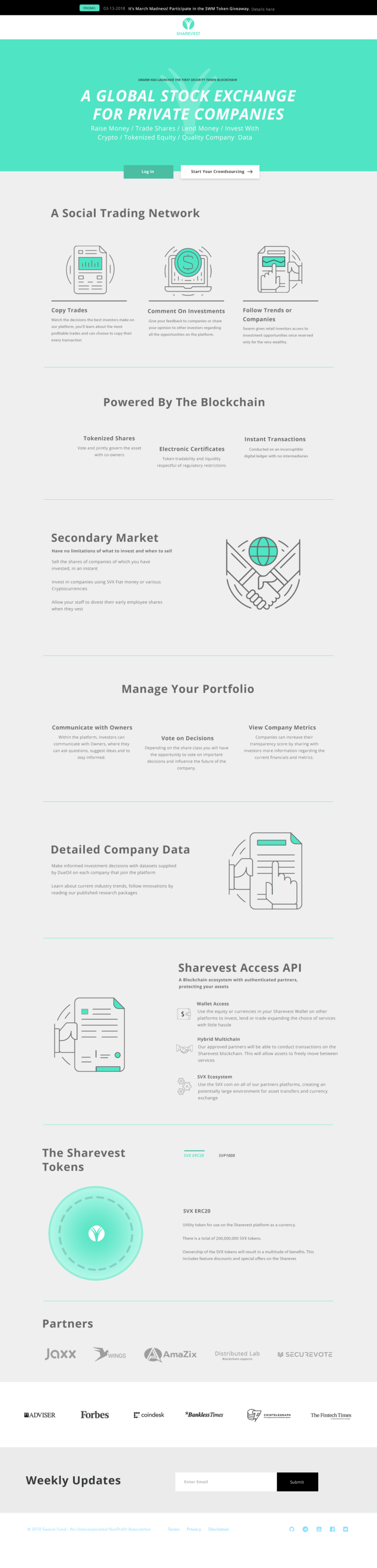
Sharevest's click-through page for a blockchain exchange in private company shares, built on Unbounce for crypto-aware investors. The rotating headline, the press logos, and the regulatory badge we would test.
- Primary CTAStart Your Crowdfundingthe button the page is built around
- GoalClick-Throughwhat counts as a conversion
- PlatformUnbounceclick-through page
- Built forB2CFinance
- The page as built, not a mockup.Analysed by Apexure, not by Sharevest.
- Client
- SharevestFinance
- Industry
- Finance32 examples
- Audience
- B2CClick-Through
- Platform
- Unbounce132 examples
- Page type
- Click-throughClick-Through
- Analysed by
- Waseem BashirMarch 2026
What the page does, and why
Why we built this finance Click-Through
Private company investment has traditionally been locked behind accreditation requirements, minimum investment thresholds, and the kind of institutional access most individuals never get near. Sharevest was building a platform to change that, a global stock exchange for private companies, powered by blockchain tokenisation. The product was genuinely novel. That novelty was both the strongest selling point and the biggest conversion challenge.
The visitors landing on this page were a specific type: crypto-aware retail investors and early adopters who understood tokenisation conceptually but needed to see how it worked in practice for private company shares. They weren’t sceptical of blockchain. They were sceptical of this specific application of it. The conversion problem wasn’t explaining what the platform does. It was convincing a sophisticated audience that this particular implementation was credible, functional, and worth the attention of their investment capital.
We chose a feature-education architecture over a lead-capture-first design because the platform had too many novel concepts for a traditional above-the-fold CTA to convert effectively. Someone who has never thought about buying tokenised shares in a private company needs to understand the mechanism before they’re willing to click anything. The page needed to earn that click through education, not pressure the click before earning it.
Design decisions
The hero carries a rotating value proposition in the headline area
Rather than a single static headline, the hero rotates through the platform’s core use cases: “Raise Money / Trade Shares / Lend Money / Invest With Crypto.” This acknowledges that Sharevest serves multiple audiences, founders raising capital, investors buying shares, lenders, crypto holders, without committing the page to one positioning. The risk with rotating headlines is that visitors who land mid-rotation see incomplete messaging. We addressed this by keeping the rotating element to a secondary role, with the static primary headline “A Global Stock Exchange for Private Companies” always visible.
The dual CTA structure (“log in” / “start your crowdfunding”)
in the hero separates returning users from new visitors at the decision point. This matters for a platform in early growth: traffic comes from both existing users who have already converted and new visitors who haven’t. Sending both through the same CTA creates friction for the former and confusion for the latter. The dual CTA routes each group cleanly while keeping the primary “Start Your Crowdfunding” CTA visually dominant through colour and size contrast.
The feature grid organises value into four scannable buckets
: Social Trading, Blockchain Infrastructure, Secondary Market, and Portfolio Management. We specifically ordered these to mirror the investor’s decision journey, first they want to know what kind of actions they can take (social trading), then how the underlying technology works (blockchain), then what liquidity looks like (secondary market), then ongoing management. The grid structure allows investors with different priorities to find their entry point without linear reading.
The media logos strip at the bottom of the page includes Forbes
This placement is deliberate, it functions as a final credibility confirmation for visitors who’ve read through the full feature set and are now weighing the sign-up decision. By this point in the scroll. They’re not sceptical of the concept; they’re sceptical of this specific company. The media mentions answer that specific residual doubt: “multiple independent journalists investigated this and thought it was worth writing about.”
The weekly newsletter signup in the footer
adds a second conversion path for visitors who are interested but not ready to invest. This is the commitment-and-consistency principle applied to a long decision cycle: get the visitor to take a low-friction action (subscribe) so you can nurture them toward the higher-friction action (invest). Investment decisions rarely happen on the first visit, and a newsletter subscription captures visitors who are in research mode rather than decision mode.
Trust architecture
Layer 1: Instant credibility
The teal gradient hero with bold white typography creates a premium first impression that signals design investment, and design investment signals company investment. In fintech, where scam platforms are visually indistinguishable from legitimate ones to the untrained eye, professional design quality is a genuine trust signal. We combined this with the platform’s core claim in precise language: “global stock exchange for private companies.”
Layer 2: Technology partner validation
The partner logos (Jaxx, Wanchain, AmaZix, Distributed Lab, SecureVote) serve a specific trust function in blockchain. These are recognisable names in the ecosystem that have chosen to integrate with or endorse the platform. Partners with their own reputations to protect don’t associate publicly with fraudulent projects. For crypto-native visitors, this partner strip communicates more than any testimonial could.
Layer 3: Media coverage as independent validation
The Forbes, Financial Times, and Coindesk logos near the footer carry the weight of editorial review. These publications don’t accept payment for coverage, they wrote about Sharevest because their journalists judged it newsworthy. That independence is exactly what makes media logos powerful social proof for a novel investment product. Visitors who trust these publications extend some of that trust to the platform.

"Blockchain and crypto landing pages often make the mistake of overloading the hero with technical credentials, consensus mechanisms, token standards, security audits. That's important information, but it belongs mid-page after the value proposition has landed. Visitors need to understand why they should care before they'll engage with how it works. Lead with the investor's opportunity, follow with the technology that enables it."
What we would test today
The data we’ve accumulated from fintech and investment platform pages since this build suggests three evolution paths:
Test 1: A social proof counter in the hero
The current page lacks a user count or assets-under-management figure. Adding something specific, “Join 12,000+ investors trading private company shares”, near the hero CTA would provide the social validation signal that’s missing. Investment platforms with visible user counts convert at meaningfully higher rates because the number answers “is anyone else doing this?” Investment decisions feel safer with company.
Test 2: A single animated demo of the trading interface
The current page explains features through icons and text. A short looping animation showing the actual portfolio interface (chart moving, a trade executing, a balance updating) would make the platform feel real rather than theoretical. For a product with no physical equivalent, a product demo is the closest thing to a test drive. Medium-high impact because visual product demonstrations reduce the abstraction barrier that holds back investment-platform sign-ups.
Test 3: Regulatory compliance badge in the hero
The page currently doesn’t address regulatory status above the fold. For any investment platform, the question “is this regulated?” sits in the back of every prospect’s mind. A “Regulated by [relevant authority]” or “Compliant with [framework]” badge near the hero CTA would address this before it becomes an objection. High impact specifically for traditional investors who are blockchain-curious but need regulatory assurance before they’ll consider it.
"The secondary market section is doing more conversion work than it looks like. Most early investors in private companies have one dominant fear: illiquidity. You put money in and you can't get it back. By dedicating an entire feature section to secondary market access, and naming it explicitly rather than burying it in feature copy. We addressed the illiquidity objection before it hardened into a reason not to sign up."
Need a landing page that makes a complex fintech product feel accessible and credible? Talk to our team.
Waseem founded Apexure in 2015 and has led its work on 3,000+ pages for 300+ clients since. He writes about what the team sees after the click, which is pages, forms, tracking and the systems behind them.
What the page leans on
The principles at work on this page, each named in the analysis above.
Visual hierarchy
Controlling what visitors see first, second, and third guides them toward the conversion goal.
Social proof
People follow the actions of others. Testimonials, reviews, and client logos build trust and reduce hesitation.
Authority bias
People trust credible experts. Certifications, awards, media mentions, and expert endorsements boost credibility.
Cognitive load reduction
Simpler pages convert better. Reducing visual noise, breaking forms into steps, and clear copy lower mental effort.
Anchoring effect
The first piece of information shapes all subsequent judgements. Price comparisons and headline stats set expectations.
What people ask about pages like this
Blockchain investment platforms face a compounded trust problem. They're asking visitors to take two leaps simultaneously: trust the concept of private company shares, and trust blockchain as the underlying technology. Most platforms make the mistake of leading with blockchain education, which delays the value proposition. The better approach is to lead with the investment opportunity itself, global stock exchange for private companies, and introduce blockchain as the mechanism that makes it secure and accessible, not as the headline feature.
Investment platform sign-ups require more pre-commitment context than most financial products. Asking for an email and password before a visitor understands the platform's core value creates premature friction. A click-through architecture lets us deliver the full value stack, copy trades, follow trends, secondary market access, API ecosystem, before the visitor commits to registration. By the time they click through to sign up, they've answered their own objections and the registration form feels like a natural next step, not a cold ask.
Early-stage fintech pages have a credibility gap that can't be filled with fabricated social proof. The honest answer is to substitute institutional partners for client testimonials. Sharevest's media coverage in Forbes, Financial Times, and specialist crypto publications signals that credible third parties have reviewed and validated the platform. Their technology partners, blockchain firms, wallet providers, security auditors, function the same way. A recognisable name in the partner strip carries more weight than a testimonial from an anonymous investor.
Click-through pages for investment platforms typically convert at 3-8% from cold traffic, higher from retargeting. The range is wide because the audience sophistication varies enormously, crypto-native investors convert much faster than traditional investors exploring blockchain for the first time. The more useful metric is qualified sign-up rate after the click-through: how many visitors who land on the registration page actually complete it. We optimise the landing page for qualified intent, not raw click volume.
Three more, taken apart the same way


Want one like this?
Tell us what the page has to do and where the traffic comes from. Within 48 hours you get a written quote from the people who wrote this breakdown. Already have a page that is not converting? Send it for a free audit instead.
UK hours, which is the East Coast morning.
"The teal gradient hero is doing conversion work beyond aesthetics. Colour-distinguishing a fintech page from the sea of dark-navy competitors signals 'we're different' before a word is read. In crypto and blockchain specifically, most platforms default to dark, aggressive palettes to signal seriousness. A teal-and-white palette says 'accessible and modern' to the retail investor audience this page is targeting. That aesthetic positioning sets the right expectations before the headline lands."