
Netflix and Spotify logos on a workplace safety page.
Safety Minds' consultation booking page for HR and safety leads at fast-growing tech companies. How the People-First positioning and flower illustration set it apart, and the quantified case study we would add.
- Primary CTABook a Free Consultthe button the page is built around
- GoalConsultation Bookingwhat counts as a conversion
- PlatformCustomlead generation page
- Built forB2BEducation & Training
- The page as built, not a mockup.Analysed by Apexure, not by Safety Minds.
- Client
- Safety MindsEducation & Training
- Industry
- Education & Training21 examples
- Audience
- B2BConsultation Booking
- Platform
- Custom38 examples
- Page type
- Lead generationConsultation Booking
- Analysed by
- Waseem BashirMarch 2026
What the page does, and why
Why workplace safety pages need to lead with culture: not compliance
Safety Minds’ page makes a deliberate strategic bet: that the enterprise buyers most likely to invest in a full safety programme are motivated by culture building, not just compliance avoidance. That’s the right bet for their target market (fast-growing tech companies with distributed teams) where the traditional physical safety checklist is largely irrelevant, but psychosocial hazards, mental health strain, and leadership capability are genuine and costly risks.
Design decisions
The dark hero with a horizontal stats bar
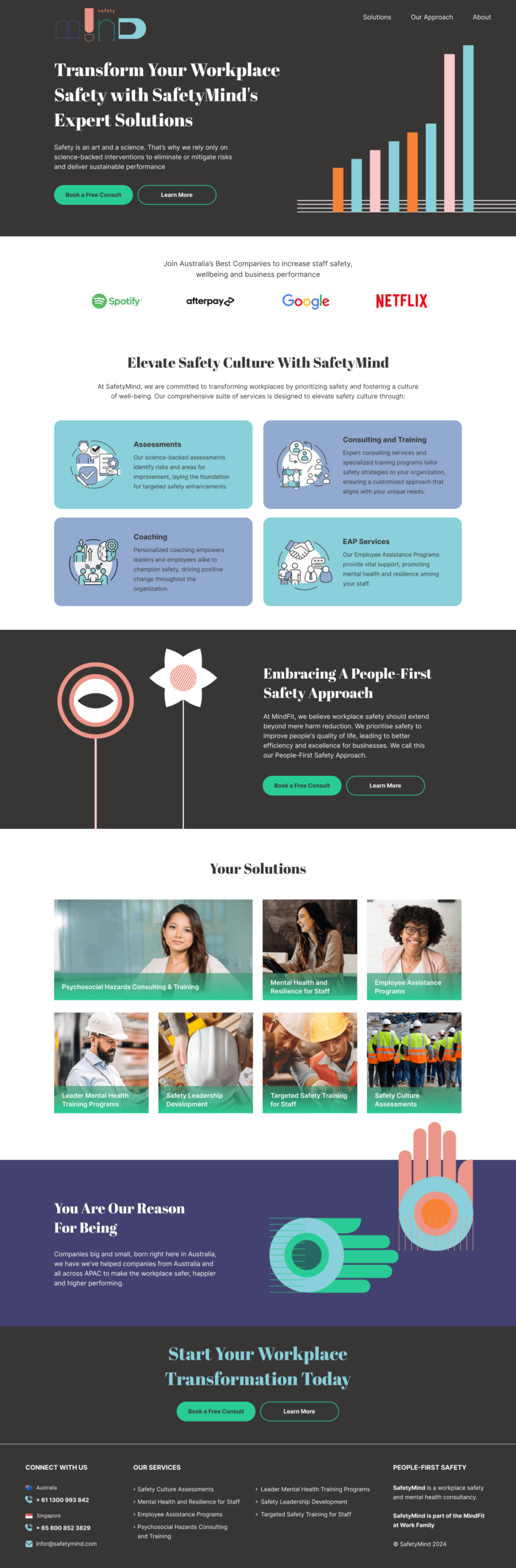
The hero featuring Spotify, Afterpay, Google, and Netflix logos creates an immediate authority signal. The dark background and clean white typography position Safety Minds as a premium, sophisticated service rather than a compliance training vendor. The contrast between the dark hero and the lighter service sections below creates a visual rhythm that guides the eye without requiring complex layout decisions.
The four-service cards
Assessments, Consulting and Training, Coaching, EAP Services. The cards use custom illustrated icons in a consistent teal and warm colour scheme. The illustrations are modern and slightly abstract, avoiding the tired stock imagery of safety vests and hard hats most workplace safety brands use. That visual vocabulary signals Safety Minds is working in a different, more progressive definition of safety.
The “People-First safety approach” section
The section uses a striking brand illustration (an abstract flower or mandala symbol) alongside a text block explaining the philosophy. That illustration is unusual for a B2B safety services page, and its unusual nature is deliberate. It communicates that Safety Minds approaches safety as a design challenge, not a regulatory exercise. The flower motif implies growth, wellbeing, and organic improvement rather than inspection, enforcement, and restriction.
The tagline "Transform Your Workplace Safety with SafetyMind's Expert Solutions" sets outcome expectations before any service detail is revealed. "Transform" is a high-commitment word. It implies before-and-after states, not incremental improvement. For buyers who've tried conventional safety programmes and been disappointed, "transform" signals a different kind of intervention. That word choice attracts buyers who are ready to invest in meaningful change, not just tick a compliance box.
The “Your Solutions” image grid
The grid uses real photography of people in relevant professional contexts: workers in hard hats, office employees in collaborative settings, frontline staff in hi-vis. That breadth of imagery communicates Safety Minds serves clients across industries (construction, office, field operations). For buyers in any of those sectors, the photography creates visual confirmation Safety Minds understands their specific work environment.
The “you are our reason for being” section
The closing section uses a large illustrated hand (a stylised graphic) that reinforces the people-centred brand identity. It grounds the brand in its purpose statement before presenting the final CTA, creating an emotional beat that follows the rational service descriptions. The sequence (services, then purpose) is intentional. Establish capability, then connect to values.
Trust architecture
Safety Minds’ trust architecture is values-forward rather than credentials-forward, which is appropriate for their audience. Enterprise client logos provide aspirational peer validation. The four-service breadth provides capability depth. The brand philosophy illustration provides values alignment. The solutions portfolio photography provides industry breadth. The stack works because enterprise safety buyers at progressive companies respond to peer alignment (we work with companies like yours) and values alignment (we share your definition of what safety means) more than to accreditation badges.

"For enterprise B2B pages targeting HR and People teams, case study metrics carry more conversion weight than any design element. 'We reduced psychosocial incident reports by 40% at a 2,000-person tech company over 18 months' is a compelling proof point. The challenge is that confidentiality agreements often prevent this specificity. The brands that work around it with anonymised but detailed case studies convert better than those that rely on logos alone."
The "Book a Free Consult" and "Learn More" CTA pair on the hero serves two visitor types at once. The ready-to-act buyer who has done their research and wants to talk, and the evaluating buyer who wants more information before committing to a conversation. Both paths are honoured without competing for prominence, which reduces the decision paralysis of seeing two equal-weight options.
Conversion strategy
The page uses a free consultation as the primary conversion offer, which is appropriate for a service that requires scoping and custom pricing. “Book a Free Consult” is a specific and actionable CTA that implies a defined first interaction (a call or meeting) rather than submitting details into a void. “Free” removes the financial commitment hesitation. “Consult” positions the interaction as expert advice rather than a sales pitch.
Positioning as "People-First Safety" rather than "safety compliance solutions" attracts a essentially different buyer: one with larger budgets, longer relationships, and genuine belief in the investment. That positioning means Safety Minds competes on value rather than price, which is the right competitive active for a service that delivers measurable wellbeing outcomes rather than checkbox deliverables.
What we’d evolve today
One quantified case study outcome. Adding a single case study with a specific metric (“Reduced psychosocial risk incidents by 35% at a 1,500-person distributed team”) would give the values-driven positioning a concrete evidence anchor.
Role-specific CTAs. An HR manager and an EHS officer have different primary concerns. A “What’s your role?” selector near the consultation CTA that routes to a tailored brief sequence would raise consultation quality and reduce time-to-qualification.
Service outcome micro-descriptions. The four service cards describe what each service is. Adding a one-line outcome statement beneath each (“Assessments: identify your highest-priority risk areas in 30 days”) would connect each service to a tangible business result.
Browse our full collection of landing page examples or contact us to discuss enterprise safety and wellbeing page design.
Waseem founded Apexure in 2015 and has led its work on 3,000+ pages for 300+ clients since. He writes about what the team sees after the click, which is pages, forms, tracking and the systems behind them.
What the page leans on
The principles at work on this page, each named in the analysis above.
Authority bias
People trust credible experts. Certifications, awards, media mentions, and expert endorsements boost credibility.
Social proof
People follow the actions of others. Testimonials, reviews, and client logos build trust and reduce hesitation.
Visual hierarchy
Controlling what visitors see first, second, and third guides them toward the conversion goal.
Values alignment
This principle influences visitor behaviour and supports the page's conversion goal.
Cognitive load reduction
Simpler pages convert better. Reducing visual noise, breaking forms into steps, and clear copy lower mental effort.
What people ask about pages like this
Safety Minds differentiates by extending the definition of workplace safety beyond physical hazard reduction to include psychosocial wellbeing, mental health, and organisational culture. The 'People-First Safety Approach' positioning signals to HR and EHS (Environmental Health and Safety) buyers that this is a whole-person service partner, not a compliance checklist vendor. For enterprise buyers who have been disappointed by tick-box safety programmes that didn't reduce incidents or improve engagement, this values-led positioning creates immediate resonance.
These four brand names are among the most recognisable in the global tech and consumer sector. Their presence on a workplace safety services page signals that Safety Minds operates at the enterprise scale of world-class, high-growth companies. For HR professionals and safety managers at similar organisations, seeing these logos answers the question 'do you work with companies like ours?' before it's asked. The implicit message is: these companies invest in safety culture, and Safety Minds is their partner.
Enterprise safety buyers rarely need just one service, they need a programme. The four-service structure allows buyers to see the full scope of what Safety Minds provides and identify the entry point most relevant to their current need. A visitor responding to a specific psychosocial hazard assessment requirement will enter through 'Assessments'; a visitor building out a wellbeing strategy from scratch will engage the full programme. The grid format makes all four visible simultaneously, which surfaces the breadth without overwhelming.
We'd look at two areas: role-specific messaging and the specificity of the consultation CTA. HR managers, EHS officers, and CEOs each have different entry points to a safety programme conversation. A 'Book a Free Consult' CTA that branches based on role, 'I'm an HR Manager', 'I'm an EHS Officer', would personalise the follow-up conversation before it starts. [Contact us](/contact-us/) to discuss how we'd approach your workplace safety page.
Three more, taken apart the same way


Want one like this?
Tell us what the page has to do and where the traffic comes from. Within 48 hours you get a written quote from the people who wrote this breakdown. Already have a page that is not converting? Send it for a free audit instead.
UK hours, which is the East Coast morning.
"Enterprise HR and safety pages that lead with regulatory compliance attract a budget-constrained, tick-box buyer. Pages that lead with 'your people's safety should extend beyond mere harm reduction' attract a values-driven buyer who is investing in culture. These are different buyers with different budgets and different relationships with service providers. Safety Minds has correctly identified which buyer they want."