
Scenarios before rates, so borrowers recognise themselves first.
Rapid Bridging's residential bridging loan lead page, built on Unbounce for buyers who may not know bridging is the answer. How accreditation, a video testimonial and a 'Why Us' pledge list build trust, and the calculator we would add.
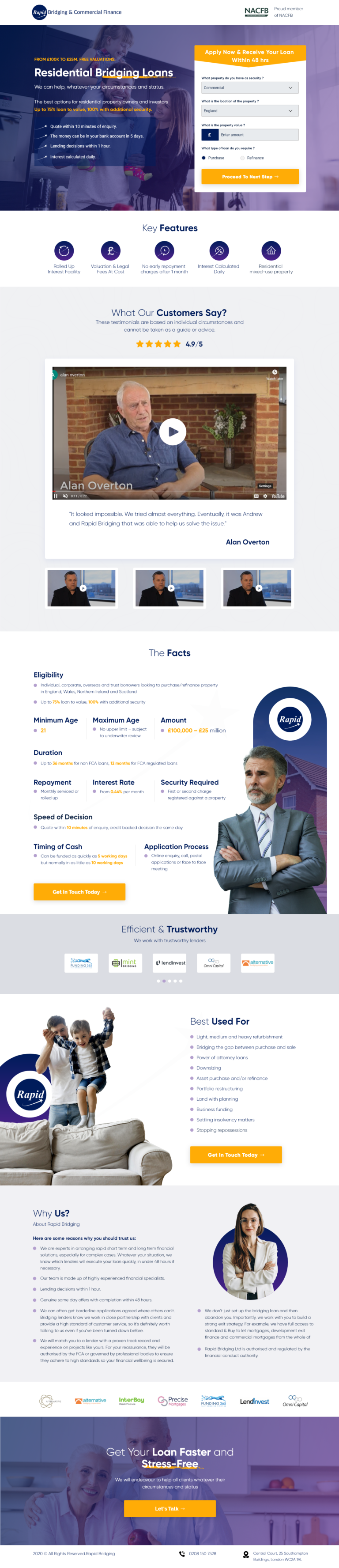
- Primary CTAGet In Touch Todaythe button the page is built around
- GoalLead Generationwhat counts as a conversion
- PlatformUnbouncelead generation page
- Built forB2CFinance
- The page as built, not a mockup.Analysed by Apexure, not by Rapid Bridging.
- Client
- Rapid BridgingFinance
- Industry
- Finance32 examples
- Audience
- B2CLead Generation
- Platform
- Unbounce132 examples
- Page type
- Lead generationLead Generation
- Analysed by
- Waseem BashirMarch 2026
What the page does, and why
Why we built this bridging loan lead generation page
Bridging finance is a category that most homeowners and property investors do not know they need until they’re in a situation that requires it. The classic bridging scenario, a buyer who wants to purchase before selling their existing property, creates a short window of time-sensitive decision making. The buyer needs to act quickly, understand exactly what they are committing to, and trust that the lender is both legitimate and capable of moving at the required speed.
Rapid Bridging’s value proposition maps directly to these three requirements: NACB accredited (legitimacy), up to £25 million available (capability), and “within 3 minutes of enquiry” response (speed). Getting those three messages into the hero clearly and credibly was the foundation of the conversion architecture.
The secondary challenge was audience qualification. Bridging loans are relevant to a broad audience, homeowners, landlords, property developers, auction buyers, businesses managing cash flow, but the best-used-for scenarios are very different across these groups. A property investor using a bridge to fund a refurbishment before refinancing has completely different requirements than a homeowner bridging between a sale and a purchase. The page needed to serve all these audiences with one entry point while still creating the feeling of relevance for each.
Design decisions
The dark blue split hero
with the property photography left and the lead form right creates an immediate financial-services-sector aesthetic: authoritative, professional, and trustworthy. The NACB (National Association of Commercial Finance Brokers) logo in the header provides immediate regulatory credibility, for a consumer about to submit personal and property information, a recognised trade body membership signals that this is a regulated operation.
The form fields are: Full Name, Email, Telephone, and a property value range selector. This qualification structure captures the minimum information needed for an initial assessment call without creating the friction of a full mortgage application form. The property value range selector qualifies the lead before the call, the sales team knows whether they are speaking to a £150k residential borrower or a £5M commercial property owner.
The key features icon bar
Rated on Trustpilot, Regulated & Insured (No Early Repayment, Option to Extend, Personalised Service) addresses five distinct trust concerns with five corresponding icons. These are scanned, not read, which is why the icon format is correct for this section. Each icon answers a specific anxiety: Trustpilot (are others happy with them?), Regulated & Insured (are they legitimate?), No Early Repayment (will I be penalised for paying back early?), Option to Extend (what if my situation changes?), Personalised (will I be a number or a person?).
The video testimonial featuring Alan Overton
is the most important trust element on the page. Mr Overton appears professional, clearly at ease, and speaking from direct experience. The video is prominently placed above the eligibility section, before the visitor has to evaluate whether they qualify. They see a real person who did qualify and is satisfied with the outcome. This sequencing creates the “someone like me used this successfully” social proof that makes the eligibility section feel approachable rather than intimidating.
The “Best Used For” section
with a bulleted list (light bridging to long-term, bridging the gap between purchase and sale, home improvements, business finance, avoiding chain collapse, and others) operates as a self-qualification map. Each bullet point is a situation. Visitors scan this list and count how many scenarios match their situation. Every matching scenario increases confidence that this product is relevant to them.
The "Why Us?" section lists human commitments rather than product features: "We will always talk to you honestly," "We will search the whole of market to find you the best deal," "We will not charge until your mortgage has been completed." These are service promises, not capability claims. For a consumer handing over property security, the character of the people they are working with matters as much as the rate. Human commitments convert differently from product features.
Trust architecture
Layer one: NACB accreditation and trustpilot rating in the header
Both signals are visible before the hero content is processed. Trade body accreditation tells the borrower this broker is known to regulators. Trustpilot tells them other borrowers have used them and are satisfied. Neither signal requires reading, they are visually processed in the first second.
Layer two: partner logo strip mid-page
Uswitch, Landlord Network, LendInvest, and other financial platform logos position Rapid Bridging within the established financial ecosystem. These are not customers, they are platforms that endorse and list the broker, which implies a vetting process that the consumer benefts from.
Layer three: the “Why us” pledge section
The bulleted commitments in the “Why Us” section are the final objection-removal layer before the bottom CTA. They address the specific character concerns, honesty, whole-market search, no upfront fees, that make a consumer confident enough to submit their personal and property information.

"The 'no fees until completion' commitment in the Why Us section is doing specific objection-removal work. A lot of potential bridging borrowers have had bad experiences with brokers who charge arrangement fees upfront and then don't deliver. Naming this concern directly, 'we will not charge until your mortgage has been completed', converts the visitors who have been burned before and are the most valuable audience because they've already been qualified by their own search history."
Conversion strategy
The visitor journey follows a trust-to-eligibility arc. The hero establishes credibility and captures high-intent leads immediately. The key features bar handles specific trust concerns. The testimonial video provides peer social proof. The eligibility section and “Best Used For” grid qualifies the visitor and creates self-identification. The partner logos add institutional credibility. The “Why Us” pledges make the human commitment before the final CTA.
The minimum loan amount (£30,000 minimum) and maximum loan amount ($750,000 maximum, now higher) are stated in the eligibility section rather than in the hero, because readers who see a loan range minimum before they understand the product may self-disqualify prematurely if their amount is near the threshold. Putting eligibility after the product understanding section gives context to the numbers.
"The bottom CTA section, 'Get Your Loan Faster and Stress-Free' with the family photograph, closes on an emotional outcome, not a financial one. By this point in the page, the visitor understands the product. They don't need another rate reminder. They need to imagine how different their situation will feel once the bridging finance is in place. The family image and the 'stress-free' language create that visualisation in the final moment before they click."
What we would evolve today
Add a bridging calculator in the hero
A simple “how much could I borrow?” calculator, property value input, current mortgage balance input, that outputs an indicative bridging loan amount and monthly cost would personalise the lead capture. Visitors who have run the numbers for themselves tend to convert better because they arrive at the form with confirmed intent rather than speculative interest.
Test a “What happens next” confirmation page optimisation
The enquiry confirmation page is an underinvested conversion moment. Visitors who have just submitted a financial enquiry are at peak anxiety: “did it send? Will someone call? When?” A confirmation page that sets a specific callback expectation (“We’ll call you within 3 hours during business hours”) and shows the first steps of the assessment process reduces post-submission drop-off from multiple-enquiry behaviour.
Add a downloadable guide: “5 questions to ask before taking a bridging loan.”
A lead magnet that educates borrowers about what to look for in a bridging loan also implicitly positions Rapid Bridging as the lender that answers those questions correctly, setting a comparison standard that benefits an established, regulated broker over less scrupulous competitors.
Browse our full collection of landing page examples for more finance and mortgage page breakdowns. Building a bridging or specialist finance lead generation page? Talk to our team.
Waseem founded Apexure in 2015 and has led its work on 3,000+ pages for 300+ clients since. He writes about what the team sees after the click, which is pages, forms, tracking and the systems behind them.
What the page leans on
The principles at work on this page, each named in the analysis above.
Authority bias
People trust credible experts. Certifications, awards, media mentions, and expert endorsements boost credibility.
Social proof
People follow the actions of others. Testimonials, reviews, and client logos build trust and reduce hesitation.
Loss aversion
People feel losses more strongly than gains. Framing around what they will miss motivates action.
Anchoring effect
The first piece of information shapes all subsequent judgements. Price comparisons and headline stats set expectations.
Processing fluency
This principle influences visitor behaviour and supports the page's conversion goal.
What people ask about pages like this
Bridging loan buyers often arrive without knowing whether a bridging loan is the right product for their situation. They know they need short-term finance; they may not know that bridging is the category that solves their problem. 'Best Used For' scenarios, bridging the gap from purchase to sale, refurbishment funding, auction purchases, avoiding a chain collapse, are educational self-qualification prompts. A visitor who sees 'auction property purchases' listed as a use case and is about to bid at auction self-identifies as a bridging loan candidate before they've read a rate table. That recognition converts at much higher rates than cold rate presentation.
For a financial product that involves handing over a significant property as security, a video testimonial does work that text cannot. A real person, with a face, a name (Alan Overton), and a specific situation, speaking directly to camera about their bridging loan experience eliminates the 'was this a real customer?' concern that undermines text testimonials. Video also conveys emotional state: a relaxed, confident borrower talking positively about their experience communicates more trust than the same words in a quote format. For a high-stakes financial product, the authenticity of video is a qualitatively different trust signal.
Partner logos on a bridging loan page, showing networks like Uswitch, Landlord Network, Quivira, LendInvest, and others, validate the broker's position within the regulated financial ecosystem. For a consumer borrower evaluating an alternative lender, seeing that established financial comparison and network platforms endorse this broker is a regulatory trust signal. These logos communicate 'this company is known to and trusted by platforms that vet their financial services partners.' That's a different function from a typical brand logo strip, it's regulatory credibility, not just business scale.
Showing eligibility criteria, even complex ones, consistently improves lead quality without meaningfully reducing enquiry volume. The Rapid Bridging eligibility section covers minimum age, property types accepted, maximum LTV, and application process. A borrower who reads the criteria and recognises that they qualify submits an enquiry with confidence. A borrower who submits without understanding the criteria, then learns they don't qualify in the first call, wastes the sales team's time. Eligibility transparency is a lead quality mechanism, not a conversion inhibitor.
Three more, taken apart the same way


Want one like this?
Tell us what the page has to do and where the traffic comes from. Within 48 hours you get a written quote from the people who wrote this breakdown. Already have a page that is not converting? Send it for a free audit instead.
UK hours, which is the East Coast morning.
"Bridging loan pages that lead with rates lose borrowers who don't yet know if they qualify. Pages that lead with 'Best Used For' scenarios convert better because they help the visitor identify with their own situation before evaluating cost. Once a visitor has thought 'yes. This is exactly my situation'. They are no longer price-shopping. They are looking for the right partner. Price sensitivity drops significantly after identity recognition."