
Four live totals right under the trial form.
PurplyApp's free trial page for businesses evaluating affiliate software, built on Unbounce with the form in the hero. How the 135,509-partner figure and 8.5% adoption stat sell, and the industry filter we would add.
- Primary CTATry For Freethe button the page is built around
- GoalFree Trial Sign-Upwhat counts as a conversion
- PlatformUnbouncelead generation / free trial page
- Built forB2BSaaS
- The page as built, not a mockup.Analysed by Apexure, not by PurplyApp.
- Client
- PurplyAppSaaS
- Industry
- SaaS30 examples
- Audience
- B2BFree Trial Sign-Up
- Platform
- Unbounce132 examples
- Page type
- Lead generation / free trialFree Trial Sign-Up
- Analysed by
- Waseem BashirMarch 2026
What the page does, and why
Why we built this affiliate management SaaS page
Affiliate program management is a crowded SaaS category where the product’s differentiation is often invisible until you use it. Most affiliate platforms offer partner discovery, tracking, and payouts. The feature parity at the commodity level is high. PurplyApp’s differentiation is its AI-driven suggestion engine and its 135,509-partner network: capabilities that go beyond basic affiliate tracking into intelligent program growth.
The conversion problem was articulating this difference to buyers who arrive with commodity expectations (“I need affiliate tracking software”) and need to be elevated to understand what intelligent affiliate management actually delivers. A visitor who understands the 91.5% of companies not currently using affiliate as a channel as an opportunity (rather than a sign that affiliate doesn’t work in their vertical) is a very different buyer with much higher intent.
The page also needed to handle the self-serve evaluation active of the SaaS affiliate space. Buyers in this category want to try before they buy, and a “book a demo” barrier between interest and experience consistently reduces conversion for self-serve-oriented products. The free trial CTA was the right primary conversion action, with lead qualification handled through the trial sign-up form fields.
Design decisions
The split hero
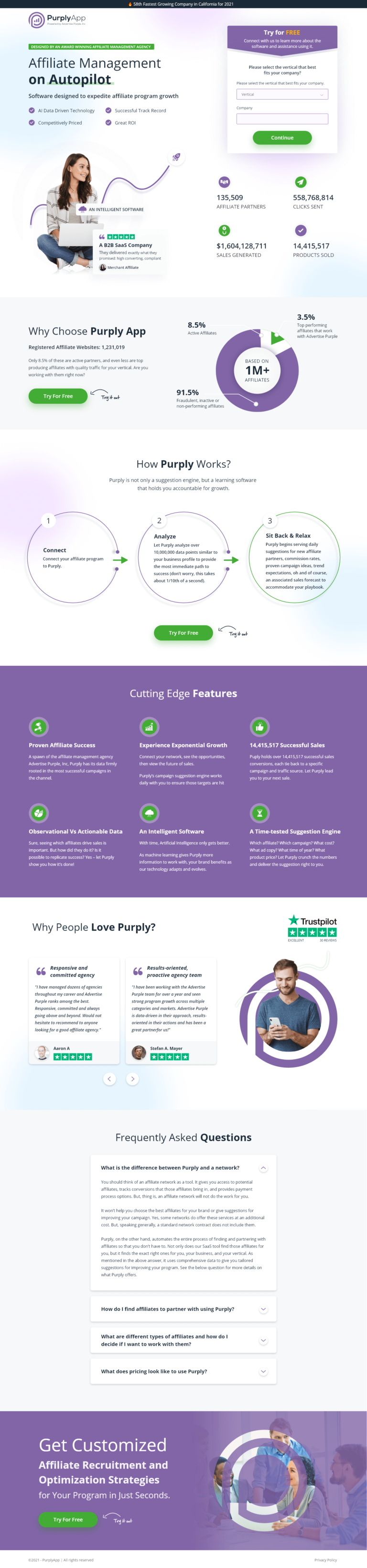
The split hero places the headline “Affiliate Management on Autopilot” on the left with a woman using a laptop (suggesting ease of use) and a prominent trial form on the upper right. The “Try For Free” CTA in the form is paired with a PayPal-branded button, suggesting fast social sign-up and reducing the friction of registration for a product the buyer wants to evaluate immediately. The Trustpilot “4 star rated” badge visible in the hero adds immediate credibility before the visitor has read the stats below.
The “affiliate management on autopilot” headline
The headline is precisely targeted. “Autopilot” speaks to the core value proposition: this is not manual affiliate management software. It is intelligent automation. The word does more work than “powerful” or “full” because it communicates a specific outcome: you set it up, it manages itself.
The four-metric stats bar
The four-metric stats bar (135,509 Affiliate Partners, $58,768,814 USD Ad Spend, $1,606,128,711 Sales Generated, 14,415,517 Products Sold) sits immediately below the hero as the first scroll content. These four numbers are chosen to speak to the four stakeholders in an affiliate marketing decision: the VP of partnerships (partner network size), the marketing director (ad spend managed), the CEO (total sales generated), and the operations team (products sold). Each metric validates a different aspect of the platform’s scale.
The “why choose purply app” section
This section introduces two market statistics: only 8.5% of companies currently use affiliate as a primary acquisition channel, and affiliate marketing returns $1 for every $3 spent (versus 3.5x for other channels). These are market intelligence claims that reframe the buyer’s context. They convert the product from “affiliate tracking software” to “access to an underused growth channel.”
The “How Purply Works” three-step flow
The flow (Connect, Analyse, Sit Back & Relax) uses circular icons with a connector line. Connect links your affiliate program; Analyse processes 10,000+ data points; Sit Back & Relax delivers suggestions for new affiliates and partner management. The diagram communicates the product’s workflow in a format that a time-limited B2B buyer can process in fifteen seconds.
The features grid (Proven Affiliate Success, Experience Exponential Growth, 14,493,377 Successful Sales) uses a specific sales count as a feature title. This is a deliberate choice to keep the social proof visible throughout the page even in the features section, rather than isolating it in a testimonial block. Every section of a well-built SaaS page should reinforce confidence, not just the dedicated trust section.
Trust architecture
Layer one: Trustpilot rating in the hero
The four-star Trustpilot badge visible in the hero provides third-party validated credibility before the visitor has read the stat bar. Third-party ratings are more credible than self-claims because they represent an external system that cannot be easily manipulated.
Layer two: scale statistics as ongoing proof
The stats bar’s four numbers (updated in real time as the platform grows) provide living proof of active use. Unlike a static testimonial that represents a point in time, a running total of sales and partners communicates that the platform is continuously in production use.
Layer three: named testimonials before the final CTA
Two testimonials with full names (Augustino/Responsive and Organized Agency, and Selina S./Results-Oriented Proactive Agency Team) appear above the FAQ accordion. The naming of the testimonial reviewer’s organisation type (“responsive and organised agency”) is a smart trust mechanism: it lets the reader self-identify with a reviewer in a similar position.

"The '91.5% of companies don't use affiliate as a channel' stat is doing something clever. It's both a market education claim and a competitive intelligence signal. A buyer reading this thinks 'if most of my competitors aren't doing affiliate. This could be an advantage.' That's a more motivating frame than 'affiliate marketing increases revenue' because it connects the channel adoption to competitive advantage, which is a much higher-stakes purchase motivation."
Conversion strategy
The page operates on two tracks. The immediate-intent track captures visitors with high purchase readiness through the hero trial form: these are buyers who understand affiliate management and are evaluating specific platforms. The education track serves buyers who need to understand what intelligent affiliate management is before evaluating PurplyApp specifically. These visitors engage with the market statistics, the how-it-works section, and the testimonials before reaching the final CTA.
The FAQ accordion at the bottom provides the objection-removal layer for visitors who have been engaged but not yet converted. Questions like “How do I know the suggested affiliates are relevant to my brand?” and “How does pricing scale?” address the specific hesitations that a visitor in final evaluation will have, turning a page exit into a conversion.
"The bottom CTA on this page ('Get Customized Affiliate Recruitment and Optimization Strategies for Your Program in Just Seconds') is doing something most SaaS pages miss: it personalises the outcome. Not 'start your free trial' but 'get customised strategies for your program.' The ownership language ('your program') shifts the visitor from evaluating a product to imagining they already have the outcome. That's a subtle but effective close."
What we would evolve today
Test a partner network industry filter in the hero
Letting the visitor select their industry (eCommerce, SaaS, Finance, Health) and see a filtered partner count relevant to their vertical would make the 135,509 number more immediately relevant. “135,509 partners across all categories” is impressive; “27,400 eCommerce-focused partners available in your category” is personally relevant.
Add a competitor comparison table
In a crowded SaaS category, buyers in active evaluation are comparing PurplyApp against ShareASale, Impact, or PartnerStack. A direct feature comparison table placed after the features section keeps the evaluation on the page rather than routing it to comparison sites.
Add a case study with a specific program growth metric
“How [Brand] grew their affiliate revenue by 340% in 90 days using PurplyApp” as a linked case study section would give the most evaluative buyer a before/after outcome story that the stats bar and testimonials alone cannot provide.
Browse our full collection of landing page examples for more SaaS and software page breakdowns. Building a free trial or lead generation page for a SaaS product? Talk to our team.
Waseem founded Apexure in 2015 and has led its work on 3,000+ pages for 300+ clients since. He writes about what the team sees after the click, which is pages, forms, tracking and the systems behind them.
What the page leans on
The principles at work on this page, each named in the analysis above.
Authority bias
People trust credible experts. Certifications, awards, media mentions, and expert endorsements boost credibility.
Social proof
People follow the actions of others. Testimonials, reviews, and client logos build trust and reduce hesitation.
Anchoring effect
The first piece of information shapes all subsequent judgements. Price comparisons and headline stats set expectations.
Cognitive load reduction
Simpler pages convert better. Reducing visual noise, breaking forms into steps, and clear copy lower mental effort.
Commitment consistency
This principle influences visitor behaviour and supports the page's conversion goal.
What people ask about pages like this
Affiliate marketing buyers are typically self-serve evaluators, they want to explore the platform themselves before talking to a sales team. A demo request introduces a human delay into an evaluation process the buyer wants to control. A free trial invitation removes that delay and lets the product sell itself. For a category where the buyer's due diligence involves testing partner discovery, suggestion accuracy, and tracking reliability, a free trial gives them the direct experience that no sales demo can replicate. PurplyApp's 'Try For Free' CTA captures the self-serve majority while the form fields (company details) make sure the trial sign-up is qualified.
PurplyApp's stat, 135,509 affiliate partners in the network, is a network effect proof point. For affiliate management software, the value of the platform depends directly on the size of the partner network available to the user. A list of platform features describes what the software can do; a partner count shows what using the software gets you access to. For a buyer whose primary concern is 'will I be able to find the right partners?' the 135,509 figure answers that question with a number, not a promise. Numbers anchor expectations; features describe capability.
This statistic creates a market opportunity framing: most of your competitors are not using affiliate marketing yet. For a B2B SaaS buyer, this means two things, first, the channel is relatively uncontested in many verticals (early mover advantage), and second, PurplyApp has the data to show this, which implies market research capability beyond a basic tracking tool. Statistic-based market positioning is a specific form of authority bias, by showing the buyer data about their competitive environment, the software positions itself as a partner with market intelligence, not just a tracking utility.
Affiliate management software buyers have specific technical and commercial questions that a features list cannot answer: 'Is this just manual triage?' 'How do you handle different affiliate types?' 'What does pricing look like at scale?' The FAQ accordion addresses these questions directly, which is more efficient than a features matrix for a buyer in active evaluation mode. Each question represents an objection that, if left unanswered, would cause the visitor to leave and research elsewhere. An FAQ that answers the top five objections keeps the evaluation on the page.
Three more, taken apart the same way



Want one like this?
Tell us what the page has to do and where the traffic comes from. Within 48 hours you get a written quote from the people who wrote this breakdown. Already have a page that is not converting? Send it for a free audit instead.
UK hours, which is the East Coast morning.
"The stat bar on this page (135,509 affiliate partners, $58,768,814 ad spend managed, $1,606,128,711 sales generated) does something that feature bullets cannot do. It proves the platform is in active use at real commercial scale. Those aren't theoretical claims from a new product; they're evidence that businesses are already running live programs through PurplyApp. For a SaaS buyer, scale of existing use is a much stronger signal than any feature description."