
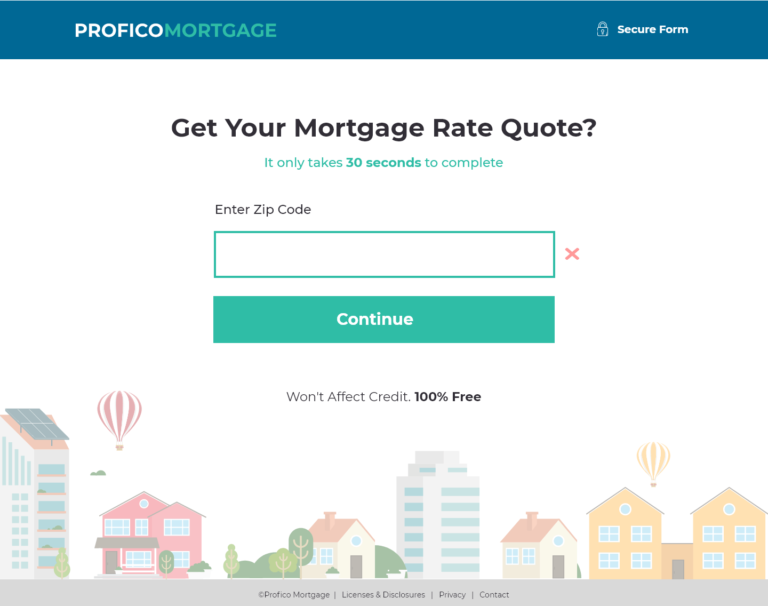
Asks for a zip code and nothing else.
Profico Mortgage's Unbounce squeeze page, step one of a rate quote funnel for borrowers who have already decided to shop. Why 'Secure Form' and a 30-second promise are all the trust it needs, and what we would add.
- Primary CTAContinuethe button the page is built around
- GoalLead Qualificationwhat counts as a conversion
- PlatformUnbouncesqueeze page page
- Built forB2BFinance
- The page as built, not a mockup.Analysed by Apexure, not by Profico Mortgage.
- Client
- Profico MortgageFinance
- Industry
- Finance32 examples
- Audience
- B2BLead Qualification
- Platform
- Unbounce132 examples
- Page type
- Squeeze pageLead Qualification
- Analysed by
- Waseem BashirMarch 2026
What the page does, and why
Why we built this mortgage squeeze page
Mortgage rate shopping is a high-consideration, high-anxiety activity. Visitors searching for mortgage rates are typically carrying stress: they’re time-constrained. They have a financial decision weighing on them, and they’ve often already had a discouraging conversation with a bank. The worst thing a landing page can do in this context is add friction.
The Profico Mortgage squeeze page is a study in radical restraint. The visible page contains a brand header, a headline, a time-to-complete claim, a single form field, and a continue button. Nothing else. No navigation, no testimonials, no feature lists, no benefit explanations. This is not a page for visitors who need convincing. It is a conversion mechanism for visitors who have already decided to explore their mortgage options and need a zero-friction entry point.
The design question this page answers is: how little can we ask and still generate a useful lead? The answer is a zip code. A zip code qualifies the visitor geographically (does Profico serve their area?), creates the Zeigarnik commitment effect, and reveals nothing personal about the borrower. It is simultaneously the least threatening first step possible and a genuinely useful qualification criterion.
Design decisions
The teal brand header with the “PROFICO MORTGAGE” wordmark and “Secure Form” in the top right
establishes brand identity and addresses the primary anxiety simultaneously. The colour split, dark teal header, white body, creates a clear visual division between the brand identity section and the action section. This helps the visitor’s eye move directly from “who is this?” (header) to “what do they want me to do?” (form field) without visual noise in between.
The headline “get your mortgage rate quote?”
uses a question mark, which is unusual for a CTA headline. The question framing serves a specific function: it sounds like the visitor’s own thought, not a company demand. “Get a mortgage rate quote” is a directive from the company. “Get your mortgage rate quote?” echoes the visitor’s internal question, which creates a more natural psychological alignment between the visitor’s intent and the page’s offer.
The “It only takes 30 seconds to complete” subheadline uses bold emphasis on “30 seconds”, the critical information that reduces time-cost anxiety. The bolding creates a visual anchor that the eye lands on even in a scan, making sure the time commitment claim is seen even by visitors who do not read the full subheadline.
The single “Enter Zip Code” field with a prominent teal Continue button
is the entire action section of the page. The field is wide enough to be comfortable on desktop and mobile. The red × icon on the right of the field suggests a clear/reset option, which subtly communicates that the field is interactive and has been used before, a small processing fluency signal.
No navigation: no footer links, no secondary CTAs
This page is a deliberate dead end with one path forward. The only clickable elements are the Continue button and the form field. Removing exit paths is the correct design choice for a squeeze page where the conversion action is the entry to a multi-step funnel.
This page converts because it asks nothing threatening. A zip code is publicly available information, entering it triggers no privacy concern. The Zeigarnik effect then does the conversion work: once a visitor has typed their zip and pressed Continue, stopping the process feels like abandoning something they started. Progressive disclosure turns a zero-commitment first step into a completed multi-step qualification.
Trust architecture
The “Secure Form” label in the header
is the only trust signal visible above the fold, and it is the right trust signal for this page. In a minimalist page design, every element has proportionally more weight. A small padlock icon and two words, “Secure Form”, in the header of a finance page address the security anxiety before any other content is processed.
The brand name itself
PROFICO MORTGAGE, visible as the first text element on the page establishes that this is a named, branded company, not a lead generation broker. For mortgage applicants who are wary of their information being sold to multiple lenders, a named brand in the header provides implicit accountability.
The single-step nature
of the visible page is paradoxically a trust signal. A page that asks for nothing except a zip code communicates confidence: “we don’t need your personal information to show you something valuable.” That restraint signals a professional operation that respects the visitor’s privacy.

"Clients often feel nervous about squeeze pages because they look 'too simple.' There's nothing on the page, they say, where's the credibility? I always explain: the simplicity IS the credibility. A page that asks for nothing threatening communicates confidence. You don't need to prove yourself with a wall of content when the ask is low. Save the proof for the next step, after the visitor has already made the micro-commitment."
Conversion strategy
The squeeze page is step one of a multi-step qualification funnel. The zip code entry routes the visitor to a confirmation of service area coverage, then into progressive qualification: property value range, desired loan amount, property type, and finally contact details. Each step is small enough to feel non-threatening on its own; the cumulative effect is a fully qualified lead delivered to the sales team with all the information needed for a productive first conversation.
The “Continue” button copy is deliberately neutral, not “Get My Rate” (which implies an immediate result the system cannot yet deliver) and not “Submit” (which sounds like form submission in the administrative sense). “Continue” matches the multi-step funnel context: the visitor is continuing a process, not submitting to a database.
"Multi-step forms tend to outperform single long forms in financial services because each step resets the psychological commitment. The visitor is never looking at a form that asks for ten things. They're completing step one, then step two, then step three. By the time they reach the personal information step, they've invested so much in the process that completing it feels natural. The dropout rate per step is lower than the equivalent single-form completion rate."
What we would evolve today
Add a progress indicator from step one
Since this is step one of a multi-step process, a subtle “Step 1 of 4” indicator below the form field would manage expectations and reduce dropout in later steps by making the total process length visible from the start. Visitors who know there are three more steps approach step two differently than visitors who are surprised by additional steps.
Test a personalised headline after zip entry
A active confirmation, “Great, we cover [City Name]. What type of mortgage are you looking for?”, immediately after zip code submission would increase continuation rate by confirming relevance before the next step’s form appears.
Add a “no personal data shared with third parties” statement
For multi-lender comparison platforms, visitor anxiety centres on whether their contact information will be sold. A single line beneath the Continue button, “Your details are only shared with Profico Mortgage, never third parties”, would address the most common objection to completing the subsequent steps without adding visual noise to the minimalist design.
Browse our full collection of landing page examples for more finance and mortgage page breakdowns. Building a squeeze page or multi-step qualification funnel? Talk to our team.
Waseem founded Apexure in 2015 and has led its work on 3,000+ pages for 300+ clients since. He writes about what the team sees after the click, which is pages, forms, tracking and the systems behind them.
What the page leans on
The principles at work on this page, each named in the analysis above.
Cognitive load reduction
This principle influences visitor behaviour and supports the page's conversion goal.
Commitment consistency
This principle influences visitor behaviour and supports the page's conversion goal.
Zeigarnik effect
This principle influences visitor behaviour and supports the page's conversion goal.
Anchoring effect
The first piece of information shapes all subsequent judgements. Price comparisons and headline stats set expectations.
Processing fluency
This principle influences visitor behaviour and supports the page's conversion goal.
What people ask about pages like this
A zip code entry is a zero-threat first step. It asks for no personal information, carries no privacy implications, and takes two seconds to complete. Yet the act of completing it creates the Zeigarnik effect: a started action that feels incomplete until finished. A visitor who enters their zip code and clicks Continue has made a micro-commitment to the process, they are psychologically invested in the next step. A full five-field contact form in the same position would convert a fraction as well because the commitment ask is too high before any trust has been established.
Time-to-complete reassurances directly address the 'I don't have time for this' objection that kills completion on financial product forms. Mortgage applicants have typically been through at least one exhausting application process with a bank. The association of mortgage applications with lengthy, complex forms creates automatic friction on any new mortgage-related form. '30 seconds to complete' resets that expectation and makes the next step feel categorically different from a bank mortgage application. The 30-second claim also creates a commitment challenge, most people can spare 30 seconds, which makes declining to continue feel actively unreasonable.
Financial data entry triggers a specific anxiety: 'who will see this, and what will they do with it?' A padlock icon with 'Secure Form' in the header addresses this anxiety in the most visible position on the page, before the visitor has even looked at the form field. This placement matters because trust signals need to be seen before the anxiety-creating element (the form), not after. A 'secure form' badge at the bottom of the page is seen only by visitors who have already decided whether to fill it in. In the header, it de-escalates the privacy concern at first view.
The squeeze page is the entry point, not the entire funnel. Its job is to capture the highest possible percentage of interested visitors into the first step of a progressive qualification process. Each subsequent step, after the zip code, likely property value, loan amount, contact details, is presented as a natural continuation of a process the visitor has already started. Progressive disclosure of form complexity is consistently more effective than front-loading all qualification questions, because it converts curious visitors into engaged leads rather than filtering them out before they've experienced the product's value proposition.
Three more, taken apart the same way


Want one like this?
Tell us what the page has to do and where the traffic comes from. Within 48 hours you get a written quote from the people who wrote this breakdown. Already have a page that is not converting? Send it for a free audit instead.
UK hours, which is the East Coast morning.
"We've built hundreds of finance forms, and the most consistent finding is this: the longer the form, the fewer completions, but the first step matters more than the field count. A form that starts with a zip code or a non-threatening qualifier will get higher total completion rates than one that opens with 'enter your full name and credit score.' The opening move sets the entire psychological tone for what follows."