
Three familiar problems, one beta form, a free year.
PretaProcess's beta sign-up page for SME process automation, built in Unbounce for owners with no IT team. A hero form, plain feature cards, a FAQ that explains automation, and the use-case selector we would add.
- Primary CTASign Up To Our Betathe button the page is built around
- GoalBeta Registrationwhat counts as a conversion
- PlatformUnbouncebeta sign-up page
- Built forB2BSaaS
- The page as built, not a mockup.Analysed by Apexure, not by PretaProcess.
- Client
- PretaProcessSaaS
- Industry
- SaaS30 examples
- Audience
- B2BBeta Registration
- Platform
- Unbounce132 examples
- Page type
- Beta sign-upBeta Registration
- Analysed by
- Waseem BashirMarch 2026
What the page does, and why
Why we built this SaaS beta Sign-Up page
Business process automation is a category that SME owners intellectually understand they need and practically struggle to adopt. The conversion problem for PretaProcess was not lack of interest in automation, every small business owner who has lost a warranty claim or a job application in their inbox email wants a better system. The problem was the technology gap: “automation” sounds complex, expensive, and time-intensive to set up for a business owner who runs operations without a dedicated IT function.
The page needed to bridge that gap in two steps. First, establish that the problems PretaProcess solves are immediately recognisable (“warranty claims,” “job applications,” “customer complaints”, not “workflow orchestration” or “process automation middleware”). Second, demonstrate that the solution is accessible, not just affordable, but genuinely simple to set up and use on a tablet, phone, or laptop.
The beta framing created an additional opportunity. An “open beta” is not just a product stage. It is a conversion narrative. The visitor is not being asked to buy software; they are being invited to shape it. The “Submit your process and we’ll automate it for you, and reward you with a free year of service” offer turns the sign-up from a transaction into a partnership. That framing meaningfully changes the visitor’s sense of what they’re agreeing to.
Design decisions
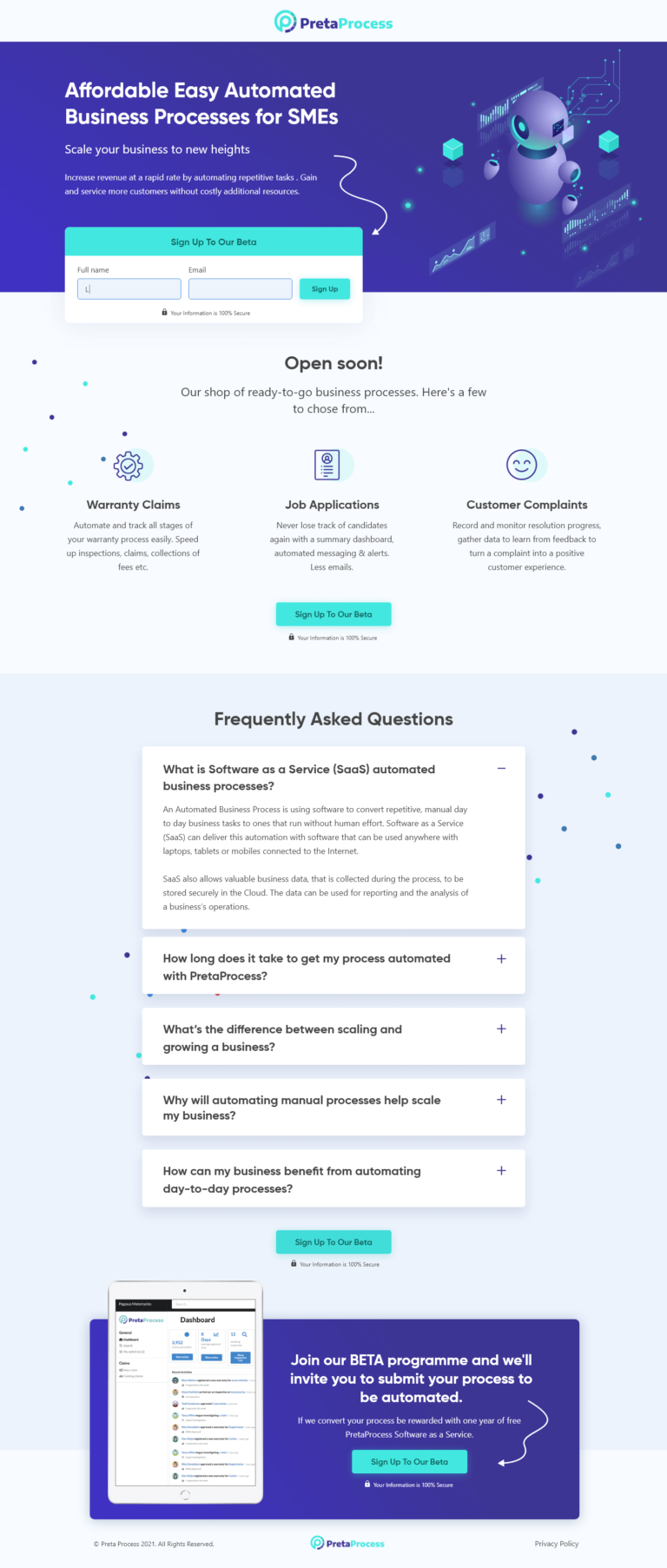
The split hero with the form on the right
makes beta sign-up immediately accessible for high-intent visitors, those who arrive with a specific problem and recognise the solution in the headline. The form has three fields: Full Name, Email, and Sign Up. The privacy assurance “Your Information is 100% Secure” sits beneath the submit button, which is the right placement: near the action it is meant to reassure, not buried in a policy disclaimer.
The illustrated robot with holographic data elements on the right side of the hero communicates the technology’s nature without requiring a product screenshot, at beta stage, the UI may not be final, so a conceptual illustration is more accurate and more aspirational than a premature screen recording. The teal and purple gradient used for the hero background positions the brand as tech-forward without the cold minimalism that can make business tools feel inaccessible.
The “Open Soon” three-column feature preview
shows the three initial use cases, Warranty Claims, Job Applications, Customer Complaints, with icons and one-sentence descriptions. These are framed as problem categories the SME owner already manages, not as product features. A small business owner who currently manages job applications through email immediately sees “Job Applications” as a category they recognise and care about. The question “which of these do I need?” creates self-selection without requiring any navigation.
The FAQ accordion
handles the educational gap for visitors who are not yet familiar with SaaS or cloud-based automation. The questions are structured around the buyer’s actual hesitations: “What is automated business process?”, “How long does it take to automate with PretaProcess?”, “What’s the difference between scaling and growing?” Each answer uses plain language at a level appropriate for a non-technical business owner. This is important: a SaaS pre-launch page that uses technical language loses the SME audience it is trying to serve.
The BETA programme benefit section
at the bottom, white text on a deep purple background with the product dashboard mockup on the left, provides a high-contrast visual break and delivers the conditional incentive clearly: submit your process, get it automated for free, receive a year of free service. This is placed at the bottom because it rewards visitors who have engaged with the page rather than opening with the offer, which would attract low-quality sign-ups from people who want the free year but have no genuine use for the product.
The subheadline "Scale your business to new heights" deliberately uses "scale", a word that many SME owners have only recently begun using in the context of their own businesses, driven by startup culture content. It signals that PretaProcess understands the ambition of a growth-oriented SME owner, not just the day-to-day operational pain.
Trust architecture
Layer one: accessible pricing signal
“Affordable” in the headline is a trust signal for SME buyers who have been burned by enterprise software pricing. It immediately distinguishes PretaProcess from the category of tools they assume would be too expensive for their size of business.
Layer two: specificity in feature descriptions
The detail in each use-case description, “Automate and track all stages of your warranty process easily. Speed up inspections, claims, collections of fees etc.”, signals that the team has practical knowledge of how these processes actually work in SMEs. That familiarity with the problem is itself a credibility signal.
Layer three: the reciprocal beta incentive
The “submit your process and we’ll automate it for you” offer creates a genuine exchange rather than a one-sided ask. The visitor gives their time and process knowledge; the company gives their automation expertise and a year of free service. This reciprocal structure removes the “what do I get out of signing up for an unbuilt product?” hesitation.

"Pre-launch pages that offer a conditional incentive, 'we'll do something valuable for you if you participate', tend to outperform unconditional discounts. The conditional incentive attracts the right early adopters: people genuinely interested in the product, not deal-hunters. It also creates a natural qualification process. If someone submits their actual warranty process. They're already a real prospect."
Conversion strategy
The visitor journey follows a qualification arc. The hero presents the offer and captures high-intent sign-ups immediately. The feature section builds understanding for visitors who need to see the use cases before they understand how the product applies to them. The FAQ handles scepticism from visitors who question the technology or the company’s ability to deliver. The beta incentive section at the bottom creates urgency for visitors who have been convinced by the content but haven’t yet committed, the conditional offer is the final nudge.
The “Sign Up To Our Beta” CTA appears three times: in the hero form, below the feature section, and at the bottom of the beta programme section. Each placement serves a different visitor stage. The staggered placement means the page converts at the right moment rather than requiring all visitors to reach a single endpoint.
"The FAQ on this page is not padding. It's conversion infrastructure. For a product category that SME owners have read about but never used, the FAQ is where misconceptions get corrected. Every misconception we correct in the FAQ is one fewer reason to not sign up. We treat FAQ sections as objection-removal tools, not as 'nice to have' content."
What we would evolve today
Add a use-case selector in the hero
Since launch, we’ve found that allowing visitors to select their primary use case (“I want to automate: Warranty Claims / Job Applications / Customer Complaints”) above the form increases both form completions and lead quality. The self-selection act creates commitment before the form is submitted, and the sales team receives pre-qualified context for their follow-up.
Test a video walkthrough of the dashboard
Even at beta stage, a thirty-second screen recording of the interface in action, showing a warranty claim being tracked through stages to resolution, makes the abstract concept of process automation concrete and removes the “I don’t know what I’m signing up for” hesitation.
Add a “companies signed up” count
A visible counter (“312 SMEs already signed up for beta access”) provides social proof that other business owners have evaluated and committed to the product. For a pre-launch page, this number signals that the product has passed the initial credibility threshold for a meaningful number of peers.
Browse our full collection of landing page examples for more SaaS pre-launch and beta page examples. Building a pre-launch page that attracts the right early adopters? Talk to our team.
Waseem founded Apexure in 2015 and has led its work on 3,000+ pages for 300+ clients since. He writes about what the team sees after the click, which is pages, forms, tracking and the systems behind them.
What the page leans on
The principles at work on this page, each named in the analysis above.
Reciprocity
Giving something valuable first (free guide, tool, audit) creates an obligation to reciprocate.
Cognitive load reduction
Simpler pages convert better. Reducing visual noise, breaking forms into steps, and clear copy lower mental effort.
Authority bias
People trust credible experts. Certifications, awards, media mentions, and expert endorsements boost credibility.
Commitment consistency
This principle influences visitor behaviour and supports the page's conversion goal.
What people ask about pages like this
Pre-launch audiences are different from product launch audiences. They are typically early-adopter SME owners who have already identified business process automation as a priority, they are not passively browsing. For this audience, the form in the hero is a commitment signal rather than a barrier. The name and email fields are minimal enough that the friction is low, and the 'Your information is 100% Secure' reassurance text beneath the form handles the data concern without adding visual noise. Visitors who are not ready to sign up will scroll through the feature sections and the FAQ, both of which reinforce the value case before a second CTA at the bottom.
The key is to lead with the outcome, not the technology. 'Automate and track all stages of your warranty process easily' says what happens to the business; it does not require the user to understand what SaaS automation means. PretaProcess's feature cards each follow this pattern: 'Warranty Claims,' 'Job Applications,' 'Customer Complaints', these are recognisable business problems that an SME owner already deals with, not technology categories. The page then connects each problem to the solution rather than asking the user to make that connection themselves.
The best beta incentive is directly tied to the product's value, not a discount or a prize. PretaProcess offered a year of free service to beta users whose processes were submitted and converted. This is effective because it creates a two-way commitment: the beta user invests in the platform by submitting their actual workflow, and in return receives a tangible reward. Conditional incentives like this also attract the right early adopters, those who are genuinely willing to engage with the product, rather than people signing up speculatively for a discount they may never use.
Pre-launch pages carry an inherent credibility risk: the product does not fully exist yet, and visitors know it. The most effective objection removal is specificity. Generic promises ('we'll automate your business') are unverifiable. Specific feature descriptions ('automate job applications with a summary dashboard, automated messaging, and alerts') are concrete enough to feel real. The FAQ accordion on this page answers the direct question 'what is automated business process?' with a detailed, jargon-light explanation, that level of specificity signals that the team has thought through the product carefully, even if it is not yet live.
Three more, taken apart the same way



Want one like this?
Tell us what the page has to do and where the traffic comes from. Within 48 hours you get a written quote from the people who wrote this breakdown. Already have a page that is not converting? Send it for a free audit instead.
UK hours, which is the East Coast morning.
"Pre-launch pages have one real job: convert visitors who are right for the product now, before the product is publicly available. That means targeting people who already feel the problem. The headline 'Affordable Easy Automated Business Processes for SMEs' is deliberately plain, it mirrors the search intent of an SME owner who types 'automate my business processes' into Google, not a tech enthusiast browsing for SaaS innovation."