
Origin first, product grid second, discount last.
Pod Co's plant-based protein product page, built on WordPress for everyday Australian buyers comparing flavours. How star ratings, an Instagram feed and a late discount work together, and the flavour selector it lacks.
- Primary CTAShop Nowthe button the page is built around
- GoalDirect Purchasewhat counts as a conversion
- PlatformWordPressproduct page page
- Built forB2CE-Commerce
- The page as built, not a mockup.Analysed by Apexure, not by Pod Co.
- Client
- Pod CoE-Commerce
- Industry
- E-Commerce21 examples
- Audience
- B2CDirect Purchase
- Platform
- WordPress96 examples
- Page type
- Product pageDirect Purchase
- Analysed by
- Waseem BashirMarch 2026
What the page does, and why
Why we built this e-commerce product page
Plant-based protein is a trust-sensitive category. The buyer is putting something in their body, often every single day. Before they click “buy,” they want to know exactly what’s in the product, where it came from, and whether people like them (not just elite athletes) actually enjoy it. The conversion problem here isn’t demand. Australia’s health supplement market is growing fast. The problem is differentiation in a shelf crowded with competing powders, all making similar claims.
Pod Co’s differentiator is Australian-grown protein from local farms. That story needed to be front and centre, not buried in an “About Us” tab. We also had to handle the flavour consideration problem. Supplement buyers almost always want to choose between flavour and format variants before committing. A single-product hero approach would lose the comparison shopper before they even saw the range.
The third challenge was community. Repeat purchase rate in supplements is the business model. A first sale that doesn’t connect the buyer to the brand’s community results in churn to the next sale offer that lands in their inbox. The Instagram feed and lifestyle content lower down the page aren’t decoration. They’re community entry points.
Design decisions
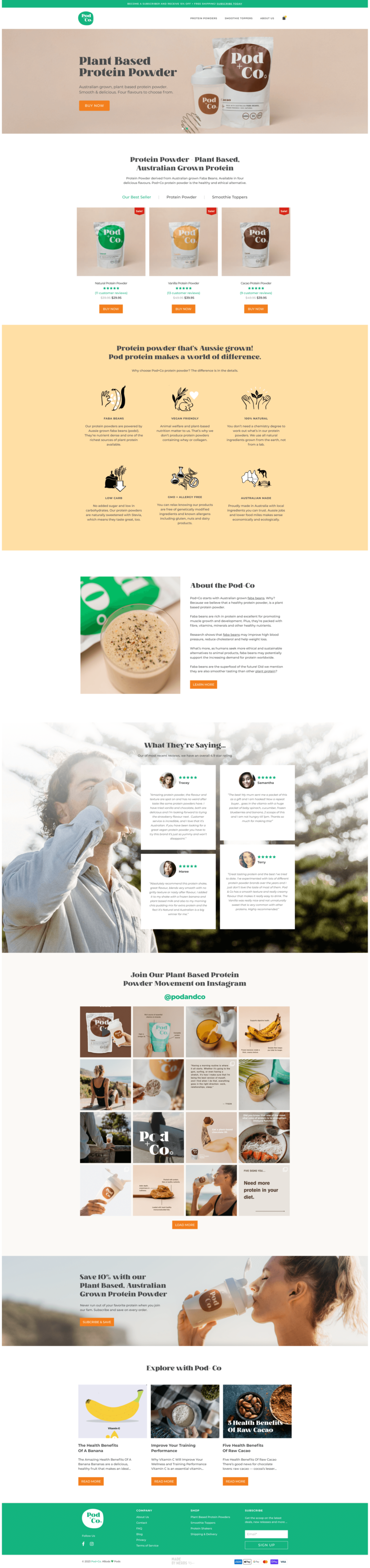
The warm beige hero with the hand-held Pod Co bag
The warm beige hero creates an immediate tonal contrast to the clinical white-and-blue aesthetic that dominates cheap supplement brands. The palette signals natural, premium, and approachable, appropriate for a brand whose core claim is clean ingredients from local farms. We didn’t use an athlete. The hero image is a product shot against a warm background, which is the right choice for a range-focused page. The product is the hero, not a lifestyle.
The headline “Plant Based Protein Powder” is direct and unambiguous. This page is for people searching for exactly that product, and the headline confirms it immediately. The orange “Shop Now” CTA provides the necessary contrast against the warm background, drawing the eye without the aggressive urgency of red.
The three-column product grid with star ratings and prices
The grid sits immediately below the hero, preceded by the heading “Protein Powder - Plant Based, Australian Grown Protein.” Each product card shows the flavour variant, star rating, review count, and price. Everything needed to make a variant selection decision without leaving the page. We considered a tabbed format with detailed spec sheets per variant, but our testing on supplement pages shows that a visual grid with ratings converts better because it mirrors the actual decision-making process: buyers look, compare visually, read ratings, select.
The “Protein powder that’s Aussie grown” section with illustrated icons
The section explains the sourcing story through five icons: the lifecycle from farm to product. It’s educational content that builds confidence, not marketing fluff. Each icon represents a step in the supply chain, which implicitly answers the trust objection: “I know where this came from.” We used hand-drawn style illustration rather than stock icons to keep the brand’s natural, artisanal positioning.
The Instagram feed embed
The feed at the base of the page does something no testimonial grid can. It proves daily usage by a diverse range of real people. The grid shows product photos, recipe ideas, and active customers, building the lifestyle context that converts first-time buyers into community members. We sized it to show nine tiles in a 3x3 grid on desktop. Enough to communicate volume without requiring a scroll commitment.
The "Save 10%" section appears well below the fold, after the brand story, product grid, and social proof have done their work. Discounts placed in the hero of a premium food brand undermine the quality perception the brand is trying to build. Positioned after trust is established, the same discount converts as a loyalty reward rather than a desperation signal.
Trust architecture
Layer one: provenance above the fold
“Australian Grown Protein” in the hero subtitle isn’t a tagline. It’s a trust signal that does more work than any certification badge for this audience. It answers the origin question before the visitor can ask it.
Layer two: community proof mid-page
The “What They’re Saying” testimonial section features verified star ratings with real names, profile photos, and detailed review text. We made sure the reviewers shown represent the actual demographic (everyday health-conscious buyers, not competitive athletes) because the Pod Co customer identifies with the former. A testimonial from someone who “uses it in my morning smoothie” lands better than an athlete’s performance metric for this specific buyer.
Layer three: Instagram as living proof
The embedded @podandco feed provides active social validation. It updates automatically, which signals the brand is active, has regular customers, and stands behind its product enough to feature real usage publicly. For a food product, that matters particularly. Seeing other people prepare and enjoy it normalises the purchase.

"Review counts matter as much as ratings. A product with 4.8 stars from 4 reviews looks shakier than one with 4.6 stars from 847 reviews. On this page the review counts sit under each product card in the grid, not just stars, but the number that proves the rating is real. That detail alone reduces the hesitation of first-time buyers."
Conversion strategy
The page follows a clear persuasion arc: establish what the product is and where it comes from (hero), show the range with social proof attached (product grid), explain the sourcing story that makes it worth the premium (icons section), validate with real community voices (testimonials), show the community in action (Instagram), then offer a first-purchase incentive (10% save section). Each section earns the next scroll.
The “Explore More with Pod Co” blog-style content section at the bottom serves dual purposes: it gives SEO-relevant content for organic traffic, and it gives indecisive buyers more reasons to stay engaged with the brand rather than bouncing to a competitor. Visitors who read the blog posts return at higher rates because they’ve invested time in the brand’s content, that investment creates commitment.
"DTC food brands make the mistake of putting everything behind the 'buy' button. The content section at the bottom of this page (recipe ideas, health benefits articles) keeps indecisive visitors in the brand ecosystem. They read one article, come back tomorrow, and convert on the second or third visit. The page does retention work, not just acquisition."
What we would evolve today
Our data from subsequent e-commerce builds suggests three changes worth testing for a Pod Co refresh:
Add a flavour selector inside the hero
Rather than requiring the visitor to scroll to the product grid to choose a flavour, placing a simple three-button selector (Original / Chocolate / Vanilla) in the hero reduces the step count to purchase. Visitors who choose a flavour above the fold arrive at the checkout step with higher intent.
Test a “starter bundle” bundle offer against the single-product grid
Subscription-model buyers in supplements often want to try two flavours before committing. A hand-picked starter pack, two variants at a bundle price, both increases order value and reduces the variant-selection paralysis that costs conversions in multi-SKU ranges.
Surface the review count in the hero
Something like “Rated 4.8 by 1,200+ Australians” immediately below the headline connects the page’s overall reputation to the first impression, before the visitor has had to scroll to the product grid to see individual product ratings.
Browse our full collection of landing page examples for more e-commerce design breakdowns. Want to build a product page that converts browsers into buyers? Talk to our team.
Waseem founded Apexure in 2015 and has led its work on 3,000+ pages for 300+ clients since. He writes about what the team sees after the click, which is pages, forms, tracking and the systems behind them.
What the page leans on
The principles at work on this page, each named in the analysis above.
Social proof
People follow the actions of others. Testimonials, reviews, and client logos build trust and reduce hesitation.
Visual hierarchy
Controlling what visitors see first, second, and third guides them toward the conversion goal.
Mere exposure effect
This principle influences visitor behaviour and supports the page's conversion goal.
Reciprocity
Giving something valuable first (free guide, tool, audit) creates an obligation to reciprocate.
What people ask about pages like this
Supplement buyers rarely purchase a single SKU on their first visit. They compare flavours, protein content per serve, and price per gram before deciding. A product grid showing three or four variants side by side, each with a star rating and price, maps to how this buyer actually shops. A single-hero approach works for a flagship launch, but for a product range with multiple options, the grid removes the 'which one do I get?' confusion that kills conversion.
Provenance claims in the supplement space carry real weight because adulteration scandals have made buyers genuinely cautious about what goes into their powder. 'Australian Grown Protein' is not just a patriotism cue, it's a quality signal and a supply chain transparency claim. For Pod Co, leading with the Australian sourcing story above the product features positions the brand as the premium, trustworthy option in a crowded market of cheaper imported alternatives.
An embedded Instagram grid showing real customers using the product serves three functions: it proves the product is in active use by real people (not just a polished brand shoot), it creates a lifestyle context that helps shoppers picture themselves as Pod Co customers, and it adds a stream of fresh UGC that signals the brand is alive and growing. For health products particularly, seeing diverse real people using something daily is more persuasive than a professional sports ambassador.
Our testing shows that a first-visit discount on supplement pages works best when it's positioned as a genuine value offer rather than a desperation tactic. The Pod Co 'Save 10%' section works because it comes after the brand story and product education, the visitor has already built intent before the discount is offered. Leading with a discount in the hero signals low perceived value and trains buyers to always wait for a deal. Lead with product quality, then offer the incentive as a loyalty reward.
Three more, taken apart the same way


Want one like this?
Tell us what the page has to do and where the traffic comes from. Within 48 hours you get a written quote from the people who wrote this breakdown. Already have a page that is not converting? Send it for a free audit instead.
UK hours, which is the East Coast morning.
"Supplement brands almost always want to lead with the product. We push back. Lead with the why. Visitors who understand 'Australian Grown, nothing added' before they see the product lineup make faster, more confident purchase decisions. The product grid becomes a confirmation, not a discovery."