
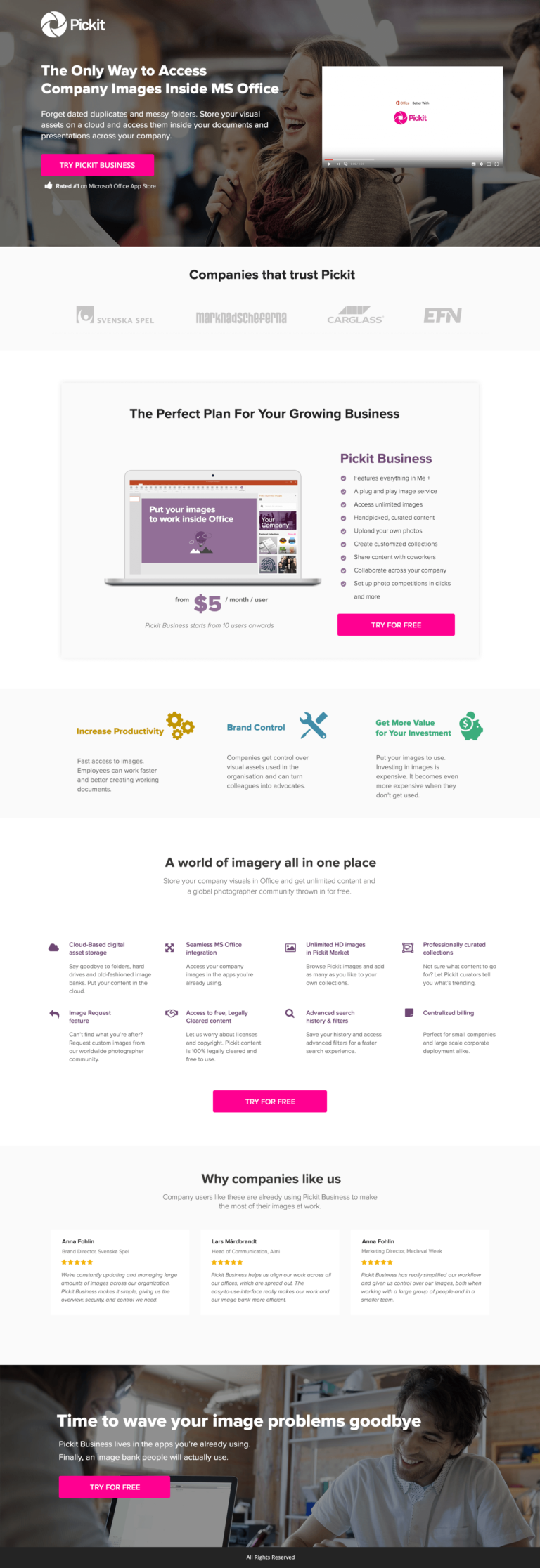
Shown inside PowerPoint, sold at $5 a user.
Pickit's click-through page for enterprise marketing and IT teams, built on Unbounce with a free trial as the only ask. The 'only way' headline, one benefit column per stakeholder, and the security section we would add.
- Primary CTATry for Freethe button the page is built around
- GoalClick-Throughwhat counts as a conversion
- PlatformUnbounceclick-through page
- Built forB2BSaaS
- The page as built, not a mockup.Analysed by Apexure, not by Pickit.
- Client
- PickitSaaS
- Industry
- SaaS30 examples
- Audience
- B2BClick-Through
- Platform
- Unbounce132 examples
- Page type
- Click-throughClick-Through
- Analysed by
- Waseem BashirMarch 2026
What the page does, and why
Why this page was built this way
Pickit solves a specific, expensive problem that most large organisations don’t realise they have: employees making off-brand presentations because they can’t find the right images in time, so they use whatever they can access quickly. The page’s job is to make this invisible problem visible, and then show that Pickit resolves it at a price that feels trivial against the cost of brand inconsistency.
The Microsoft Office positioning is the strategic anchor. Every enterprise buyer in the target demographic uses Office. Placing Pickit inside a tool they already live in removes the adoption friction that kills most enterprise SaaS purchases.
Design decisions
“The only way to access company images inside MS office”
The headline is a category claim that positions Pickit as uniquely occupying a gap in the enterprise software market. It doesn’t say ‘the best way’ or ‘an easier way’. It says ‘the only way’, which implies that without Pickit, the problem is unsolved. This headline type tends to outperform feature-first headlines in enterprise SaaS because it creates urgency from the absence of the solution, not the promise of the feature.
“Put your images to work inside office” dashboard mockup
The mockup shows the product in the exact context the buyer cares about: a PowerPoint document with the Pickit panel open inside it. This is the most important product visualisation decision on the page. Showing the product inside Office means the buyer can immediately envision adoption without a dedicated IT deployment. The interface looks familiar because it lives inside a familiar tool.
The three benefit columns
Increase Productivity, Brand Control, Get More Value for Your Investment. The three columns address the three buying perspectives in an enterprise SaaS purchase. The department manager cares about productivity. The CMO cares about brand control. The CFO/procurement cares about value for investment. Each column speaks directly to one stakeholder’s primary concern. The structure means the page works for a buying committee, not just a single decision-maker.
The eight-feature grid
Cloud storage, MS Office integration, unlimited HD images, hand-picked collections, image request feature, legally cleared content, advanced search, centralised billing. The breadth of features signals that Pickit isn’t a point solution but a full DAM platform. Enterprise buyers want to know they’re not going to hit a ceiling within a year.
The client logo section
Featuring recognisable enterprise names including EY, Reuters, Aon, the logo section provides tier-appropriate social proof. Enterprise buyers validate new tools by checking whether comparable organisations already use them. Seeing EY and Reuters on the page signals that Pickit’s security, reliability, and enterprise support capabilities meet standards the buyer’s IT team will recognise.
The "legally cleared content" feature bullet is a risk-removal signal that matters disproportionately to the enterprise audience. Large organisations have been exposed to copyright infringement claims from employees using unlicensed images. A platform that guarantees legally cleared content isn't just offering a convenience. It removes a liability. Legal risk removal is a more powerful enterprise buying signal than almost any productivity benefit.
Trust architecture
Pickit’s trust architecture is built for multi-stakeholder enterprise evaluation. Microsoft integration depth (the product lives inside Office) signals security and compatibility approval. Enterprise client logos (EY, Reuters, Aon) provide tier-matched social proof. The legal clearance claim removes compliance risk. Per-user pricing from $5 makes the financial justification straightforward. The free trial CTA removes the commitment barrier for evaluation. Together these signals answer the five enterprise buying questions: Does it work with our tools? Do comparable companies use it? Is it safe from a legal standpoint? Can we afford it? Can we evaluate it before committing?

"Enterprise SaaS pages have to satisfy multiple stakeholders who are all looking at the same page with different questions. The IT manager asks 'will this break anything?', the CMO asks 'will this solve my brand problem?', and the CFO asks 'is this worth the budget?' The Pickit page is architected to answer all three simultaneously. That's why the trust architecture, benefit columns, and pricing section are all on the same page."
Read more about how we approach trust signals in our guide to Ways To Increase Landing Page Social Proof.
The "Try for Free" CTA for an enterprise product is a notably bold conversion strategy. Enterprise platforms typically require a demo request or sales contact before any product access. By offering a free trial directly from the landing page, Pickit signals confidence in its product quality and removes the sales friction that causes enterprise evaluators to defer decisions. Self-service trial access tends to outperform demo-first funnels for mid-market enterprise buyers.
Conversion strategy
The primary CTA (“Try for Free”) drives enterprise evaluators directly into a trial rather than a sales contact. The self-service model respects the enterprise buyer’s time and their preference to evaluate software independently before engaging with sales. The trial converts at the point of product realisation: when the buyer installs Pickit inside Office and sees their brand images available in a PowerPoint panel, the value proposition becomes immediately self-evident.
"For a product that integrates directly into the buyer's daily tool, the free trial is the most efficient sales process available. Once a team has Pickit inside their PowerPoint and experienced the speed of accessing approved brand images instantly, the question isn't 'should we buy this?'. It's 'why didn't we have this sooner?' Build the trial experience to deliver that realisation moment, and the conversion happens without a sales call."
Platform: Unbounce
Unbounce was chosen for the flexibility to build the feature grid, benefit columns, and client logo sections with precise visual control. The platform’s A/B testing capability enabled iteration on the headline variants and CTA copy without developer involvement.
Mobile experience
Enterprise SaaS evaluations increasingly happen on mobile during commutes and travel. The feature grid and pricing section were optimised to stack cleanly on mobile screens while keeping the feature comprehensiveness that enterprise buyers need to see. The “Try for Free” CTA was sized for confident mobile tap.
Enterprise SaaS pages are evaluated competitively. Buyers often have multiple browser tabs open comparing platforms simultaneously. A slow page loses attention before the buying committee has reached the feature grid. We kept the dashboard mockup as a CSS-styled component rather than a photographic file, keeping visual impact at minimal load cost.
Evolve today
Three changes would improve this page’s performance.
Brand consistency ROI calculator. A “calculate your brand consistency cost” tool, framed around what inconsistent brand presentation costs an enterprise, makes the business case immediately quantifiable. Enterprise buyers who can see the financial cost of the problem they’re solving are more motivated than those who see only the solution.
IT security section. A brief “enterprise-grade security” callout (SOC 2 compliance, SSO support, admin controls) would address the IT security evaluation that happens in parallel with the business case evaluation at most enterprises. Security objections not addressed on the page become the delay at the procurement stage.
Video walkthrough. A 90-second screen recording of Pickit inside PowerPoint (showing the search, selection, and insertion flow) would convert evaluators who need to see the product working before starting a trial. The “only way” claim becomes irrefutable once you’ve seen the integration in action.
Browse our full collection of landing page examples to see how we apply these principles across industries. Building an enterprise SaaS page that converts evaluators into trial users? Talk to our team.
Waseem founded Apexure in 2015 and has led its work on 3,000+ pages for 300+ clients since. He writes about what the team sees after the click, which is pages, forms, tracking and the systems behind them.
What the page leans on
The principles at work on this page, each named in the analysis above.
Visual hierarchy
Controlling what visitors see first, second, and third guides them toward the conversion goal.
Authority bias
People trust credible experts. Certifications, awards, media mentions, and expert endorsements boost credibility.
Social proof
People follow the actions of others. Testimonials, reviews, and client logos build trust and reduce hesitation.
F-pattern layout
Eye-tracking shows people scan pages in an F-shape. Placing key content along this path increases engagement.
Cognitive load reduction
Simpler pages convert better. Reducing visual noise, breaking forms into steps, and clear copy lower mental effort.
What people ask about pages like this
Pickit is an enterprise image management platform that integrates directly with Microsoft Office, allowing employees to find, access, and use on-brand images inside PowerPoint, Word, and other Office applications without leaving the suite. It's designed for marketing and IT teams at mid-to-large enterprises who need to enforce brand consistency across presentations and documents, while reducing the time employees waste searching for approved imagery on external platforms.
The 'only way' claim is a category-creation strategy. By framing Pickit as the exclusively native solution for image access inside Office, the page defines a category it occupies alone. This is more effective than leading with feature lists because it immediately establishes a comparison framework: 'what's the alternative?' The alternative, employees hunting across shared drives, emailing the marketing team, using unauthorised stock photos, is implicitly made visible by the 'only way' framing.
For a SaaS product whose core value proposition is Microsoft Office integration, Microsoft's implicit endorsement, shown through logo placement and integration depth, is the single most powerful trust signal available. Enterprise buyers evaluating new tools ask 'is this going to cause IT problems?' Microsoft logo proximity answers that question before it's asked. The EY, Reuters, and Aon client logos then confirm that enterprise organisations at scale are already using the platform.
At $5 per user per month, Pickit is priced below the threshold that requires CFO approval in most enterprises, it's a manager-level or team budget decision. The page correctly starts Pickit Business at 10 users, which creates a natural team-size minimum that filters out individual freelancers while remaining accessible for department-level decisions. The per-user pricing model also scales the value proposition: as more employees use Pickit, brand consistency improves proportionally.
Three more, taken apart the same way



Want one like this?
Tell us what the page has to do and where the traffic comes from. Within 48 hours you get a written quote from the people who wrote this breakdown. Already have a page that is not converting? Send it for a free audit instead.
UK hours, which is the East Coast morning.
"Enterprise SaaS pages fail when they lead with features and miss the business problem. The Pickit page gets this right by framing the product through its integration with the tool the buyer already uses all day. You're not asking them to adopt a new platform. You're giving them a better version of the tool they already depend on. That framing eliminates the adoption objection before it forms."