
Four steps to a certificate, £99 by every button.
Niche Academy's ClickFunnels sales page for a £99 beginner facial course, aimed at career-changers with no training. How process steps beat a curriculum list for nervous learners, and the sample lesson we would add.
- Primary CTAEnrol in the Coursethe button the page is built around
- GoalClick-Throughwhat counts as a conversion
- PlatformClickFunnelsclick-through page
- Built forB2CEducation & Training
- The page as built, not a mockup.Analysed by Apexure, not by Niche Academy Courses 2.
- Client
- Niche Academy Courses 2Education & Training
- Industry
- Education & Training21 examples
- Audience
- B2CClick-Through
- Platform
- ClickFunnels11 examples
- Page type
- Click-throughClick-Through
- Analysed by
- Waseem BashirMarch 2026
What the page does, and why
Why this page was built this way
The Basic Facial Course sales page targets career-changers and side-income seekers who are interested in beauty therapy but have never taken a formal course. The visitor is usually confident about their interest but uncertain about two things: whether they can complete a course, and whether the investment will pay off.
The page resolves both concerns quickly. The beginner-friendly framing removes capability anxiety. The £99 price point and certification outcome reframe the cost as a low-risk career investment with a tangible credential at the end.
Design decisions
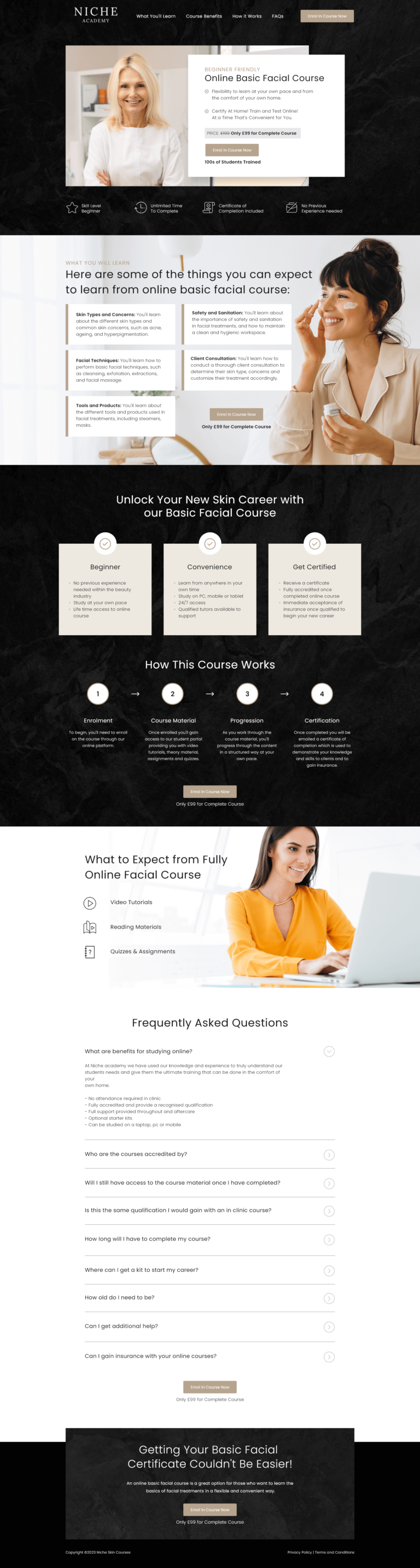
The three-pillar benefit section (Beginner, Convenience, Get Certified) is the page’s first decision architecture. Each pillar addresses a specific visitor concern. Beginner resolves “can I do this?”. Convenience resolves “will this fit my life?”. Get Certified resolves “is it worth doing?”. Three is the right number here. One pillar per core objection, presented in the order those objections typically surface.
The 4-step “How This Course Works” section (Begin, Course Material, Progression, Certification) makes the learning journey feel achievable before the visitor has committed. Four clearly labelled steps to a credential signal: this is a finite, structured path with a definite end point. Vague “flexible online learning” language generates anxiety. Numbered steps to a certificate generate confidence.
The “Only £99 for Complete Course” price callout, repeated near every CTA, does value framing that long sales copy would take paragraphs to achieve. At £99, the course is accessible to most visitors without serious budget deliberation. The word “complete” signals there’s no upsell or additional spend hiding behind the enrolment button.
The “What to Expect from Fully Online Facial Course” section with video tutorials, reading materials, and quizzes sets delivery expectations clearly. Visitors who know exactly what they’re buying have lower post-purchase regret and lower chargeback rates. Course content transparency is also a trust signal. Providers who are specific about delivery have nothing to hide.
The FAQ section at the bottom handles the long-tail objections that the above-fold content can’t address without creating clutter. FAQs work well on course pages because they anticipate and answer the individual questions that prevent sign-up without requiring the visitor to contact support or search elsewhere.
For beginner-level courses, the page's conversion challenge isn't convincing visitors the course is good. It's convincing them they're capable of completing it. Curriculum-heavy pages fail beginners because they make the course look complicated. Process-forward pages succeed because they make the path look achievable. Design for capability confidence, not just product quality.
Trust architecture
For a low-price online course, trust is built through four things. Process transparency: the 4-step completion path shows a real course structure. Certificate specificity: a named, recognisable credential rather than a vague “certificate of completion.” Delivery detail: video tutorials, reading materials, quizzes, all of which show genuine content depth. Price transparency: no hidden costs, one clear price, no required upsells.

"Online courses under £100 are bought on impulse but abandoned at checkout if the trust signals aren't in place. The trust required for a £99 course isn't about brand prestige. It's about certainty. Will I get what they're promising, will the certificate mean something, and will this actually teach me skills I can use? Answer those three questions clearly on the page and the £99 barrier is trivial."
Read more about how we approach trust signals in our guide to Ways To Increase Landing Page Social Proof.
The "Getting Your Basic Facial Certificate Couldn't Be Easier" footer section reframes the end of the page (typically where uncertainty peaks) with a confidence statement. That final reassurance addresses the last-moment hesitation that prevents form completion on low-cost course pages. An ending that says "this is easy" sends visitors into the checkout with momentum rather than doubt.
Conversion strategy
The page drives a single enrolment action through the “Enrol in the Course” CTA. At £99 with a direct payment flow, the enrolment friction is minimal. The page’s job is to make sure the visitor is confident and excited, not just interested, when they reach the CTA. The process section, certification promise, and FAQ do the groundwork. The CTA catches the decision at the moment confidence is highest.
"At £99, the primary conversion job isn't overcoming price resistance. It's overcoming inertia. Most visitors who land on a well-built beginner course page already want to do this. The page's job is to resolve the 'but I'll do it later' objection by making now feel like the right time. The process steps and clear certification outcome create the urgency that 'buy now' copy never achieves."
Platform: ClickFunnels
ClickFunnels manages the transition from course page to payment smoothly, keeping visual continuity and avoiding the jarring context switch that causes checkout abandonment. For a low-price, impulse-proximate purchase, a smooth transition between page and payment is a meaningful conversion factor.
Mobile experience
Beauty career seekers browse and enrol largely on mobile, often during evening leisure time. The course steps, benefit pillars, and CTA were all sized and spaced for comfortable mobile reading and tapping. The price callout near every CTA means the visitor never has to scroll back to confirm the cost before committing.
Low-cost course pages are often driven by high-volume paid social traffic. At low per-click costs, every second of load delay multiplies across thousands of visits. We kept the page clean and media-light, using compressed imagery and icon-based design elements that render instantly without sacrificing the premium aesthetic that the cream/charcoal palette creates.
Evolve today
Three improvements would meaningfully lift this page’s performance.
A brief case study (“Sarah had never done a facial before. After completing the Basic Facial Course, she now offers treatments from home for £50 per session”) makes the £99 investment feel like a business decision with a clear financial return rather than a course fee.
A 5-minute video preview of an actual course lesson, visible without signing up, would let interested visitors experience the teaching quality before committing. For a £99 course, product sampling dramatically accelerates the purchase decision.
Specifying which industry bodies or insurance providers recognise the certificate would address the “but is this qualification actually useful?” question that underlies many of the FAQ queries.
Browse our full collection of landing page examples to see how we apply these principles across industries. Building a course or certification sales page? Talk to our team.
Waseem founded Apexure in 2015 and has led its work on 3,000+ pages for 300+ clients since. He writes about what the team sees after the click, which is pages, forms, tracking and the systems behind them.
What the page leans on
The principles at work on this page, each named in the analysis above.
Visual hierarchy
Controlling what visitors see first, second, and third guides them toward the conversion goal.
Social proof
People follow the actions of others. Testimonials, reviews, and client logos build trust and reduce hesitation.
F-pattern layout
Eye-tracking shows people scan pages in an F-shape. Placing key content along this path increases engagement.
Cognitive load reduction
Simpler pages convert better. Reducing visual noise, breaking forms into steps, and clear copy lower mental effort.
What people ask about pages like this
The Basic Facial Course is Niche Academy's entry-level skin qualification, designed for absolute beginners, no prior experience required. It delivers a recognised certification in facial skincare, accessible entirely online, for £99. The course is positioned as a career starting point: the credential that allows graduates to offer professional facial treatments as a freelance or employed therapist.
£99 sits below the psychological barrier that triggers serious deliberation in the education purchase. At this price, the decision is impulsive-adjacent, the visitor doesn't need to consult a partner, wait for a pay cycle, or justify the spend to themselves at length. The page's entire conversion architecture is built around maintaining this low-friction price perception: simple page, clear process, single CTA. Any additional complexity would disproportionately damage conversion at this price band.
A curriculum list creates a 'how much work is this?' reaction. A 4-step process creates a 'what happens when I sign up?' reaction. The difference is psychological: process steps are motivating (they show a path to completion), while curriculum lists are evaluative (they invite the visitor to assess whether they can or want to do all of that). For a beginner course selling to people who are nervous about learning, showing a short clear process dramatically reduces enrolment anxiety.
A completion certificate changes the purchase from a learning expense to a career investment. When visitors know they'll receive a recognised credential, the ROI calculation changes: they're not just paying for information, they're paying for a qualification that enables income. This reframing of the purchase is particularly effective for beginner-level courses where the visitor needs to justify spending £99 on something they've never done before.
Three more, taken apart the same way



Want one like this?
Tell us what the page has to do and where the traffic comes from. Within 48 hours you get a written quote from the people who wrote this breakdown. Already have a page that is not converting? Send it for a free audit instead.
UK hours, which is the East Coast morning.
"Entry-level course pages have one primary conversion job: eliminate the 'but I've never done this before' objection. The word 'beginner' in the headline does more CRO work than any feature list. It gives permission. Once someone knows the course was built for people like them, the price and process become much easier to commit to."