
Built for couples, sold with real screenshots.
Monarch Money's Unbounce click-through page for its personal finance app, aimed at partners who budget together. Six product panels, a 4.8-star rating from 2,700 reviews, the 7-day trial, and the missing bank logos.
- Primary CTAStart a Free 7-Day Trialthe button the page is built around
- GoalClick-Throughwhat counts as a conversion
- PlatformUnbounceclick-through page
- Built forB2CSaaS
- The page as built, not a mockup.Analysed by Apexure, not by Monarch Money.
- Client
- Monarch MoneySaaS
- Industry
- SaaS30 examples
- Audience
- B2CClick-Through
- Platform
- Unbounce132 examples
- Page type
- Click-throughClick-Through
- Analysed by
- Waseem BashirMarch 2026
What the page does, and why
Why this page was designed this way
Monarch Money sits in a crowded personal finance app market. Every competitor offers budgeting, expense tracking, and financial goals. The differentiator Monarch owns is couples. The app is built for shared financial management between partners. This page leans into that positioning completely rather than trying to appeal to everyone.
The design shows the product’s personality: clean, premium, reassuring. Financial apps need to convey security and competence without feeling cold. The white-dominant layout with blue and soft coral accents achieves that balance.
Design decisions
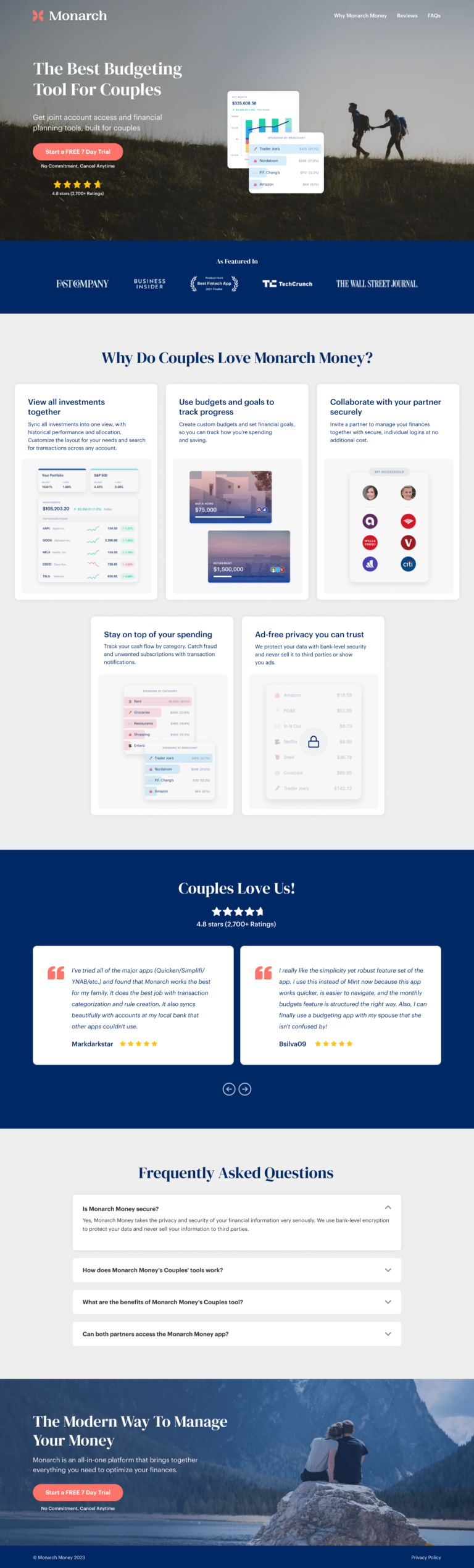
The product feature grid (six feature panels in a clean two-column layout) gives a full but scannable overview of what the app does. Each panel has a heading, a brief description, and a product screenshot. The screenshots are genuine UI from the app, not marketing mockups, which matters because authenticity signals the product is mature and real.
The “Couples Love Us!” section with a 4.8-star rating and 2,700+ reviews is the page’s primary trust anchor. We positioned it mid-page, after the feature present, because by the time a visitor has seen the features and thought “this looks promising,” social proof closes the remaining doubt. Placing it before the features would waste the credibility. The visitor hasn’t yet decided they want the product.
The testimonial pair (MarkDarkstar and BelicaD5) are from people describing their couple-specific use case. MarkDarkstar says “I found that Monarch works best for my family.” BelicaD5 says “I can finally use a budgeting app with my spouse.” Those testimonials reinforce the couples positioning without the page having to state it again.
The hero screenshot showing the actual Monarch dashboard with real financial data (portfolio allocation, transactions, investment performance) demonstrates the richness of the product. For a paid subscription, prospective users want evidence that the tool is full. The dashboard screenshot is that evidence.
The FAQ section addresses the product’s four main conversion objections: security, the couples-sharing mechanism, the benefits, and accessibility for both partners. Each FAQ is answered concisely. The goal is to resolve doubt, not to educate. Visitors who want more can find it. The FAQ exists to stop the page from losing visitors to unanswered questions.
The footer CTA ("The Modern Way to Manage Your Money") is a positioning statement, not a tagline. It tells the visitor that not using Monarch is the old way and using it is the modern way. That framing creates gentle social pressure: savvy people manage money this way now. Positioning your product as the contemporary choice makes inaction feel dated.
Trust architecture
Monarch Money’s trust architecture is product-led. The screenshots are the most powerful trust signal on the page. For a financial app, showing real UI (with real investment data, real budget allocations, real partner collaboration features) is more convincing than any testimonial. The testimonials reinforce what the screenshots have already established. The star rating with count provides social scale.

"For apps, screenshots are testimonials. When a visitor can see the actual interface they'll be using (not a polished marketing mockup, but the real product) their anxiety about 'will this actually work for me?' drops dramatically. Real UI is the strongest trust signal a SaaS product can show."
Read more about how we approach trust signals in our guide to Ways To Increase Landing Page Social Proof.
The "No commitments. Cancel anytime." line below the trial CTA is a friction reducer that costs nothing but removes a real objection. Visitors who were hesitating because they feared being trapped in a subscription now feel safe to start. This micro-copy is doing heavy conversion lifting for two words.
Conversion strategy
The “Start a FREE 7-Day Trial” CTA is the page’s conversion mechanism. “FREE” reduces friction, “7-Day” sets a clear scope, “Trial” implies no obligation. Together those three elements make the click feel low-risk. The “No commitments. Cancel anytime.” line below the button reinforces that framing for the final hesitant visitors.
"Adding 'No credit card required' or 'Cancel anytime' below a trial CTA has lifted trial sign-ups on pages we have built. The visitor has already been sold on the product by the page. The only barrier left is commitment anxiety. Two short phrases remove that barrier for a meaningful percentage of hesitant visitors."
Platform: Unbounce
Unbounce was used here for its clean canvas and native A/B testing. The product screenshot grid and testimonial slider were built without custom code, keeping the page maintainable for the client’s marketing team.
Mobile experience
Personal finance management is a mobile-primary activity for most users. We made sure the feature grid stacks cleanly to single-column on small screens, the screenshots scale without distortion, and the trial CTA is accessible without scrolling past the fold on common phone sizes.
The six feature panel screenshots are the page's heaviest assets. We compressed each to WebP and lazy-loaded below-fold panels so the hero loads instantly. Users who don't scroll to see all features still get a fast initial experience, which is critical for paid traffic conversion.
Evolve today
Three changes would improve this page’s conversion rate:
- Couple-specific onboarding preview: A short animated GIF showing how two people set up a shared Monarch account in under 2 minutes would reduce the “how does the couple thing actually work?” question that FAQs don’t fully resolve
- Partner brand integrations list: Showing logos of banks and investment platforms Monarch connects to (Fidelity, Vanguard, Chase, etc.) would address the “will it work with my accounts?” question that’s likely a significant drop-off point
- Exit intent offer: A pop-up offering an extended trial (14 days instead of 7) for visitors who show exit intent would recover a meaningful percentage of visitors who liked the page but weren’t quite ready to start
Browse our full collection of landing page examples to see how we apply these principles across industries. Want a SaaS trial page that converts? Talk to our team.
Waseem founded Apexure in 2015 and has led its work on 3,000+ pages for 300+ clients since. He writes about what the team sees after the click, which is pages, forms, tracking and the systems behind them.
What the page leans on
The principles at work on this page, each named in the analysis above.
Visual hierarchy
Controlling what visitors see first, second, and third guides them toward the conversion goal.
Social proof
People follow the actions of others. Testimonials, reviews, and client logos build trust and reduce hesitation.
F-pattern layout
Eye-tracking shows people scan pages in an F-shape. Placing key content along this path increases engagement.
Cognitive load reduction
Simpler pages convert better. Reducing visual noise, breaking forms into steps, and clear copy lower mental effort.
What people ask about pages like this
Monarch Money's key differentiator is the couple-first design, the app is built for financial collaboration between partners, not just individual budgeting. The landing page leads with this positioning ('Couples Love Us!') because it narrows the target audience to a specific use case and makes the app feel purpose-built rather than generic. Purpose-built tools always convert better than general-purpose ones with equivalent features.
For a financial management app, the product itself is the most compelling visual. Screenshots of the actual dashboard, investment tracking, budget allocation, partner collaboration, answer the visitor's first question: 'What will I actually be using?' Showing real UI reduces uncertainty about what they're signing up for, which is one of the biggest conversion barriers for SaaS trials.
The star rating with a specific count is more persuasive than a rating alone because the number signals scale: 2,700 people made a deliberate choice to rate this app. That's not a hand-picked sample, it's a mass behaviour signal. On a page where the visitor is deciding whether to hand over their financial data, a large-scale positive rating is one of the most effective trust signals available.
Seven days is a deliberate choice, not an arbitrary one. Long enough for the user to set up their accounts, run one budget cycle, and see the app's value, short enough to create urgency around the subscription decision. 30-day trials often result in users forgetting to cancel rather than choosing to subscribe. 7 days forces the decision when the experience is fresh and the value is most apparent.
Three more, taken apart the same way



Want one like this?
Tell us what the page has to do and where the traffic comes from. Within 48 hours you get a written quote from the people who wrote this breakdown. Already have a page that is not converting? Send it for a free audit instead.
UK hours, which is the East Coast morning.
"SaaS pages that try to appeal to everyone convert poorly for everyone. The moment Monarch Money narrowed its positioning to 'the app for couples,' they gave themselves a distinct advantage over generic budgeting apps. That positioning work (done before the page was designed) is what makes the landing page effective."