
The 90+ lender count outworks any testimonial.
Miles&Barr's Buy to Let mortgage advice lead page for landlords, built on Unbounce around a free consultation. Why the star rating sits under the headline, and the keyword-matched headlines and video we would add.
- Primary CTABook a Free Consultationthe button the page is built around
- GoalLead Generationwhat counts as a conversion
- PlatformUnbouncelead generation page
- Built forB2CFinance
- The page as built, not a mockup.Analysed by Apexure, not by Miles&Barr.
- Client
- Miles&BarrFinance
- Industry
- Finance32 examples
- Audience
- B2CLead Generation
- Platform
- Unbounce132 examples
- Page type
- Lead generationLead Generation
- Analysed by
- Waseem BashirMarch 2026
What the page does, and why
Why this page was built the way it was
Miles&Barr’s mortgage advice service operates in a crowded field. Every major bank, every comparison site, and every independent broker is competing for the same buyer intent searches. The brief was clear: we needed a page that earns trust inside the first viewport and holds it through to the form.
The audience is B2C, landlords and homeowners who are financially literate but emotionally invested. They’re not looking for jargon. They want to know that this firm understands their situation and can find them the right deal across a wide panel of lenders.
Design decisions
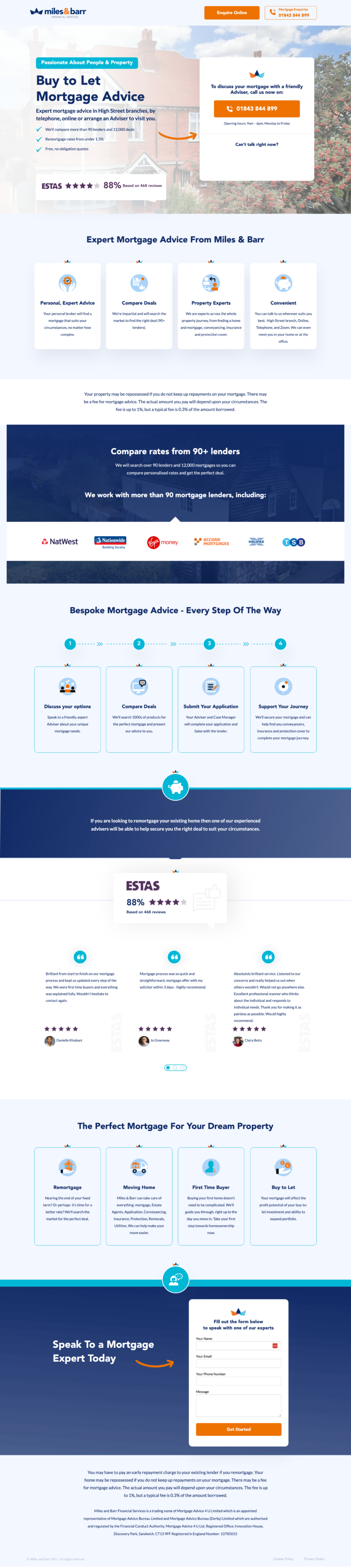
The full-width hero leads with the service name, “Buy to Let Mortgage Advice”, not a clever headline that makes visitors work. The hero image shows property, reinforcing the Buy to Let context. This is intentional message-matching: the visitor who clicked a Buy to Let ad arrives and immediately sees Buy to Let. That confirmation reduces bounce before a single word is read.
The star rating and review count sit directly below the headline. We placed these at the top because social proof is most powerful where doubt is highest, and doubt peaks the moment someone lands on an unfamiliar page. The 5-star rating with a numerical count anchors trust before the visitor has any reason to distrust.
Custom icons
in the services strip (Personal Expert Advice, Exclusive Deals, Property Expertise, Insurance) communicate scope efficiently. Rather than a paragraph of service descriptions, each icon-plus-label pair takes one second to absorb. The strip tells visitors what they’ll get without asking them to read.
The “Compare rates from 90+ lenders” section is a credibility section masquerading as a feature. “90+” is a number that carries weight. It signals access, breadth, and negotiating power. We made this a standalone section rather than burying it in body copy because numbers anchored in their own space carry more cognitive weight.
The sticky header keeps the CTA button visible at every scroll depth. On a page this length, a visitor convinced at section three shouldn’t need to scroll back to act. The sticky header eliminates that friction entirely.
The most important trust signal on a finance page isn't a testimonial. It's a number. "90+ lenders" does more conversion work than any written testimonial because it's instantly verifiable in the visitor's mind and immediately relevant to their decision.
Trust architecture
Trust is layered across this page, not concentrated in one place. Above the fold: brand name, star rating, and review count. Mid-section: the expert icons strip, which communicates professional competence without having. Lower section: the lender count, which signals market access. Near the CTA: the invitation to compare, a low-commitment framing that reduces the psychological weight of submitting a lead form.

"The biggest trust mistake I see on finance pages is treating testimonials as decoration, a carousel at the bottom that no one scrolls to. Move your strongest social proof to where anxiety is highest: right below the headline, before the visitor has decided whether to stay."
Read more about how we approach trust signals in our guide to Ways To Increase Landing Page Social Proof.
The review count matters as much as the star rating. "5 stars" is meaningless without scale. "5 stars from 950+ reviews" is credibility. Always show the number alongside the rating, it transforms a decoration into a data point.
Conversion strategy
The lead form strategy on this page is deliberate restraint. We ask for only what’s needed to start a conversation, the visitor doesn’t need to provide mortgage details upfront. The CTA framing (“Book a Free Consultation”) positions the next step as a benefit, not a commitment. This matters enormously in finance, where visitors are trained to be suspicious of data-harvesting forms.
"On finance pages, the CTA isn't asking for a sale. It's asking for a conversation. The moment your button says 'Book a Free Consultation' instead of 'Get a Quote', the perceived commitment drops dramatically. That single word change can move conversion rate by 15% or more."
Platform: Unbounce
Unbounce was the right platform here because it gives us full design control alongside native A/B testing. For a regulated sector like mortgages. We need to be able to iterate quickly on copy, particularly around compliance language, without a developer deploy cycle.
Mobile experience
Mortgage searches spike on mobile during commutes and evenings. We tested the page on a phone, thumb-tested every tap target, and confirmed the form fields were large enough to complete without zooming. The sticky CTA on mobile is sized for thumb access rather than pointer precision.
Finance pages attract high-intent traffic that cost real money to acquire. A slow load wastes that spend. We optimise every page we build for Core Web Vitals, not as a box-ticking exercise but because speed directly correlates with the bounce rate of paid traffic.
Evolve today
If we were revisiting this page now, three changes would be top of the list:
- Personalised headline variants: Use Unbounce’s active text replacement to swap the headline for visitors arriving from specific keyword groups, “Buy to Let Mortgage Advice” for BTL searches, “Remortgage Advice from 90+ Lenders” for remortgage traffic. Same page, dramatically higher message match
- Add a concrete timeline: “Get a rate comparison in 24 hours” reduces the ambiguity around what happens after the form submission. Visitors fear the unknown follow-up more than they fear the form itself
- Video testimonial above the fold: A 30-second video from a real landlord client would outperform the text review strip in both trust transfer and dwell time
"Active text replacement is underused on finance pages. Every keyword group has a slightly different intent, and a headline written for that specific intent will always outperform a generic headline. It takes an hour to set up and the lift in conversion is measurable within days."
Browse our full collection of landing page examples to see how we apply these principles across industries. Ready to build a finance page that earns trust and converts? Talk to our team.
Waseem founded Apexure in 2015 and has led its work on 3,000+ pages for 300+ clients since. He writes about what the team sees after the click, which is pages, forms, tracking and the systems behind them.
What the page leans on
The principles at work on this page, each named in the analysis above.
Visual hierarchy
Controlling what visitors see first, second, and third guides them toward the conversion goal.
Social proof
People follow the actions of others. Testimonials, reviews, and client logos build trust and reduce hesitation.
F-pattern layout
Eye-tracking shows people scan pages in an F-shape. Placing key content along this path increases engagement.
Cognitive load reduction
Simpler pages convert better. Reducing visual noise, breaking forms into steps, and clear copy lower mental effort.
What people ask about pages like this
A mortgage advice landing page converts when it removes ambiguity fast. Visitors arrive with a specific situation, Buy to Let, remortgage, first-time buyer, and the headline must confirm immediately that this page is for them. From there, trust signals (ratings, lender counts, expert credentials) do the heavy lifting. The CTA should describe the action and its outcome: 'Book a Free Consultation' beats 'Get in Touch' every time.
The main Miles&Barr website serves multiple audiences across estate agency and financial services. A dedicated landing page strips everything away except the single offer, mortgage advice, and guides each visitor toward one action. Removing navigation, competing services, and unrelated content consistently increases conversion rates for focused campaigns.
The '90+ lenders' stat does two things simultaneously. It communicates breadth of choice, visitors feel they won't be locked into a limited panel, and it signals expertise. An advisor who works across 90+ lenders isn't a generalist; they're a specialist who knows the full market. Statistics like this anchor perceived value before the visitor has read a single benefit bullet.
A finance lead generation page typically takes 2–3 weeks from brief to launch. This covers audience research, wireframing, visual design, copy, Unbounce build, and device testing. We work quickly but not at the cost of quality, every element is reviewed against the conversion goal before we call it done.
Three more, taken apart the same way


Want one like this?
Tell us what the page has to do and where the traffic comes from. Within 48 hours you get a written quote from the people who wrote this breakdown. Already have a page that is not converting? Send it for a free audit instead.
UK hours, which is the East Coast morning.
"Finance pages lose visitors to distrust, not to disinterest. The person clicking a mortgage ad already wants a mortgage, they just don't trust the firm yet. So we treat the first viewport as a credibility pitch, not a sales pitch. If we earn trust above the fold, the form is easy."