
Bring happy back, then name the science.
MindFit's workplace mental health training page, built in Unbounce for HR and L&D leads who must justify the spend. Four delivery formats, a research section, a book-a-call CTA, and the ROI calculator we would add.
- Primary CTABook a Callthe button the page is built around
- GoalLead Generationwhat counts as a conversion
- PlatformUnbouncelead generation page
- Built forB2BEducation & Training
- The page as built, not a mockup.Analysed by Apexure, not by MindFit.
- Client
- MindFitEducation & Training
- Industry
- Education & Training21 examples
- Audience
- B2BLead Generation
- Platform
- Unbounce132 examples
- Page type
- Lead generationLead Generation
- Analysed by
- Waseem BashirMarch 2026
What the page does, and why
Why this page was built
MindFit delivers science-backed mental health training to workplaces looking to address employee wellbeing beyond tick-box compliance. The target buyers are HR directors, wellbeing leads, and L&D managers at organisations that have recognised mental health as a business performance issue, not just an HR obligation.
The landing page needed to establish scientific credibility, demonstrate practical delivery flexibility, and create enough confidence for a buying conversation, without requiring the prospect to commit before understanding what the programme involves.
Design decisions
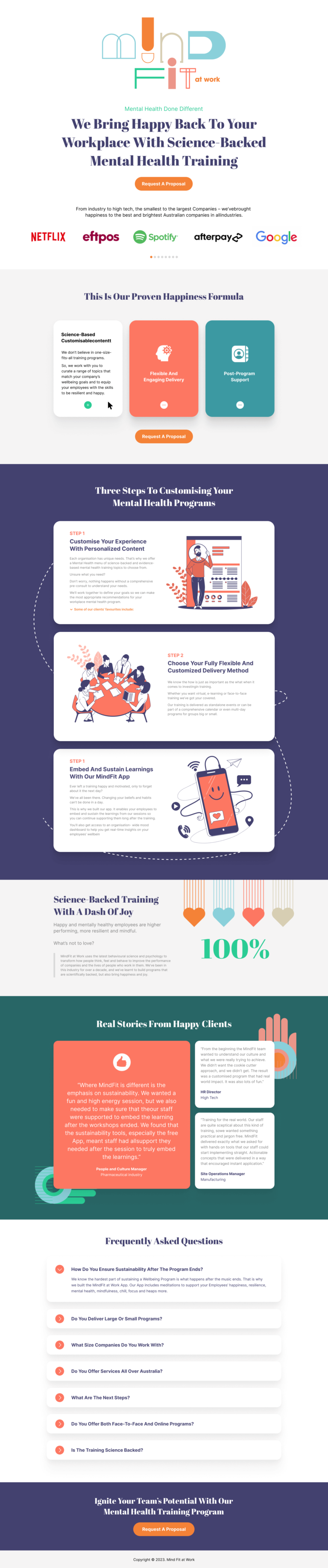
The teal and orange colour pairing communicates clinical warmth, teal’s professional credibility balanced with orange’s human energy. In the mental health category, where buyers are wary of cold, clinical aesthetics that can feel detached from lived experience, this combination signals that the provider understands both the science and the human dimension.
The ‘We Bring Happy Back to Your Workplace With Science-Backed Mental Health Training’ headline is one of the most effective in the wellbeing training market because it pairs an emotional promise with a scientific credibility claim in a single sentence. The headline earns the attention of both the emotionally motivated buyer and the evidence-sceptical procurement stakeholder.
The delivery format card slider, Live Facilitation (E-Learning Modules, Blended Programme, and Manager Toolkit) communicates organisational flexibility without requiring a separate products page. Each card describes the format’s ideal use case, which helps buyers self-identify which option matches their organisational context before they book a call.
The research and institution credibility section names the clinical frameworks and research sources that underpin the training. This section is specifically designed for L&D sceptics and procurement evaluators who need to justify the investment to leadership. Named institutions and methodologies convert doubt into confidence in a way that testimonials alone cannot.
The accordion-based FAQ section handles the questions that procurement-stage buyers carry: group size requirements, customisation options, certification outcomes, and post-training support. Answering these questions on the page eliminates the ‘let me schedule a call to ask a few things’ delay that stalls conversion in the final stage.
The client logo bar positions MindFit in the same company as recognisable employer brands. For an HR director evaluating a training provider, peer company endorsement is the fastest credibility shortcut available. If 'Company X that I respect has used this provider', the buyer's own evaluation effort is reduced to 'would this work for an organisation like mine?' rather than 'is this provider credible at all?'
Trust architecture
Layer one: scientific foundation
Named research frameworks and institutional references give evidence-driven buyers the substantiation they need to justify internal recommendation. This layer specifically targets L&D leads with academic or clinical backgrounds.
Layer two: organisational social proof
Client logos from recognisable brands validate that MindFit’s training works at scale for real organisations, not just small teams or pilot programmes.
Layer three: participant testimonials
Testimonials from programme participants, describing specific mindset shifts or skills gained, provide the human evidence that the scientific framework actually translates into behavioural change in the workplace.

"The testimonials on mental health training pages need to be participant testimonials, not just client logos. Logos tell you an organisation bought the training. Participant quotes tell you it actually worked. For a product that promises behaviour change and wellbeing improvement, the voice of someone who experienced the change is the only credible proof the page can offer."
Read more about how we approach B2B training conversion in our guide to B2B Landing Page Examples.
The 'Book a Call' CTA is deliberately positioned as a conversation, not a purchase. In B2B training procurement, the call is the next natural step, no HR director commits to a training programme without a discussion. Framing the conversion action as 'book a call' rather than 'get a quote' or 'enquire now' signals confidence: MindFit isn't closing you on the page; it's inviting you to a peer conversation. That tone difference matters for professional buyers.
Conversion strategy
The page funnels interested buyers toward a single CTA: booking a call. The extended page content pre-qualifies interest and addresses likely objections so that visitors who reach the CTA are motivated and informed, not passive. This means the call conversations are higher-quality, not exploratory discovery calls, but conversations from buyers who’ve already evaluated the offer and want to understand fit.
The call booking is the minimum commitment required to start the commercial conversation, and the page is structured to make that minimum feel obvious rather than premature.
"I always push B2B training clients to put more content on the page, not less. The temptation is to withhold detail to force a sales call. But a buyer who reaches the call without understanding the programme is an unqualified lead. A buyer who arrives already knowing the framework, the delivery formats, and the outcomes is a warm prospect. More page content means better calls, not fewer."
Platform: Unbounce
Unbounce’s active text replacement allows different traffic sources to see contextually relevant copy, visitors from HR forums see messaging specific to people management, while wellbeing conference traffic sees mental health-specific language. The call booking integration connects directly to the MindFit team’s calendar for immediate confirmation.
Mobile experience
HR professionals research training solutions during commute time and between meetings. The delivery format cards stack vertically on mobile without losing the key differentiating details. The FAQ accordion is touch-friendly and keeps the page manageable at mobile scroll depth. The ‘Book a Call’ CTA is sticky on mobile for persistent access throughout the reading experience.
The card slider uses CSS transitions rather than JavaScript animation libraries, keeping the interaction smooth without adding render-blocking dependencies. The research and credibility section uses inline SVG icons rather than icon fonts, eliminating font-loading delay. Both choices protect the professional first impression for a target audience accustomed to high-quality enterprise software experiences.
What we’d evolve today
Three improvements to increase booking rate:
- Add an ROI calculator to the page: A tool that lets HR buyers input employee count and absence rate, then shows projected cost savings from reduced absenteeism, translates the wellbeing investment into financial terms that justify board-level sign-off.
- Surface a specific outcome metric from a client programme: ‘Company X saw a 23% reduction in reported stress levels after MindFit training’ is more persuasive than qualitative testimonials for evidence-driven procurement decisions.
- Test a sample session video: A 5-minute excerpt from an actual training session (showing facilitation quality, participant engagement, and content depth) converts hesitant buyers faster than any written description of the programme.
Key takeaway
MindFit’s training page demonstrates how to balance emotional resonance and scientific credibility for B2B wellbeing services. The delivery format flexibility, research foundation, and peer company logos work together to convert HR buyers who are simultaneously emotionally motivated and procurement-minded.
Browse our full collection of landing page examples to see how we apply these principles across industries. For methodology, read our guide to B2B Landing Page Examples.
Waseem founded Apexure in 2015 and has led its work on 3,000+ pages for 300+ clients since. He writes about what the team sees after the click, which is pages, forms, tracking and the systems behind them.
What the page leans on
The principles at work on this page, each named in the analysis above.
Authority bias
People trust credible experts. Certifications, awards, media mentions, and expert endorsements boost credibility.
Social proof
People follow the actions of others. Testimonials, reviews, and client logos build trust and reduce hesitation.
Visual hierarchy
Controlling what visitors see first, second, and third guides them toward the conversion goal.
Cognitive load reduction
Simpler pages convert better. Reducing visual noise, breaking forms into steps, and clear copy lower mental effort.
What people ask about pages like this
HR directors and L&D managers procuring mental health training face a credibility problem: the market is saturated with providers who claim evidence-based methods but offer little supporting detail. 'Science-backed' is table stakes, the differentiation comes from specifying which science, which research institutions, and which clinical frameworks the training draws from. The claim needs to be substantiated to move from marketing language to genuine trust signal.
Mental health training procurement is an emotionally charged decision. The HR director buying this training has often watched colleagues struggle, seen productivity decline, or received pressure from leadership to address wellbeing formally. 'Bring Happy Back' speaks to that emotional context before addressing ROI metrics. The emotional hook creates alignment between the buyer's internal experience and the provider's offer, which reduces the psychological distance the prospect needs to close before they're ready to engage.
Corporate training buyers have wildly different organisational constraints: some need live facilitation for immediate impact, others need self-paced modules for distributed teams, and others need blended programmes for sustained behaviour change. Presenting multiple delivery formats with separate descriptions addresses each buyer type within a single page. It also signals experience and flexibility, a provider who can only deliver one format is less credible than one who adapts to different learning environments.
B2B training services have long sales cycles and complex stakeholder approval requirements. A longer page is justified because the procurement decision involves multiple evaluators, HR, L&D, finance, and senior leadership. Each section of the page is potentially read by a different evaluator. The research validation section speaks to L&D sceptics. The ROI section speaks to finance. The testimonials speak to HR peers. Page length equals audience coverage, not verbosity.
Three more, taken apart the same way



Want one like this?
Tell us what the page has to do and where the traffic comes from. Within 48 hours you get a written quote from the people who wrote this breakdown. Already have a page that is not converting? Send it for a free audit instead.
UK hours, which is the East Coast morning.
"Mental health training pages have a specific tension: the buyer is already emotionally invested in the problem (they've seen its impact), but they need rational justification for the purchase decision. The page has to speak to both. 'Science-backed' satisfies the rational evaluator. 'Bring Happy Back to Your Workplace' speaks to the person who's personally motivated to fix this. You need both registers on the same page."