
One column each for law firms, corporations and government.
Everlaw's demo request page for its ediscovery platform, built on WordPress for legal operations and discovery teams. Why the SOC 2 and FedRAMP badges sit near the bottom, and the segment case studies still missing.
- Primary CTAGet a Free Demothe button the page is built around
- GoalLead Generationwhat counts as a conversion
- PlatformWordPresslead generation page
- Built forB2BSaaS
- The page as built, not a mockup.Analysed by Apexure, not by Everlaw.
- Client
- EverlawSaaS
- Industry
- SaaS30 examples
- Audience
- B2BLead Generation
- Platform
- WordPress96 examples
- Page type
- Lead generationLead Generation
- Analysed by
- Waseem BashirMarch 2026
What the page does, and why
What this page is doing
Everlaw is an ediscovery and legal holds SaaS platform serving law firms, corporate legal departments, and government agencies. The visitor arriving on this page is typically a legal operations professional, discovery attorney, or IT/compliance lead who is evaluating ediscovery solutions to replace legacy tools or manual processes.
This is a high-consideration B2B SaaS purchase. Ediscovery software sits at the intersection of legal compliance, data management, and workflow efficiency. Getting this purchase wrong has real legal and financial consequences for the organisation. The page needs to communicate platform capability, security credibility, and peer validation before asking for a demo commitment.
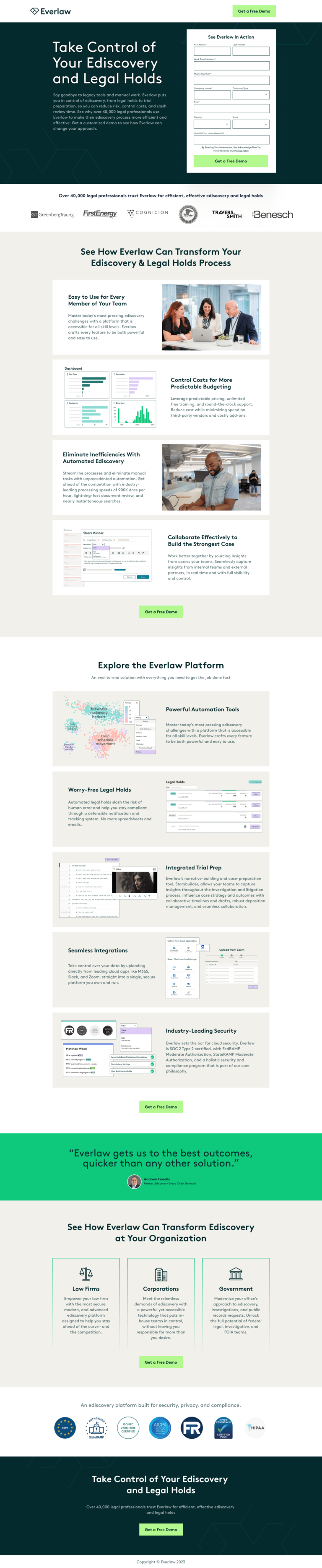
The page is exceptionally well structured. It moves systematically from the core value proposition (control your ediscovery) through feature capability (four platform strengths), an audience segmentation section (law firms, corporations, government), and closes with security certifications and a testimonial. Every section earns its place.
Design decisions
The clean white background with dark green CTA buttons creates immediate visual clarity. The hero uses a form-on-the-right layout with the headline and feature benefits on the left. For a B2B SaaS product where the demo form is the primary conversion action, this layout makes sure that ready-to-convert visitors can submit in the hero without scrolling.
The “Over 40,000 legal professionals trust Everlaw” credibility line sits directly beneath the hero form, alongside recognisable law firm and corporation logos. The combination of a specific number and recognisable brand names creates immediate scale proof before the visitor has absorbed any feature content.
The four feature sections, Easy to Use, Control Costs, Eliminate Inefficiencies, Collaborate Effectively, each pair a descriptive headline with a product screenshot and a brief paragraph. This alternating layout creates a predictable scan pattern. We kept each section to three to four sentences because legal buyers read feature descriptions closely, dense paragraphs would lose them, but points without substance would not satisfy them.
The “Explore the Everlaw Platform” section (covering Automation Tools, Legal Holds, Integrated Trial Prep, Smooth Integrations, and Industry-Leading Security) provides the feature depth that enterprise evaluators need to complete their internal justification. This section isn’t for convincing. It’s for equipping the champion to present the platform to their team.
The audience segmentation section, three columns for Law Firms (Corporations, and Government) is a structural decision that significantly improves relevance for each visitor type. A discovery attorney at a law firm reads the Law Firms column and immediately sees a value proposition written for their specific context, rather than inferring relevance from a generic description.
The security certification badge section, SOC 2 Type 2 (FedRAMP, StateRAMP, CJIS, HIPAA) appears near the bottom of the page. This placement is strategic: security certifications are the last major procurement hurdle for enterprise legal buyers. By the time a visitor reaches this section. They're already convinced of capability and are now evaluating whether the platform meets their compliance requirements. Having the certifications at this stage of the scroll is exactly right, they close the deal, not introduce it.
Trust architecture
Legal SaaS trust requires three distinct proofs. The first is scale and peer proof: 40,000 legal professionals and named law firm logos communicate that Everlaw is market-tested at enterprise scale. For a legal buyer who needs a platform that their peers have evaluated and validated, this scale signal reduces the “am I taking a risk on an unproven tool?” concern.
The second is product capability: the platform screenshots in each feature section provide concrete evidence that the tool works as described. For a software buyer, seeing an actual interface rather than illustration or stock photography confirms that the product is real and functional.
The third is compliance certification: the security badge stack, SOC 2 Type 2, FedRAMP, HIPAA, confirms that the platform meets the specific compliance standards that legal buyers require. These aren’t nice-to-have features; for many enterprise legal departments. They’re procurement requirements.

"The 'Collaborate Effectively to Build the Strongest Case' feature section is doing something clever. It's not just describing collaboration features. It's framing the collaborative outcome in legal terms: 'building the strongest case.' Every feature description should connect to a specific professional outcome, not just describe what the feature does. 'Source insights from leading cloud apps' is a feature. 'Build the strongest case' is an outcome. The page is mostly writing outcomes, which is why it converts well."
The hero form collects enough information to qualify the demo request without overwhelming the visitor. Name, email, company, role, and a free-text field for "What are your ediscovery needs?", this collection gives Everlaw's demo team everything they need to personalise the call and show the most relevant platform features, improving both the demo experience and the close rate.
Conversion strategy
The demo form appears in the hero and at the bottom of the page, not at the middle. This is correct for a long-form B2B page: enterprise buyers need to consume the feature content before they’re ready to commit to a demo. Placing the form too early would produce lower-quality leads from visitors who haven’t yet confirmed that the platform matches their use case.
The “Get a Free Demo” CTA is consistent throughout. The “Free” qualifier matters, enterprise buyers who have experienced high-pressure SaaS demos are cautious about what “book a demo” implies. “Free” removes the implied sales pressure and frames the demo as educational rather than transactional.
"The 'See Everlaw in Action' headline above the hero form is the right positioning for a legal SaaS product. 'See it in action' makes the demo feel like a product experience rather than a vendor meeting. For a buying process that involves multiple stakeholders and detailed evaluation criteria, framing the first interaction as a product experience sets better expectations and produces more engaged demo attendees."
Platform: WordPress
WordPress was chosen for the design flexibility to implement segment-specific content blocks, accurate product screenshots, and the security badge section without a locked template compromising the visual quality of any element.
Mobile experience
Legal professionals research tools on both desktop and mobile. We made sure the product screenshots remained legible on mobile, the audience segmentation columns stacked cleanly, and the security badge section displayed the logos at appropriate scale. The demo form was optimised for enterprise buyers who may complete it from a phone during a commute.
Product screenshots at full resolution can add significant page weight. We served screenshots at 2x for retina displays using srcset attributes, compressed all images to WebP with JPEG fallback, and lazy-loaded screenshots that appear below the fold. The demo form in the hero, the primary conversion element, was fully rendered before any screenshot content loaded.
What we’d evolve
Three additions for the next iteration:
- Customer story video: The Andrew Fiorella quote is excellent. A 2-minute video from him describing the platform’s impact on his firm’s discovery workflow would be significantly more persuasive for enterprise buyers who are in detailed evaluation. A named discovery professional on video saying “this changed how we do discovery” is the most powerful closing argument available
- ROI calculator: An interactive cost-savings calculator, “How much is your current ediscovery process costing you?”, would quantify the platform’s value in terms the buyer can present to their finance team. Enterprise software purchases require budget justification; a personalised ROI estimate makes that easier
- Case study by segment: Each of the three audience segments (law firms, corporations, government) would benefit from a one-page case study. Generic testimonials don’t differentiate by use case. “How Benesch reduced discovery time by 60%” would convert law firm buyers in a way the general page cannot
"The Everlaw page is operating at the top of what's achievable with standard landing page structure for B2B SaaS. The 40,000 users claim, the named law firm logos, the FedRAMP certification. These are the things that close enterprise procurement conversations. The only gap is the absence of segment-specific case studies, which would personalise the proof for each buyer type. The infrastructure is excellent; now it just needs more specific stories on top of it."
Browse our full collection of landing page examples to see how these principles apply across industries. For the theory behind enterprise SaaS pages, read our guide to B2B Landing Page Examples.
Waseem founded Apexure in 2015 and has led its work on 3,000+ pages for 300+ clients since. He writes about what the team sees after the click, which is pages, forms, tracking and the systems behind them.
What the page leans on
The principles at work on this page, each named in the analysis above.
Authority bias
People trust credible experts. Certifications, awards, media mentions, and expert endorsements boost credibility.
Social proof
People follow the actions of others. Testimonials, reviews, and client logos build trust and reduce hesitation.
Cognitive load reduction
Simpler pages convert better. Reducing visual noise, breaking forms into steps, and clear copy lower mental effort.
Visual hierarchy
Controlling what visitors see first, second, and third guides them toward the conversion goal.
What people ask about pages like this
Ediscovery is the process of identifying, collecting, and producing electronically stored information in response to legal proceedings or investigations. In large organisations, this can involve millions of documents across multiple systems, tight legal deadlines, and significant compliance risk. Manual ediscovery processes are slow, expensive, error-prone, and create serious legal exposure. Everlaw automates this process, document review, search, timeline construction, and legal holds, so legal teams can move faster with fewer people and less risk.
Everlaw serves three distinct segments, each addressed on the page: law firms (who run ediscovery for multiple clients and need speed and case isolation), corporations (who face internal investigations, regulatory enquiries, and litigation), and government agencies (who handle public records requests and regulatory compliance at scale). The page segments its value proposition for each group rather than using generic language, which is critical for a SaaS product where the use case differs significantly by buyer type.
Everlaw is SOC 2 Type 2 certified with FedRAMP Moderate Authorisation, industry-leading security certifications that matter specifically for legal and government buyers. The platform also participates in StateRAMP. For a legal team that handles sensitive client data and privileged communications, the question of whether a platform is properly certified is often a hard procurement requirement. The page displays these certifications prominently near the bottom because they convert the compliance-driven evaluation stage of enterprise purchase.
The Andrew Fiorella quote, 'Everlaw gets us to the best outcomes, quicker than any other solution', from a Director, Discovery Strategy & Innovations at a large legal firm is the page's most powerful piece of social proof. It's a specific, outcome-focused quote from a named professional with a titled role in a recognisable institution. For an enterprise legal buyer evaluating ediscovery platforms, a peer endorsement of this specificity, from someone in the exact role they hold, carries more persuasive weight than any feature comparison.
Three more, taken apart the same way



Want one like this?
Tell us what the page has to do and where the traffic comes from. Within 48 hours you get a written quote from the people who wrote this breakdown. Already have a page that is not converting? Send it for a free audit instead.
UK hours, which is the East Coast morning.
"The Everlaw page structure is one of the cleanest B2B SaaS pages we've produced. Each section has a clear job: hero confirms the promise, feature sections demonstrate capability, the audience segmentation makes the relevance specific, and the security badges close the compliance objection. The flow never feels like a sales pitch. It feels like a structured product tour for a buyer who already has questions."