
A long demo form in the hero, on purpose.
Craver's demo page for its white-label restaurant app, built on HubSpot for owners tired of delivery commissions. Why the qualifying form, POS logos and mid-page video work, and the stat we would move up.
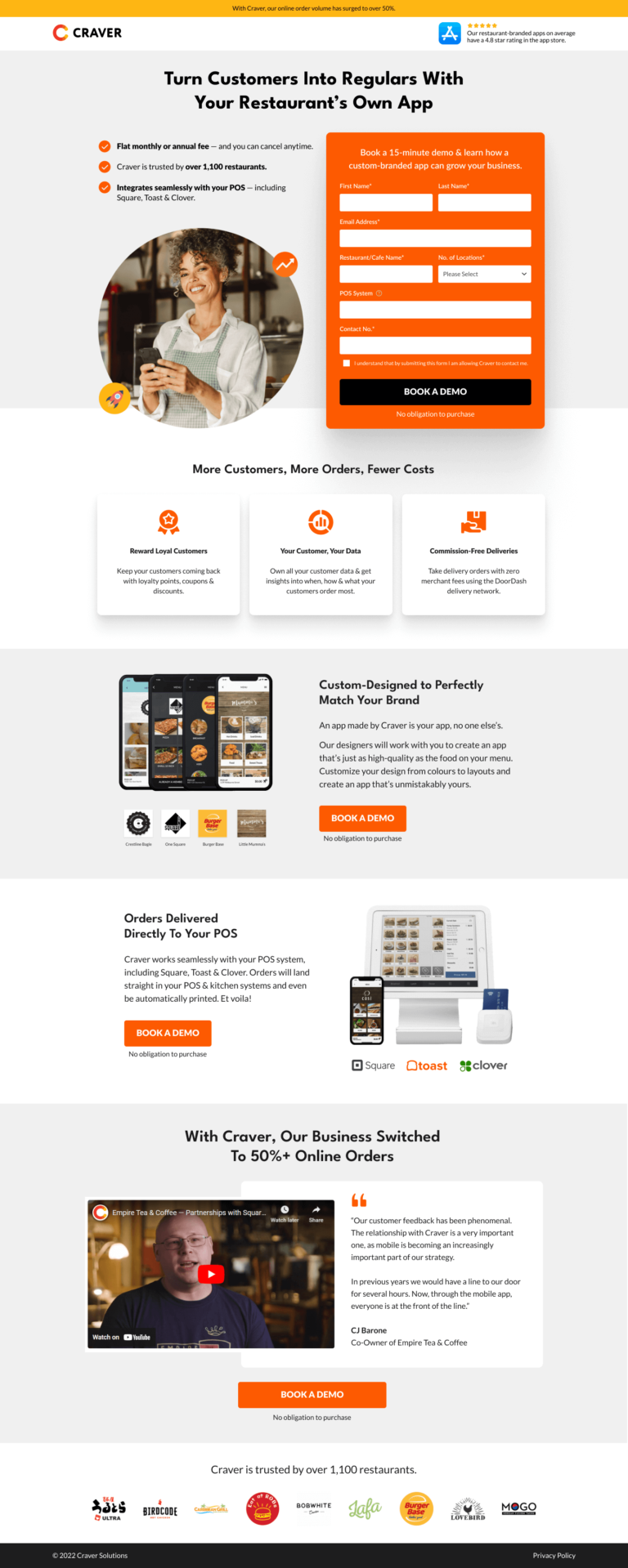
- Primary CTABook a Demothe button the page is built around
- GoalLead Generationwhat counts as a conversion
- PlatformHubSpotlead generation page
- Built forB2BSaaS
- The page as built, not a mockup.Analysed by Apexure, not by Craverapp Custom Mobile App.
- Client
- Craverapp Custom Mobile AppSaaS
- Industry
- SaaS30 examples
- Audience
- B2BLead Generation
- Platform
- HubSpot10 examples
- Page type
- Lead generationLead Generation
- Analysed by
- Waseem BashirMarch 2026
What the page does, and why
Why this page was built the way it was
Craver sells white-label mobile apps to independent and multi-location restaurants. The visitor arriving on this page is typically a restaurant owner or marketing manager. Someone who has spent time on third-party delivery platforms like DoorDash and is starting to question whether paying 30% commission is sustainable. The brief was to capture that moment of doubt and convert it into a booked demo.
The page keeps its structure tight. A lead form sits in the top-right of the hero alongside a headline that names the outcome: “Turn Customers Into Regulars With Your Restaurant’s Own App.” Below that, three bullet points address the three most common objections: cost (flat monthly fee, cancel anytime), proof (trusted by over 1,100 restaurants), and integration (works with Square, Toast, and Clover). Nothing above the fold exists that doesn’t serve one of those jobs.
The bottom half of the page handles the deeper objections from visitors who didn’t convert immediately. A video testimonial from a real restaurant co-owner, a POS integration demonstration, and a brand logo bar make the case for legitimacy before the final CTA repeat. The page closes without navigation. There’s no way to wander off to the blog or the about page.
Design decisions
The lead form in the hero
We positioned the lead form alongside the headline rather than below it. For a B2B SaaS product with a sales-led motion, getting the form visible without a scroll is one of the highest-value placements we can make. Visitors who arrive ready to buy can convert in under 30 seconds. Visitors who need convincing scroll down. The form reappears at the bottom for them.
A clean: white solid background
Restaurant industry visuals tend to be warm and food-forward. Competing with a dark or complex background would have created visual noise against the food photography. A white background lets the product mockups and restaurant imagery do the selling without fighting for attention.
The three proof icons
Reward customers, own your data, commission-free deliveries. The icons translate Craver’s core value into restaurant-owner language. “Commission-free deliveries” speaks directly to a pain point any restauranteur on DoorDash understands. We wrote these to speak to loss aversion (what the visitor is currently losing) rather than gain framing.
The YouTube video testimonial
We included a testimonial from CJ Barone positioned alongside a secondary CTA rather than auto-playing in the hero. Video placed mid-page, after initial trust has been established, performs better than video above the fold where visitors are still deciding whether to stay.
The partner brand logo bar at the bottom
The logo bar includes recognisable restaurant chains. It creates social proof at exactly the moment the visitor has consumed all the other content and is making their final decision. We chose it as a closing argument rather than an opening one because at that point in the scroll, recognising even one familiar name tips the scales.
The hero form collects restaurant name and number of locations alongside standard contact fields. That isn't just data collection. It pre-qualifies the lead and signals to the visitor that they're entering a personalised conversation, not a generic email list.
Trust architecture
Trust on this page works in three distinct layers. The first is scale proof: “trusted by over 1,100 restaurants” appears in the hero alongside logos from Square, Toast, and Clover. Three POS systems the visitor almost certainly uses. Recognising those integration logos removes a major concern before the visitor has scrolled an inch.
The second layer is outcome evidence: the CJ Barone video testimonial quotes a specific business outcome. Mobile orders becoming a core strategic channel. It’s not “great product, easy to use.” It’s “our business model changed because of this.” That level of specificity is what converts sceptical buyers.
The third layer is reassurance signals: the “no obligation to purchase” copy below the CTA, and the flat monthly fee model with cancel-anytime messaging. For restaurant owners burned by commission structures, removing perceived lock-in risk is as important as any feature.
"The integration logos (Square, Toast, Clover) are doing double duty here. They're social proof that Craver works with established systems, and they're objection removal. Any restaurant owner who sees their POS provider listed immediately thinks 'this will actually work in my business.' That's a conversion barrier eliminated before the scroll even starts."
We placed testimonial content from a named restaurant co-owner, not a generic review, because job-title-matched social proof is significantly more persuasive than anonymous ratings. A restaurant owner reading about another restaurant owner's experience with mobile ordering feels the relevance immediately.
Conversion strategy
The form in the hero is the primary conversion point. It collects first name, last name, email, restaurant cafe name, number of locations, and a contact number. Enough to qualify without overwhelming. The CTA copy reads “Book a Demo,” which sets clear expectations. The visitor knows they’re booking a call, not signing up for a product trial.
A second CTA appears mid-page after the POS integration section, and a third closes the page after the brand logo bar. Each repetition targets a different scroll depth: the ready buyer, the cautious evaluator, and the almost-convinced prospect who needed to see one more proof point.
"Restaurant owners are time-poor. When we see a five-field form on a SaaS landing page, the instinct is to cut it to two. But for demo-led sales, qualifying fields actually improve conversion quality. The restaurant name field tells the salesperson what to research before the call. The location count tells them what tier of package to pitch. Done right, a longer form produces better leads, not fewer."
Platform: HubSpot
We built this on HubSpot because Craver’s sales team needed form submissions to feed directly into their CRM pipeline without manual work. HubSpot’s landing page tools let us match the visual design while keeping the integration clean. Lead data flows into deal stages automatically, so the sales team can prioritise follow-up by number of locations.
Mobile experience
Restaurant operators increasingly use mobile devices to research vendor solutions between shifts. We sized touch targets for thumb use, made the form fields large enough to complete without zooming, and moved the most important bullet points to a prominent position on the mobile layout so they were visible before the scroll.
The YouTube video embed was configured for lazy loading. It only requests the video player after the page has fully loaded. That keeps Time to Interactive fast on first load, which matters particularly for mobile visitors arriving via paid search. A slow demo page is a leaking funnel regardless of how good the offer is.
What we’d evolve
Every page we ship is the first version, not the final one. With data behind this page, here’s where we’d focus next.
Headline split test. The current headline frames the outcome for the restaurant owner. We’d test a more direct competitive angle. Something that names the commission problem explicitly and positions Craver as the exit strategy.
Video placement pull-up. Move the CJ Barone testimonial video higher, directly beneath the hero. On pages where a founder or operator testimonial exists, surfacing it earlier reduces mid-page drop-off for visitors who didn’t convert in the hero.
Location-count micro-segmentation. Use HubSpot’s smart content to show different supporting copy for single-location versus multi-location visitors. Both groups have different priorities and the page could speak to both without needing separate URLs.
"The '50%+ Online Orders' stat at the bottom of the page is one of the strongest proof points on the entire page, and it's below the fold. I'd test pulling that metric up into the hero as a supporting line beneath the headline. A single compelling number can do more trust-building work than three paragraphs of copy."
Browse our full collection of landing page examples to see how these principles apply across industries. For the theory behind demo-led landing pages, read our guide to B2B Landing Page Examples.
Waseem founded Apexure in 2015 and has led its work on 3,000+ pages for 300+ clients since. He writes about what the team sees after the click, which is pages, forms, tracking and the systems behind them.
What the page leans on
The principles at work on this page, each named in the analysis above.
Social proof
People follow the actions of others. Testimonials, reviews, and client logos build trust and reduce hesitation.
Authority bias
People trust credible experts. Certifications, awards, media mentions, and expert endorsements boost credibility.
F-pattern layout
Eye-tracking shows people scan pages in an F-shape. Placing key content along this path increases engagement.
Cognitive load reduction
Simpler pages convert better. Reducing visual noise, breaking forms into steps, and clear copy lower mental effort.
What people ask about pages like this
The hero needs to answer three questions within three seconds: what does the product do, who is it for, and why should I trust it? For Craver, that meant leading with the outcome, turning customers into regulars, rather than the feature. The POS integrations and pricing model are supporting evidence, not the lead argument.
Restaurant owners are busy operators. A free trial puts the burden on them to self-serve, configure, and discover value. A demo shifts that work to Craver's team. The form collects restaurant name, number of locations, and contact details, enough to qualify the lead and personalise the conversation. For a product that requires setup and onboarding, demo-led sales typically produce higher-quality conversions than self-serve trials.
B2B buyers want to see social proof from peers in their industry, not just star ratings. Craver's page shows logos from recognisable restaurant brands that the visitor's competitors might already use, this triggers competitive urgency. The video testimonial from CJ Barone of Empire Tea & Coffee adds a specific voice: a real operator talking about mobile orders as a strategy, not just a feature. That specificity is what makes B2B social proof land.
A project like Craver typically runs three to four weeks from brief to launch. That covers audience research, wireframing, visual design, copywriting, HubSpot build, and cross-device QA. We front-load the research phase because the decisions made in week one, headline framing, CTA copy, trust signal selection, have more impact on conversion rate than any design detail.
Three more, taken apart the same way



Want one like this?
Tell us what the page has to do and where the traffic comes from. Within 48 hours you get a written quote from the people who wrote this breakdown. Already have a page that is not converting? Send it for a free audit instead.
UK hours, which is the East Coast morning.
"Restaurant owners don't have time to read. They scan. That's why we structured the Craver page so that someone reading only the headlines and bullets would still understand the full value proposition. The copy that goes deeper is there for the visitor who wants it, not for the visitor who doesn't."