
A 30-minute repair promise as the headline.
The Device Shop's phone repair page for Manhattan customers, built on Unbounce to send them to a booking. Covers the Yelp count, the nine brand logos, the exploded iPhone diagram and the price anchor we would add.
- Primary CTABook Your Appointment Nowthe button the page is built around
- GoalClick-Throughwhat counts as a conversion
- PlatformUnbounceclick-through page
- Built forB2CHome Services
- The page as built, not a mockup.Analysed by Apexure, not by The Device Shop.
- Client
- The Device ShopHome Services
- Industry
- Home Services20 examples
- Audience
- B2CClick-Through
- Platform
- Unbounce132 examples
- Page type
- Click-throughClick-Through
- Analysed by
- Waseem BashirMarch 2026
What the page does, and why
Why we built this phone repair landing page
Mobile phone repair is one of the highest-urgency service verticals that exists. A customer with a cracked screen or water-damaged phone is not browsing. They are in an immediate problem state. Every hour without their phone is an inconvenience. Every day is a productivity loss. The conversion window is short, the competition is high (multiple repair shops in every urban block), and the differentiator has to be communicated in seconds.
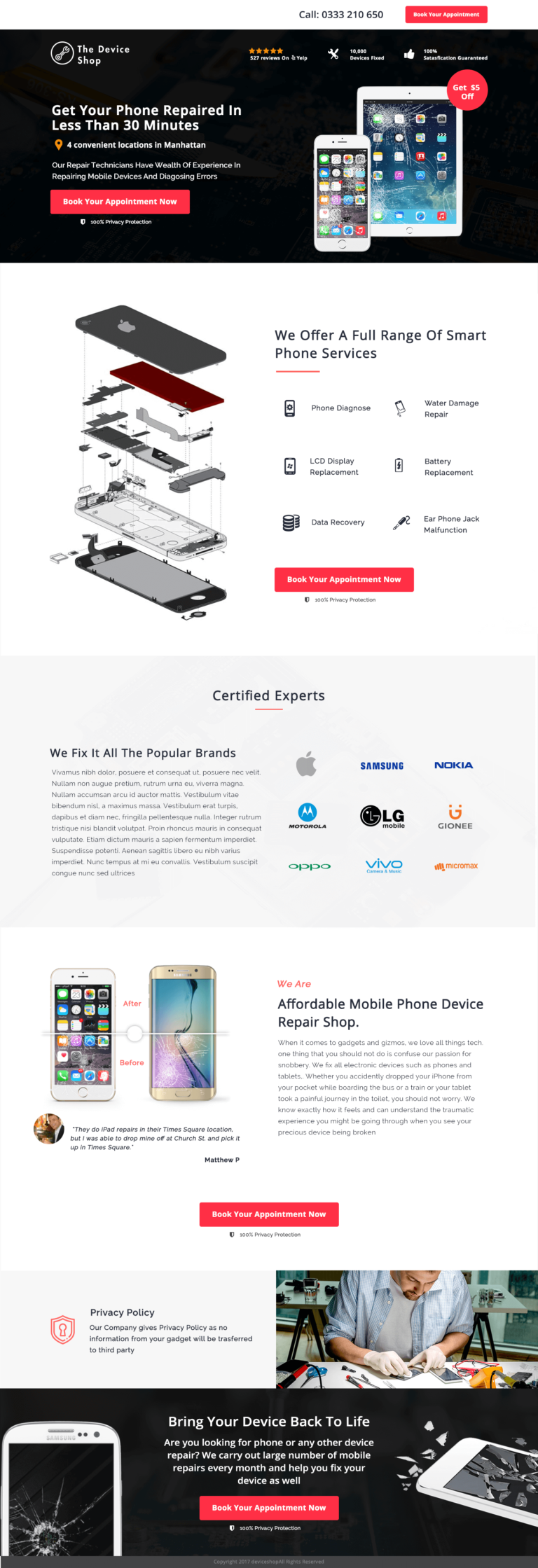
The Device Shop serves four convenient locations in Manhattan. That geographic density, four sites across a dense urban area, is a significant competitive advantage that the page needed to express immediately. Combined with a 30-minute repair promise and 527 Yelp reviews, the page needed to communicate: fast, trusted, local, and convenient.
The dark hero with a photo of two iPhones (one intact, one with a visible screen) establishes the service context without requiring any reading. The exploded iPhone diagram mid-page, showing the device’s internal components, communicates technical competence in the same way a mechanic with car parts visible behind them communicates automotive knowledge.
Design decisions
The dark hero uses split layout: headline and CTA on the left, product photography on the right
The two iPhone photographs, one in hand, one showing the screen, immediately communicate the product context. The “$5 Off” badge in bright pink draws the eye to the hero’s right side before the visitor reads the headline. The headline “Get Your Phone Repaired In Less Than 30 Minutes” is in large white type on the dark background, maximum contrast, maximum legibility under the stress of a device emergency.
Three trust signals appear in the hero header bar: 527 reviews on Yelp (4-star)
These are positioned above the headline, visible before the visitor processes any service content. For a local consumer service where trust is the primary barrier (frontloading three specific proof points, volume of reviews, volume of services, and a satisfaction guarantee) addresses the trust deficit before the visitor has to form an opinion from copy alone.
The services section uses nine service type cards with matching icons
Phone Diagnose, Water Damage Repair, LCD Display Replacement, Battery Replacement, Data Recovery, Ear Phone Jack, Malfunction, each with a distinctive icon. This grid tells a visitor with any specific problem: “we handle that.” The variety also signals workshop depth, a shop that repairs everything from LCD screens to data recovery has invested in tooling, training, and parts inventory that a single-service operation has not.
The brand logo bar: Apple
The nine brands cover the full spectrum from premium (Apple) to emerging market (Micromax). This breadth signals that The Device Shop maintains parts inventory for a wider range than the typical repair shop. For someone with a less common device, the logo bar is the difference between “this page is for me” and “I’ll have to keep looking.”
The “Affordable Mobile Phone Device Repair Shop” positioning with before/after images handles the premium brand concern
Consumers with expensive devices worry about repairs being done properly or cheaply. The “affordable” framing addresses price sensitivity, while the before/after comparison images and the “Certified Experts” section handle quality concern. The page acknowledges both anxieties rather than pretending one doesn’t exist.
The phone number "0333 210 650" in the top header bar is a conversion mechanism that often outperforms the booking form for time-critical repairs. A customer with a cracked screen who needs their phone working by 2pm will call, not complete a form. Displaying the phone number prominently acknowledges that some customer urgency levels require immediate human contact, and capturing those high-intent calls alongside form bookings maximises total conversions.
Trust architecture
Layer 1: Review count plus satisfaction guarantee in the hero
Three specific trust claims visible before any service content. The Yelp review count is verifiable in seconds on a smartphone, the visitor can cross-check immediately. The 100% Satisfaction Guarantee is the risk-reversal element that handles “what if they make it worse?” concern.
Layer 2: Technical competence imagery mid-page
The exploded iPhone component diagram communicates technical depth without requiring the visitor to read about it. Someone who wouldn’t know how to interpret the diagram still reads “these people understand what’s inside my phone” from the visual. The “Certified Experts” section reinforces this with text, after the visual has established the impression.
Layer 3: Brand-specific logos confirming device compatibility
For the visitor’s specific device brand, seeing their manufacturer’s logo on a repair shop page converts the general interest into specific relevance. A customer who has already been to three shops that “don’t stock Samsung parts” will immediately trust a shop that shows the Samsung logo.

"Local service pages should always show location prominently. '4 convenient locations in Manhattan' is doing real conversion work. It removes the 'but is there one near me?' friction immediately. A customer who knows there's a location near their office, their home, or their commute route is far more likely to book than one who has to investigate whether the service is accessible to them."
What we would test today
1. Add a real-time availability indicator
“Next appointment available today at 2:30pm” or “Current wait time: 25 minutes” would convert time-sensitive customers who are deciding between walking in now and booking ahead. Real-time availability information is a powerful conversion lever for local services because it resolves the primary practical barrier: “do they have time for me today?”
2. Test a price anchor near the “Book Your Appointment” CTA
Phone repair customers often don’t know what a fair price is. Adding “Screen repairs from $49” near the booking CTA would set a price anchor that converts visitors who are hesitating due to cost uncertainty. Known starting prices reduce the “I’d rather check somewhere else first” objection that loses conversions to competitors.
3. Add a repair warranty statement adjacent to the satisfaction guarantee
“100% Satisfaction Guaranteed” is strong but vague. “90-day warranty on all repairs” is specific and implies a standard of quality that backs the guarantee up. A named warranty period converts the visitor who is worried about the repair failing after a week, a common concern for out-of-warranty device repairs.
Browse our full collection of landing page examples to see how we design local consumer service pages across verticals.
Waseem founded Apexure in 2015 and has led its work on 3,000+ pages for 300+ clients since. He writes about what the team sees after the click, which is pages, forms, tracking and the systems behind them.
What the page leans on
The principles at work on this page, each named in the analysis above.
Visual hierarchy
Controlling what visitors see first, second, and third guides them toward the conversion goal.
Social proof
People follow the actions of others. Testimonials, reviews, and client logos build trust and reduce hesitation.
Urgency
This principle influences visitor behaviour and supports the page's conversion goal.
Loss aversion
People feel losses more strongly than gains. Framing around what they will miss motivates action.
What people ask about pages like this
Someone with a cracked screen or dead phone is in an urgent, inconvenient situation. They don't care about 'expert', every phone repair shop claims expertise. '30 Minutes' answers the question they actually have: how long will I be without my phone? That number converts because it removes the primary objection to walking into a repair shop: time cost. A business professional in Manhattan who can get their iPhone screen replaced during a lunch break will choose the shop that promises 30 minutes over the one that says 'quick and professional.' Urgency resolution beats quality claims in local services because quality is assumed; speed is differentiating.
Phone repair is a trust-deficit category. The average consumer has no way to assess technical competence before their device is opened. Review count and service volume are the only proxies available. '527 reviews on Yelp' signals sustained customer satisfaction across hundreds of interactions, a high-volume local business with this many reviews has enough market tenure to screen out fly-by-night operators. '10,000 Devices Fixed' is an operational scale claim that implies consistent process and specialised tooling. Both metrics answer 'have others trusted you with their device and been happy?' in quantified terms.
'We fix all brands' is a claim anyone can make. A visible logo bar showing nine named manufacturers is a specific claim that feels verifiable. A Samsung user scanning the page sees the Samsung logo and reads: 'they specifically work on my phone.' The logo bar also handles a specific objection for less common brands, Gionee or Micromax owners know from experience that most repair shops don't carry their parts. Seeing their brand logo changes the page from a generic service to their specific solution. Logo-specific trust is always more effective than generic capability claims.
Mobile phone repair customers are often emotionally stressed about the cost of the repair before they've even asked for a quote. A visible '$5 Off' badge in the hero provides two conversion functions: it reduces cost anxiety (there's a saving available) and it creates a reason to act now rather than shop around (to claim the discount, I need to book). The badge's bright pink colour against the dark hero creates visual contrast that draws the eye before the visitor has consciously processed it. Even a modest discount, presented prominently, converts price-sensitive consumers who might otherwise visit three shops before deciding.
Three more, taken apart the same way


Want one like this?
Tell us what the page has to do and where the traffic comes from. Within 48 hours you get a written quote from the people who wrote this breakdown. Already have a page that is not converting? Send it for a free audit instead.
UK hours, which is the East Coast morning.
"Phone repair pages have one of the shortest consideration windows of any consumer service vertical. The visitor decides within the first scroll whether to book or move on. That means the speed claim, the review count, and the booking CTA all need to be above the fold or within one scroll. We treat phone repair pages like ambulances, everything has to be visible, immediate, and clear under stress."