
£12 a month, stated before any benefit.
The Church's Unbounce click-through page for the Nightfriends fan membership, for long-time fans. Why presales lead the benefits, what named unreleased tracks do, and the track preview and member count we would test.
- Primary CTAJoin Usthe button the page is built around
- GoalClick-Throughwhat counts as a conversion
- PlatformUnbounceclick-through page
- Built forB2CEvents
- The page as built, not a mockup.Analysed by Apexure, not by The Church.
- Client
- The ChurchEvents
- Industry
- Events12 examples
- Audience
- B2CClick-Through
- Platform
- Unbounce132 examples
- Page type
- Click-throughClick-Through
- Analysed by
- Waseem BashirMarch 2026
What the page does, and why
Why we built this fan membership page
The Church has one of the most dedicated and long-standing fan bases in alternative rock. These are not casual listeners. They are collectors, concert regulars, and people who have been following the band for decades. The Nightfriends membership page needed to convert that existing deep loyalty into a monthly financial commitment without the page feeling like a commercial transaction.
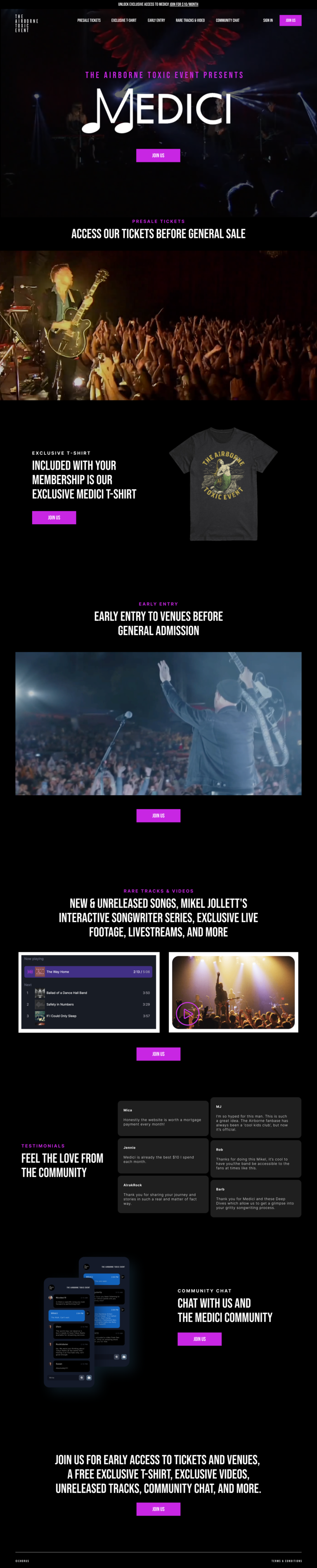
The approach was the same as with The Airborne Toxic Event’s Medici page: build the page around benefits that each segment of fan values most, maintain the concert aesthetic throughout, and make the “Join Us” CTA feel like a natural extension of the fan’s existing relationship with the band.
The specific challenge for The Church is that their audience skews toward long-term, highly engaged fans who have been burned by merchandise drop culture and streaming platforms that pay artists almost nothing. The Nightfriends membership is positioned as a direct support mechanism, joining is a way for fans to maintain the band they love. That framing adds moral motivation alongside the practical benefits.
Design decisions
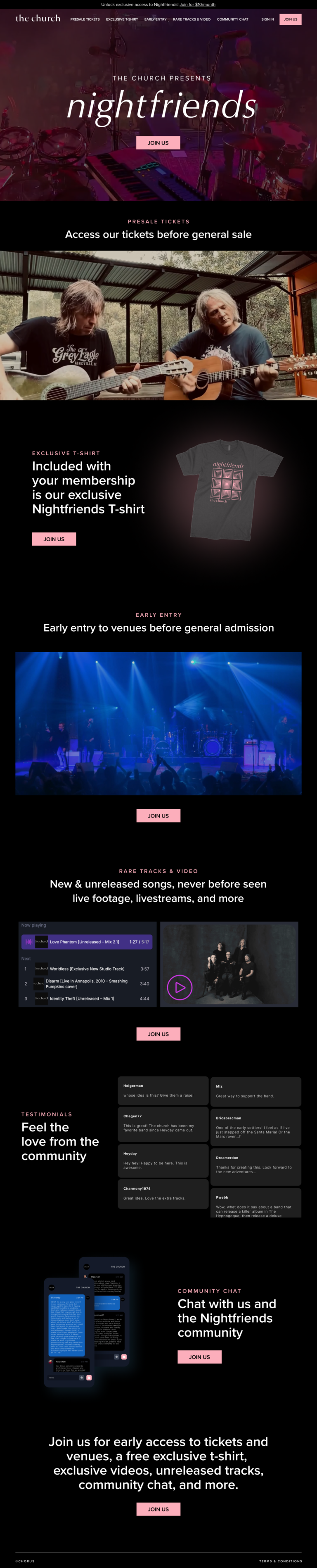
The hero projects ‘nightfriends’ in stylised script on a dark background with purple-toned concert photography
The typography choice for “nightfriends”, lowercase, flowing, matches the aesthetic of a band that has always prioritised atmosphere over spectacle. The purple concert lighting in the background photo creates visual continuity with the membership name and suggests the intimate, nocturnal feeling that longtime Church fans associate with the band’s live experience.
Each benefit section uses its own full-width concert photograph
Presale Tickets gets a crowd-at-venue image. The Exclusive T-Shirt shows the merchandise laid flat against a dark background, a retail-quality product shot that communicates tangible value. Early Entry gets a performance-from-stage-perspective image showing the crowd. Rare Tracks and Video gets an intimate rehearsal or session-style image. Each photograph is chosen to visualise the specific experience the benefit delivers, not just to look attractive.
The Rare Tracks section shows a music player interface with visible, named tracks
“Love Phantom [Unreleased – Mix 2.5] 1:27 · Worldless [Exclusive New Studio Track] 3:37 · Disarm [Live in Annapolis, 2010 – Smashing Pumpkins Cover] 3:49 · Identity Theft [Unreleased – Mix 1] 4:44.” These are real track titles, unreleased, live, and cover recordings that only a member can access. For a Church fan, seeing “Smashing Pumpkins Cover” or “Unreleased Mix 2.5” triggers genuine excitement. That excitement converts. A generic “access exclusive audio content” description does not.
The “Join Us” CTA uses the same pink accent colour throughout the page
In a near-black environment, the pink CTA is the only consistently warm colour. It guides the eye through the page’s conversion mechanism without competing with the atmospheric photography. The colour maintains visibility without the aggression of red or the casualness of green.
The top bar carries the price before any content
“Unlock exclusive access to Nightfriends. Join for £12/month.” This front-loaded pricing sets expectations before the emotional investment of reading the benefits. The fan who reads the price and continues is pre-qualified. The fan who bounces at £12/month would have bounced after the benefits section anyway, surfacing the price early saves both parties time.
The four-benefit structure (Presale Tickets, Exclusive T-Shirt, Early Entry, Rare Tracks and Video) is ordered by urgency, not exclusivity. Presale access is the most time-critical benefit; missing a ticket presale means paying more or not attending at all. Rare tracks are valuable but not time-sensitive. Leading with the most urgent benefit captures fans in tour-announcement mode, which is when membership conversion peaks.
Trust architecture
Layer 1: Named membership with visible pricing upfront
The Nightfriends name creates an identity anchor. This is a named community, not an anonymous tier. The £12/month price in the top bar establishes transparency as a brand value before the visitor has read a word of benefits copy.
Layer 2: Concert photography as experience proof
The live photography across all four benefit sections shows The Church in performance contexts, onstage, in rehearsal, with crowds. These images are not aspirational stock photography; they are documentation of real performances. For a fan who has been to Church shows or wishes they had, the images confirm that the membership connects to a living, active band.
Layer 3: Tracklist preview as exclusive content validation
The visible named tracks in the Rare Tracks section are the most tangible proof that the membership’s exclusive content is genuinely exclusive. A fan who sees “Unreleased – Mix 2.5” next to a track title understands immediately that this is unavailable anywhere else. That unavailability, the knowledge that non-members cannot access it, activates the exclusivity drive that membership models depend on.

"Music membership retention is built at the point of joining. If the first thing a new Nightfriends member receives makes them feel the decision was worth it, they stay. That means the joining experience (the welcome email, the first exclusive track, the first presale notification) has to deliver on everything the landing page promised. We always advise clients on the post-conversion journey, because a perfectly converting page that leads to a disappointing membership experience just creates churned subscribers."
What we would test today
1. Add a testimonial from a long-term member
A quote from a fan who has been a Nightfriends member for multiple years, “I’ve been a member since the first tour. The presale access alone is worth it.”, would convert fans who are considering but hesitant by providing peer social proof from someone who has remained subscribed over time. Retention testimonials are more valuable than sign-up testimonials on membership pages because they answer the implicit “will I still want this in six months?” question.
2. Test a “Your first exclusive track” preview play
Allowing a prospective member to hear the first 30 seconds of an exclusive track, behind a “Join to hear the full version” gate, would convert the music-driven segment by letting them experience the quality of the exclusive content before committing. A preview that feels premium signals that the full library is worth the membership.
3. Surface the member count
“Join [number] Nightfriends” in the hero would give the membership community a visible scale that the current page doesn’t provide. Church fans know the band has a dedicated following, seeing a membership community number confirms that the investment is shared by peers.
Browse our full collection of landing page examples to see how we design music events and fan membership pages across genres and audiences.
Waseem founded Apexure in 2015 and has led its work on 3,000+ pages for 300+ clients since. He writes about what the team sees after the click, which is pages, forms, tracking and the systems behind them.
What the page leans on
The principles at work on this page, each named in the analysis above.
Exclusivity
This principle influences visitor behaviour and supports the page's conversion goal.
Social proof
People follow the actions of others. Testimonials, reviews, and client logos build trust and reduce hesitation.
Commitment consistency
This principle influences visitor behaviour and supports the page's conversion goal.
Loss aversion
People feel losses more strongly than gains. Framing around what they will miss motivates action.
What people ask about pages like this
Fan clubs are associated with a passive, top-down relationship: the band broadcasts, the fan receives. 'Nightfriends' suggests reciprocity, friends, plural, who share something. The name positions the membership as a community identity rather than an access tier. For a band with The Church's loyal following, many fans have built social connections through their shared love of the music. 'Nightfriends' acknowledges that existing community identity and formalises it. A fan who joins Nightfriends isn't buying access, they're officially joining a community they already feel part of.
The Church and The Airborne Toxic Event are managed under the same platform, which means their membership pages share structural DNA: presale tickets, exclusive merchandise, early entry, rare tracks and video. This shared structure is not a coincidence, it shows what fan audiences across music genres consistently value. Each benefit category maps to a core fan motivation: access (presales), identity (exclusive shirt), status (early entry), and depth of connection (unreleased music). The structure works because it mirrors the hierarchy of value that dedicated music fans apply when evaluating membership.
A membership with a name of its own, rather than the band's, gives existing fans something to attach to. Longtime Church fans read 'Nightfriends' as a signal from inside the band's world, where a generic 'The Church Membership' would trigger nothing. The membership name functions as a fan knowledge signal, only people who know the band well enough will feel the resonance. That selective resonance is by design: the goal is to convert the most engaged fans, not the casual listeners who won't maintain a subscription.
The Church has been active since the early 1980s and has an extensive catalogue including unreleased sessions, live recordings, and archival footage that newer artists cannot offer. For fans of legacy artists, vault content has an entirely different value proposition than a new band's exclusive track. It is genuinely irreplaceable, the only way to access early recordings, alternate takes, or live footage from iconic tours. The Church's rare tracks and video benefit is not a supplementary perk; for deep fans of the band's history, it is the primary reason to join.
Three more, taken apart the same way

Want one like this?
Tell us what the page has to do and where the traffic comes from. Within 48 hours you get a written quote from the people who wrote this breakdown. Already have a page that is not converting? Send it for a free audit instead.
UK hours, which is the East Coast morning.
"Legacy band fan memberships are a different conversion proposition than new artist memberships. The Church's fans aren't discovering the band, they've been fans for years. The page doesn't need to introduce the band or build awareness. It needs to give fans who already want to support the band a compelling, structured way to do that. The benefits are almost secondary to the identity statement of joining."