
A cult name that filters fans before it sells.
Nothing Nowhere's Cult of the Reaper membership page, built on Unbounce in the artist's purple and black. Why the T-shirt is shown first, how three Join Us buttons catch different fans, and the artist video we would add.
- Primary CTAJoin Usthe button the page is built around
- GoalClick-Throughwhat counts as a conversion
- PlatformUnbounceclick-through page
- Built forB2CEvents
- The page as built, not a mockup.Analysed by Apexure, not by Nothing Nowhere.
- Client
- Nothing NowhereEvents
- Industry
- Events12 examples
- Audience
- B2CClick-Through
- Platform
- Unbounce132 examples
- Page type
- Click-throughClick-Through
- Analysed by
- Waseem BashirMarch 2026
What the page does, and why
Why this page was built this way
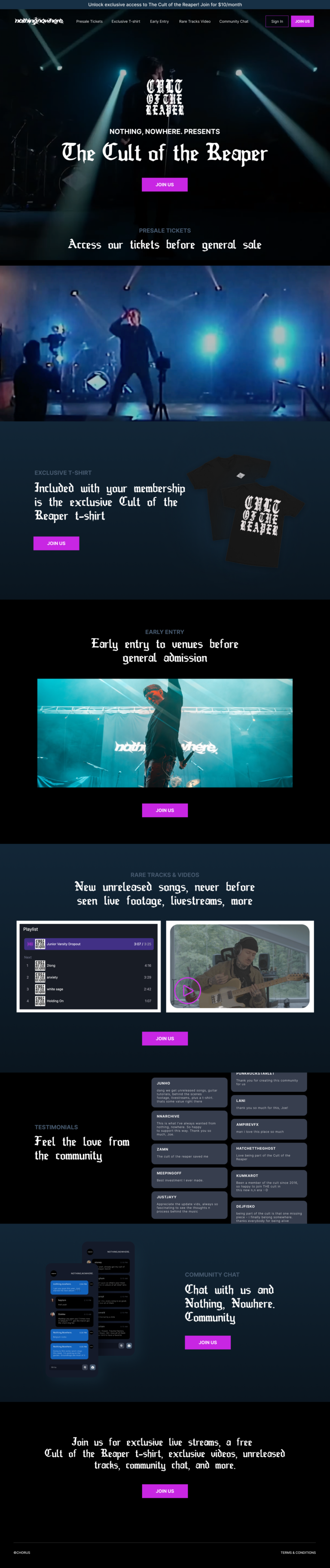
Nothing Nowhere has built a dedicated, identity-driven fanbase around an aesthetic that sits at the intersection of emo, punk, and introspective alternative music. The “Cult of the Reaper” framing isn’t just a name. It’s a community identity that fans actively want to be part of.
The page needed to make membership feel like joining something meaningful, not purchasing a subscription. The difference between those two framings is the difference between a fan who joins and a fan who stays.
Design decisions
The deep purple and near-black dark aesthetic
This is the page’s most consequential design decision. It mirrors the visual world of Nothing Nowhere’s music and live show experience: atmospheric, intense, slightly otherworldly. A visitor who connects with this aesthetic already self-identifies as the page’s target audience. Those who don’t are filtered out without wasted engagement. Design as identity filter is more efficient than demographic targeting.
The exclusive “Cult of the Reaper” T-shirt photography
A black shirt with the gothic logo appears as the first membership benefit shown. Merchandise is the membership’s most immediate tangible value, and showing it photographed well against the dark background creates instant desire. The exclusivity framing (“included with your membership”) removes the possibility of buying it elsewhere. The only path to ownership is joining.
The live performance photography section
The artist recognisable against dramatic stage lighting creates the visceral connection between the membership and the live experience. Fans who’ve been to shows see themselves in that photograph. Those who haven’t yet experienced a live show see what they’re missing. Both audiences convert.
The content benefit section
“New unreleased songs, never before seen live footage, livestreams, more” is carefully structured to appeal to fans at different engagement levels. Unreleased music attracts the dedicated listener. Never-before-seen footage attracts the collector. Livestreams attract the community member. The word “more” signals there’s always something new, making membership feel like an ongoing discovery rather than a fixed content package.
The “Feel the love from the community” section
The section uses community testimonials and messages from existing members. Fan communities are sustained by the sense that others are there, that this is a group of real people who share your specific enthusiasm. Showing existing member voices makes the community feel alive rather than aspirational.
The "Cult" naming and identity framing are deliberately polarising, and that's a conversion strength, not a risk. A membership page that tries to appeal to everyone ends up converting no one deeply. By naming the community something specific and intense, Nothing Nowhere self-selects for exactly the fans who will be most valuable members: committed, evangelical, and willing to recruit their friends.
Trust architecture
Fan membership trust is community-based rather than credential-based. Trust comes from: live performance photography (the artist is real, active, and producing the content being promised), existing member community voices (other fans are already here and engaged), exclusive physical merchandise (a tangible, ownable proof of the community’s reality), and specific content promises (“unreleased songs” and “never-before-seen footage” are specific enough to be verifiable claims, not vague marketing language).

"Music fan communities don't need the same trust signals as a financial product or a legal service. They need evidence that the community is real and active, that when they join, there will be other fans there. Showing existing member messages and live photography does this. The fan asking 'is this legitimate?' is really asking 'will I be alone here?' Answer that visually and the CTA converts itself."
Read more about how we approach trust signals in our guide to Ways To Increase Landing Page Social Proof.
The purple CTA buttons ("JOIN US" in bold against dark backgrounds) use the colour of the brand's accent palette rather than a generic green or red. Colour-consistent CTAs reinforce brand identity at the moment of action. For a music artist with a strong visual identity, keeping that identity in the CTA says: 'this is a page built for fans like you, not a generic sign-up form dressed in our colours.'
Conversion strategy
The “Join Us” CTA is repeated three times: after the merchandise benefit, after the early access benefit, and after the content benefit. This isn’t aggressive repetition; it’s recognising that different fans will be motivated by different parts of the offering. The fan whose priority is the T-shirt converts after the merchandise section. The fan who cares about early access converts after that section. Catching fans where their specific motivation peaks is more effective than a single end-of-page CTA.
"Fan memberships bundle multiple benefits, and different fans value different parts. The fan who loves merchandise will convert at the T-shirt section; the fan who prioritises exclusive content converts at the content section. Repeating the CTA after each benefit group means you're not asking the fan to remember their decision until they reach the bottom of the page. You're offering the path forward at each moment of peak desire."
Platform: Unbounce
Unbounce provided the design freedom to build the full-width dark immersive layout with large typography and section-by-section benefit architecture. The platform’s ability to handle custom CSS allowed the distinctive atmospheric visual style without template constraints.
Mobile experience
Music fans browse and join fan communities predominantly on mobile, often at a concert, on a train, or during evening social media browsing. The page was built with full-width photography that reads powerfully at phone width, large touch-friendly CTA buttons, and a dark background that looks exceptional on OLED phone screens.
Dark-background pages with full-width photography can be slow if not managed carefully. We served all live photography in WebP format, used CSS gradients for background transitions rather than image files, and deferred non-critical video loading. A fan who waits more than two seconds for a membership page to load on a concert venue Wi-Fi network will simply not join.
Evolve today
Three changes would push this page’s performance further:
Artist direct-to-camera message
A brief video of Nothing Nowhere speaking directly to fans about the Cult of the Reaper (what it means, why they created it, what members will experience) would deepen the personal connection that the identity-first framing creates. Artists who communicate personal investment in their communities see significantly higher fan membership conversion rates.
Member count social proof
“Join 4,500 Cult of the Reaper members” near the primary CTA would validate that the community is active and substantial. Fan communities have a network effect: the larger they feel, the more desirable membership becomes.
Upcoming event-specific urgency
“Members get early access to the upcoming [City] show on [date]” creates real, time-bound urgency that makes joining now feel immediately valuable. Evergreen membership pages convert at lower rates than those that create a time-proximate benefit.
Browse our full collection of landing page examples to see how we apply these principles across industries. Building a fan membership or event community page? Talk to our team.
Waseem founded Apexure in 2015 and has led its work on 3,000+ pages for 300+ clients since. He writes about what the team sees after the click, which is pages, forms, tracking and the systems behind them.
What the page leans on
The principles at work on this page, each named in the analysis above.
Visual hierarchy
Controlling what visitors see first, second, and third guides them toward the conversion goal.
Social proof
People follow the actions of others. Testimonials, reviews, and client logos build trust and reduce hesitation.
F-pattern layout
Eye-tracking shows people scan pages in an F-shape. Placing key content along this path increases engagement.
Cognitive load reduction
Simpler pages convert better. Reducing visual noise, breaking forms into steps, and clear copy lower mental effort.
Colour psychology
Colours trigger emotional responses. Strategic use of contrast and brand colours guides attention to CTAs.
What people ask about pages like this
The Cult of the Reaper is Nothing Nowhere's fan membership community. Members receive an exclusive Cult of the Reaper T-shirt upon joining, early venue entry ahead of general admission at shows, new unreleased songs, never-before-seen live footage and livestreams, and access to the fan community. The membership is designed for the artist's most committed followers who want more than a concert ticket. They want insider access and identity.
Exclusive merchandise is a physical identity token for fan communities. When someone wears a 'Cult of the Reaper' shirt, they're not just wearing clothing. They're identifying as a member of a specific community. The exclusivity of membership-only merchandise creates both perceived value (you can't buy this anywhere else) and social signalling (wearing it says something about who you are as a fan). For an artist with a distinct aesthetic identity like Nothing Nowhere, the merch is the membership made wearable.
Early venue access is a time-and-experience advantage that cannot be replicated outside membership. The promise of being at the front before general admission enters converts high-intent fans who attend multiple shows per year (the exact audience who will renew their membership). It answers the question 'what do I get at the next show that non-members don't?' with something tangible and experiential, not just digital content.
Nothing Nowhere's aesthetic is moody, atmospheric, and distinctly not mainstream. The dark purple/black visual language of the page isn't just branding. It's identity signalling. Fans of this artist have chosen an artist who doesn't look or sound like everyone else. A page that mirrors that aesthetic is itself a self-selection mechanism: visitors who are drawn to the page's look are precisely the fans who will join the community. Design as identity filter is a powerful conversion concept for niche artists.
Three more, taken apart the same way

Want one like this?
Tell us what the page has to do and where the traffic comes from. Within 48 hours you get a written quote from the people who wrote this breakdown. Already have a page that is not converting? Send it for a free audit instead.
UK hours, which is the East Coast morning.
"Fan membership pages need to sell belonging, not features. The T-shirt, the early access, the community: these aren't benefits, they're identity tokens. When a fan feels that joining this community says something true about who they are, the conversion is automatic. The page's job is to make that identity feel accessible, exclusive, and worth declaring."